You don’t need a gym membership or fancy equipment to build strength and improve your health. Bodyweight exercises and calisthenics are great for reaching your fitness goals at home.
By using your body weight as resistance, you can do many exercises. These exercises work on many muscles at once. They also improve your flexibility and balance.
Adding these exercises to your daily routine can greatly improve your fitness. You’ll see big changes in your physical health.
Key Takeaways
- Build strength without any equipment using bodyweight exercises.
- Improve flexibility and balance through calisthenics.
- Achieve your fitness goals from the comfort of your own home.
- Enhance overall physical fitness with at-home strength training.
- Variety of movements work multiple muscle groups at once.
The Power of Bodyweight Training
Bodyweight training boosts strength, flexibility, and coordination all at once. It uses your own weight for a full-body workout. This improves muscle strength and endurance.
Why Bodyweight Exercises Are Effective
Bodyweight exercises work many muscles at once. This boosts your overall fitness. For example, squats work your legs, glutes, and core. They are very effective.
Fitness expert says, “Bodyweight exercises are not just for beginners. They can be tough for advanced athletes too.”
“The best exercise is the one you will actually do.” – Unknown
Benefits Beyond Muscle Building
Bodyweight training does more than build muscle. It also boosts coordination and balance. This makes you more physically fit.
Adding bodyweight workouts to your routine brings these benefits. You’ll become more capable and resilient.
Understanding Functional Fitness
Functional fitness is a training method that makes daily tasks easier. It builds strength, flexibility, and coordination for real-life activities.
What Makes Movement “Functional”
Functional movements are those that make daily tasks simple and efficient. They often use many joints and muscles at once. Examples include squatting, lifting, bending, and carrying.
The Connection Between Bodyweight Training and Daily Activities
Bodyweight training boosts functional fitness by mimicking daily movements. Exercises like squats, push-ups, and lunges strengthen muscles and enhance coordination. This makes everyday tasks easier.
Preventing Movement Dysfunction
Functional fitness is key in avoiding movement problems. It strengthens muscles and boosts flexibility. This reduces injury risks and improves mobility.
| Daily Activity | Functional Exercise | Benefit |
|---|---|---|
| Lifting groceries | Squats | Strengthens legs and improves lifting ability |
| Carrying children | Lunges | Improves balance and strengthens legs |
| Pushing a lawn mower | Push-ups | Strengthens upper body and improves pushing ability |
Incorporating functional fitness into your routine improves daily tasks and lowers injury risks. This training method focuses on practical movements that benefit your everyday life.
Essential Equipment (or Lack Thereof)
Bodyweight training is great because you don’t need much equipment. It’s easy for anyone to start, no matter their fitness level.
Even without much, a few simple tools can make your workouts better.
Minimal Equipment Options
- A yoga mat for comfort and grip during floor exercises
- A pull-up bar or resistance bands for added resistance
- A stability ball for core exercises and stretching
These tools can make your workouts more interesting. They help work out different muscle groups.
Creating a Workout Space at Home
To make a good workout space at home, you need a clear area. Here’s what to consider:
- A clear, open space (even a small one can work)
- A non-slippery floor or a yoga mat
- Good ventilation and lighting
Having a dedicated space helps you stay on track with your fitness goals.
Foundational Bodyweight Exercises for Total-Body Strength
To build total-body strength, focus on mastering key bodyweight exercises. These exercises are the heart of any good strength training plan. You can do them anywhere, without needing any equipment.
Squats: The Lower Body Powerhouse
Squats work many muscles in your lower body. They include the quadriceps, hamstrings, glutes, and calves. They’re key for building strength, improving mobility, and enhancing lower body development.
Proper Form and Technique
To squat right, stand with your feet shoulder-width apart. Your toes should face forward or slightly outward. Lower down into a seated position, keeping your back straight and knees behind your toes. Push through your heels to stand up again.
Key tips: Keep your chest up, engage your core, and lower down until your thighs are parallel to the ground.
Common Mistakes to Avoid
- Letting the knees extend past the toes
- Rounding the back
- Not lowering down far enough
Pushups: Upper Body Development
Pushups are a basic exercise for the upper body. They work the chest, shoulders, and triceps. They’re flexible and can be adjusted for different fitness levels.
Proper Form and Technique
Begin in a plank position with hands shoulder-width apart. Lower your body until your chest almost touches the ground. Then, push back up to the starting position.
Key tips: Keep your body straight from head to heels, engage your core, and avoid letting your hips sag.
Common Mistakes to Avoid
- Letting the hips sag or the back arch
- Not lowering down far enough
- Allowing the elbows to flare out too much
Planks: Core Stability and Beyond
Planks are isometric exercises that strengthen the core. They also work the shoulders, back, and legs.
Proper Form and Technique
Begin in a plank position with hands under shoulders and toes on the ground. Hold this position, keeping your body straight and core engaged.
Key tips: Avoid letting your hips sag or your back arch. Engage your core and hold for the desired time.
Common Mistakes to Avoid
- Letting the hips sag or the back arch
- Not engaging the core
- Holding the breath
Mastering these foundational exercises is key to your strength training journey. Focus on proper form and technique to get the most out of these exercises and avoid injuries.
| Exercise | Primary Muscles | Secondary Muscles |
|---|---|---|
| Squats | Quadriceps, Hamstrings, Glutes | Calves, Core |
| Pushups | Chest, Shoulders, Triceps | Core, Back |
| Planks | Core | Shoulders, Back, Legs |
“The key to successful strength training is consistency and progressive overload. By mastering foundational bodyweight exercises and gradually increasing the difficulty, you can achieve significant gains in strength and overall fitness.”
How Bodyweight Exercises Contribute to Injury Prevention
Bodyweight training is more than just getting stronger. It’s also a great way to prevent injuries. Adding bodyweight exercises to your workout routine boosts your physical strength and reduces injury risks. This is true for both everyday activities and sports.
Building Joint Stability
Bodyweight exercises are key in preventing injuries by improving joint stability. Squats, lunges, and planks strengthen the muscles around your joints. This provides better support and lowers the chance of strains and sprains.
With stronger joints, you can do daily tasks and sports with more confidence. You’ll also face less risk of getting hurt.
Improving Movement Patterns
Bodyweight exercises also help improve movement patterns. This is important for injury prevention. By mastering proper form in exercises like pushups, squats, and lunges, you learn safer and more efficient ways to move.
This skill is useful in many areas of life. It helps with walking, running, lifting, and carrying.
Developing Body Awareness
Bodyweight training also boosts body awareness, or proprioception. This is your body’s ability to sense its position and movement. Exercises like single-leg squats or planks with leg lifts challenge your balance and coordination.
These exercises improve your body awareness. This helps you move more safely and effectively.
By focusing on joint stability, movement patterns, and body awareness, bodyweight exercises offer a complete approach to injury prevention. Adding these exercises to your regular workout routine can make your body stronger and more resilient. This prepares you for the demands of daily life and sports.
The Science of Calisthenics: Bodyweight Exercises, Calisthenics, At-Home Strength Training, Functional Fitness
Calisthenics is a science-backed way to boost functional fitness with just bodyweight exercises. It’s been around for centuries and is loved for its ability to improve strength and flexibility. You don’t need any special equipment to do it.
Historical Perspective
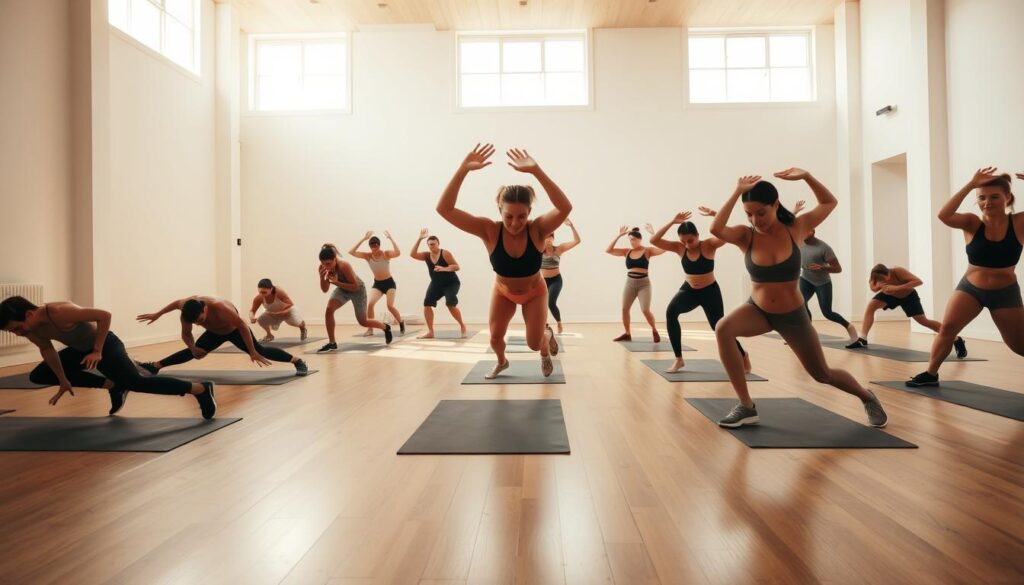
Calisthenics started in ancient Greece as a way to train athletes. The name “calisthenics” comes from Greek words for “beauty” and “strength.” It was done in public spaces, fostering a culture of fitness and community.
Modern Applications
Today, calisthenics includes many exercises and training methods. It’s great for people of all fitness levels. At-home strength training using calisthenics is very popular. It lets you get stronger and fitter without needing a gym or special gear.
Research-Backed Benefits
Studies show that bodyweight exercises in calisthenics are good for your health. They improve muscle strength, flexibility, and overall fitness. Calisthenics also helps with bone density, lowers disease risk, and boosts mental health.
By learning about calisthenics and adding it to your workout, you can see big health and fitness gains. It’s a great choice for anyone, whether you’re an athlete or just starting out.
Progressive Overload Without Weights
Bodyweight training lets you increase workout intensity in many ways. This is key to getting stronger without needing weights. By making your workouts harder, you keep getting better.
Increasing Repetitions
One easy way to make your workouts harder is to do more reps. For example, if you’re doing pushups, try to go from 10 to 15 or 20. This makes your muscles work harder and get stronger.
Adjusting Leverage and Body Position
Changing how you do an exercise can also make it harder. For instance, you can change the angle of your body during a pushup. This makes the exercise more challenging and helps you get stronger.
Adding Isometric Holds
Adding isometric holds to your exercises is another good way to get stronger. Isometric holds are when you hold a position for a while. This increases the time your muscles are working, which helps build strength.
Decreasing Rest Periods
Shortening the time you rest between sets or exercises also makes your workout harder. This increases the stress on your muscles and heart, making your workout more effective.
| Method | Description | Example |
|---|---|---|
| Increasing Repetitions | Perform more repetitions of an exercise over time. | Increase pushups from 10 to 15. |
| Adjusting Leverage | Change body position to alter difficulty. | Decline pushups or deeper squats. |
| Isometric Holds | Hold a position to increase time under tension. | Hold a plank position for longer. |
| Decreasing Rest Periods | Reduce rest time between sets or exercises. | Decrease rest from 60 seconds to 30. |
Advanced Bodyweight Exercises for Strength Development
To boost your bodyweight training, try advanced exercises that test your strength and coordination. These exercises aim to challenge you and help you grow stronger and more muscular.
Pistol Squats
Pistol squats are tough on your lower body, needing strength, balance, and control. Stand on one leg and lower your body into a squat, keeping your back straight and core tight. This exercise works your quadriceps, hamstrings, and glutes, boosting lower body strength.
One-Arm Pushup Progressions
One-arm pushups are a step up from regular pushups, demanding more strength and control. Start in a plank with one hand under your chest. Lower down until your chest almost touches the ground, then push back up. This targets your chest, shoulders, and triceps, enhancing upper body strength.
Front Lever Training
Front lever training has you holding a straight, parallel position to the ground, supported by your hands. It requires strong core and upper body muscles. It boosts overall strength, control, and muscle endurance.
Handstand Pushups
Handstand pushups are tough, focusing on your shoulders, triceps, and upper back. Start in a handstand against a wall, then lower down until your head almost touches the ground. Push back up, keeping your body straight and controlled.
Adding these advanced bodyweight exercises to your routine will keep challenging you. You’ll see big gains in strength and muscle.
Creating Effective At-Home Strength Training Programs
To make a great at-home strength training plan, you need to know about different training methods. It’s important to design a program that fits your fitness goals and skill level. This way, you can get the most out of your workouts.
Full-Body Routines
Full-body routines are perfect for beginners or those who want to stay fit overall. They work many muscle groups at once, making them efficient for building strength and endurance. A typical routine might include squats, pushups, and planks.
Split Routines
Split routines divide your workout into specific muscle groups or days. This focused approach helps improve strength in certain areas. For example, you might do upper body exercises one day and lower body another.
Circuit Training
Circuit training involves doing a series of exercises with little rest in between. It’s great for building strength and boosting your heart health. A circuit might include burpees, mountain climbers, and squat jumps.
Tabata and HIIT Approaches
Tabata and HIIT involve short, intense exercise bursts followed by brief rest. These methods are excellent for boosting strength, endurance, and fat loss. A Tabata workout, for example, might be 20 seconds of intense effort followed by 10 seconds of rest, repeated several times.
| Training Method | Description | Benefits |
|---|---|---|
| Full-Body Routines | Exercises that work multiple muscle groups at once | Efficiency, overall fitness |
| Split Routines | Dividing workouts by muscle group or day | Focused training, strength gains |
| Circuit Training | Series of exercises with minimal rest | Cardiovascular fitness, strength |
| Tabata/HIIT | Short bursts of intense exercise with brief rest | Improved endurance, fat loss |
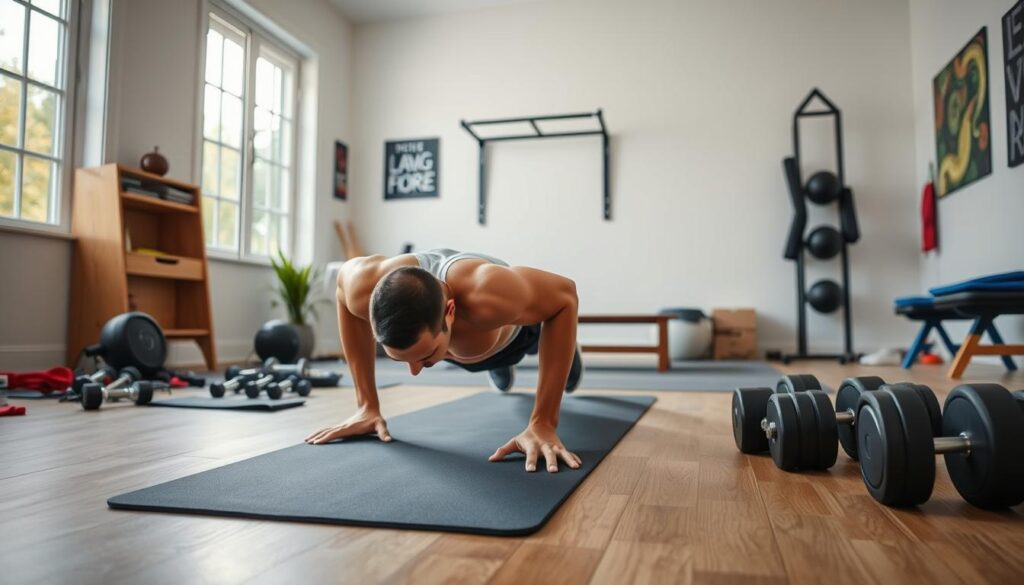
By using these different training methods, you can create a strong at-home strength training program. It will help you reach your fitness goals.
Sample Weekly Bodyweight Training Programs
You can get stronger with bodyweight exercises by following a good weekly plan. Here are some programs for different levels, from beginner to advanced.
Beginner Program
The beginner program starts with basic exercises to build strength and endurance. It has three training days a week.
- Monday: Squats (3 sets of 10 reps), Pushups (3 sets of 8 reps), Plank (3 sets of 30 seconds)
- Wednesday: Lunges (3 sets of 10 reps per leg), Inverted Rows (3 sets of 8 reps), Bicycle Crunches (3 sets of 15 reps)
- Friday: Glute Bridges (3 sets of 12 reps), Wall Pushups (3 sets of 10 reps), Russian Twists (3 sets of 15 reps)
Intermediate Program
The intermediate program gets harder by adding tougher exercises and more reps.
| Day | Exercises |
|---|---|
| Monday | Pistol Squats (3 sets of 8 reps per leg), Pushup Variations (3 sets of 10 reps), Side Plank (3 sets of 30 seconds per side) |
| Wednesday | Single-Leg Deadlifts (3 sets of 10 reps per leg), Diamond Pushups (3 sets of 10 reps), Flutter Kicks (3 sets of 20 reps) |
| Friday | Bulgarian Split Squats (3 sets of 10 reps per leg), Decline Pushups (3 sets of 12 reps), Leg Raises (3 sets of 15 reps) |
Advanced Program
The advanced program is for those who have reached the intermediate level and want more challenges.
- Monday: Handstand Pushups (3 sets of 8 reps), One-Arm Pushups (3 sets of 6 reps per arm), Hanging Leg Raises (3 sets of 12 reps)
- Wednesday: Pistol Squats with Pause (3 sets of 10 reps per leg), Plyometric Pushups (3 sets of 10 reps), Planche Holds (3 sets of 30 seconds)
- Friday: Front Lever Holds (3 sets of 30 seconds), Archaer Pullups (3 sets of 8 reps), Mountain Climbers (3 sets of 30 seconds)
Adjust these programs as you get better and feel comfortable. Always listen to your body and don’t rush.
Nutrition to Support Functional Movement Training
A well-balanced diet is key for bodyweight training and functional fitness. What you eat affects how well you do and recover from exercises.
Protein Requirements
You need enough protein for muscle repair and growth. Aim for 1.2-1.6 grams of protein per kilogram of body weight daily if you’re doing bodyweight training often.
Energy Balance Considerations
Keeping an energy balance is important. You should eat enough calories to cover your workout and daily activity needs. A caloric deficit helps with weight loss but can hurt performance if too big.
Meal Timing Around Workouts
Eating right before and after workouts can boost your performance and recovery. Eat a balanced meal or snack with protein and carbs 1-3 hours before a workout for energy. After, refuel with protein and carbs 30-60 minutes later to help recover.
Conclusion: Building Lasting Strength Through Bodyweight Training
You now see how powerful bodyweight training is. It’s a great way to get fit at home. Exercises like squats, pushups, and planks help you build strength and improve your joints.
Bodyweight training is perfect for anyone, no matter your fitness level. You can keep getting stronger by adding more reps or changing how you do the exercises. It’s a flexible way to stay fit.
Choosing bodyweight training means you’re working on your health and fitness. It’s a smart choice for a healthier, stronger you. Start today and enjoy the lasting benefits of being fit.