

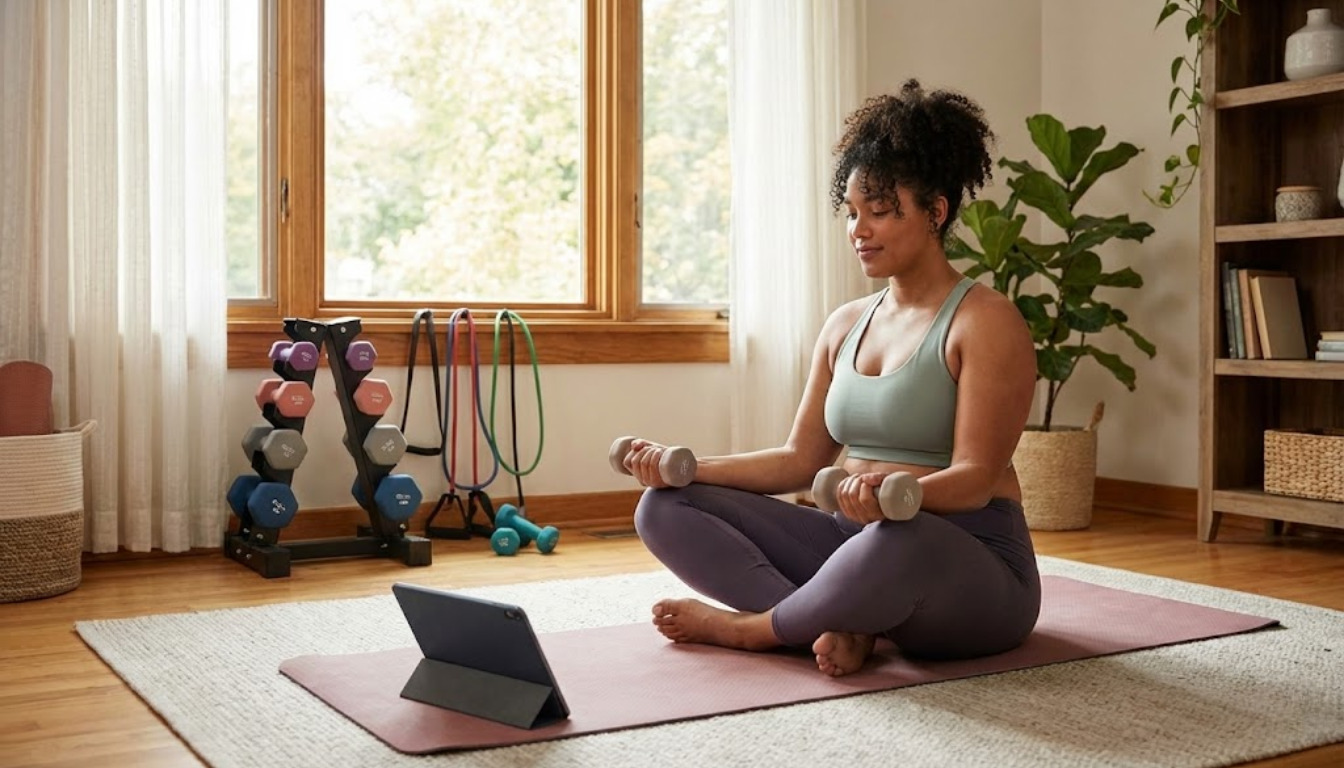
You don’t need a gym membership to start weightlifting. With just a little equipment, you can do great exercises at home.
Functional training improves your performance in everyday tasks. It boosts your coordination, mobility, and strength. Adding these basic movements to your routine will make you stronger and more capable.
These exercises are straightforward yet powerful. They help you build a strong base for more challenging moves. By starting with these basics, you can move forward at your own speed.
Key Takeaways
- Four foundational movements can be done at home with minimal equipment.
- Functional training improves daily life by enhancing coordination and mobility.
- Proper form is crucial for effective and safe weightlifting.
- Starting with simple exercises allows you to progress at your own pace.
- Minimal equipment is required for an effective home workout.
The Foundation of Strength: Why These 4 Movements Matter
The four foundational weightlifting movements are key to strength training. Squats, rows, overhead presses, and deadlifts are the base of a solid strength program. They work many muscles at once, making them great for building strength and coordination.
The Science Behind Compound Movements
Compound movements engage many muscles at once, leading to significant strength gains and muscle growth. They require complex neural coordination. For example, squats work not just the legs but also the core and lower back.
This broad muscle engagement is why compound movements are so effective for beginners’ strength training. They also mimic real-life activities, boosting functional strength. This is key to overall fitness and preventing injuries.
Benefits Beyond Muscle: Joint Health and Functionality
The four foundational movements do more than build muscle. They also improve joint health and functionality. Strengthening muscles around joints helps stabilize and protect them, lowering injury risk. Squats and deadlifts, for instance, strengthen the knees and lower back.
Rows and overhead presses, on the other hand, enhance shoulder stability. Mastering these movements also boosts your functional movement skills. This makes everyday tasks easier and helps keep you mobile and independent as you age. Adding these exercises to your at-home weightlifting routine is a wise choice for a healthier, more capable you.
Minimal Equipment, Maximum Results: What You’ll Need
You don’t need much to start strength training at home. The most important thing is the quality and versatility of your equipment, not how much you have.
Dumbbell Options for Home Training
Dumbbells are essential for home workouts. They let you do many exercises that work different muscles. Look into adjustable dumbbells, which let you change weights easily without needing many dumbbells.
Beginners should start with dumbbells weighing between 5 and 20 pounds. This range helps you do various exercises without straining your muscles too much.
| Dumbbell Type | Weight Range | Best For |
|---|---|---|
| Fixed Dumbbells | 5-50 lbs | Specific exercises, durability |
| Adjustable Dumbbells | 5-20 lbs (varies by set) | Versatility, space-saving |
Creating Space for Safe Movement
To work out safely, you need a dedicated area. Make sure you have a space that’s at least 6 feet by 6 feet. Also, choose a non-slip surface to avoid slipping.
Before You Lift: Preparation Essentials
To get the most out of your home gym workouts, start with the right preparation. Proper preparation boosts your performance and lowers injury risk. As a beginner, knowing the basics of weightlifting prep is key to a successful strength training journey.
Proper Warm-Up Protocols
A good warm-up is crucial before lifting. It gets your muscles and joints ready for exercise, improving flexibility and reducing stiffness. Include light cardio and dynamic stretching, like jogging or arm circles, to get your blood flowing and your muscles ready.
Understanding Your Starting Weight
Finding your starting weight is a big step in your strength training. It’s about picking a weight that challenges you but lets you keep proper form. Start with lighter weights and slowly add more as you get stronger and more confident. This safe and effective way helps you progress in your home gym workouts.
Master the Squat: Foundation of Lower Body Strength
For beginners, learning the squat is key to lower-body training. The squat works many muscles at once, like the legs, glutes, and core. It boosts strength and mobility and supports natural movements.
Proper Squat Form and Technique
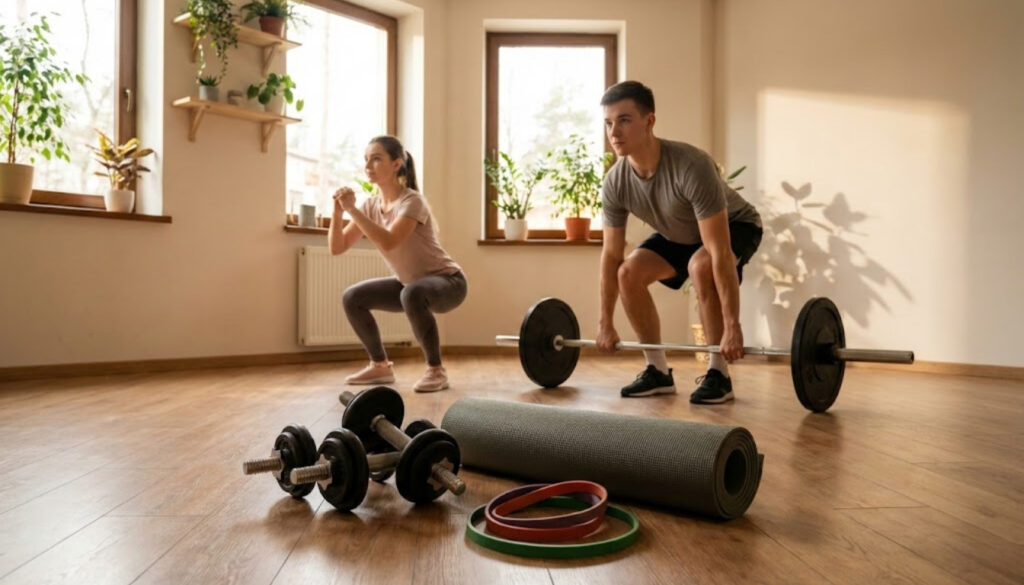
To squat right, stand with feet shoulder-width apart and toes slightly outward. Engage your core and keep your back straight. Lower down as if sitting in a chair.
Make sure your knees stay over your toes and don’t go past them. Go down until your thighs are almost touching the ground. Then, push through your heels to stand up again.
Key tips for proper form:
- Keep your chest up and back straight throughout the movement.
- Lower down slowly and control the descent.
- Push through your heels to return to standing.
- Avoid letting your knees cave inward.
Bodyweight and Dumbbell Squat Variations
Squats can be done with just your body weight or with dumbbells. Start with bodyweight squats to focus on form. As you get stronger, add dumbbells for more challenge.
Variations include:
- Bodyweight squats
- Dumbbell squats
- Sumo squats (wider stance)
- Narrow-stance squats
Standard Squat Mistakes to Avoid
Common errors in squats include letting knees go past toes, not going down enough, and arching the back. Focus on controlled movements and keep proper form.
Tips to correct common mistakes:
- Practice in front of a mirror to check your form.
- Start with lower depths and gradually increase as you build strength.
- Engage your core to support your lower back.
Perfect the Row: Building a Strong Back
Building a strong back is key to strength and stability. Rows are a top exercise for this. A strong back improves your posture and boosts athletic performance. Rows work many muscles, like the latissimus dorsi, trapezius, and rhomboids, making them vital for fitness.
Row Technique Fundamentals
To row well, focus on the proper technique. Hold a dumbbell in each hand, with feet shoulder-width apart. Bend your knees a bit and lean forward, keeping your back straight. Let your arms hang, then lift the dumbbells to your sides until your elbows are at 90 degrees. Keep your core tight and avoid swinging the dumbbells.
- Maintain a straight back throughout the movement
- Engage your core to support your lower back
- Use a weight that allows you to maintain proper form
Dumbbell Row Variations for Home Training
Dumbbell rows can be adjusted for different levels and goals. Some variations include:
- Single-arm dumbbell row: Focuses on one side, helping with strength balance.
- Bent-over dumbbell row: Targets the latissimus dorsi and trapezius muscles.
- Supported dumbbell row: Reduces lower back strain, focusing on the upper back muscles.
Form Corrections for Effective Rows
Common row mistakes include rounding the back, using too much weight, and failing to engage the core. To fix these, keep your back straight, use the right weight, and engage your core. This effectively targets your back muscles and helps prevent injury.
Incorporate rows into your routine and focus on proper technique. This will help build a strong back, improving your fitness and athletic performance.
Overhead Press: Developing Shoulder Strength and Stability
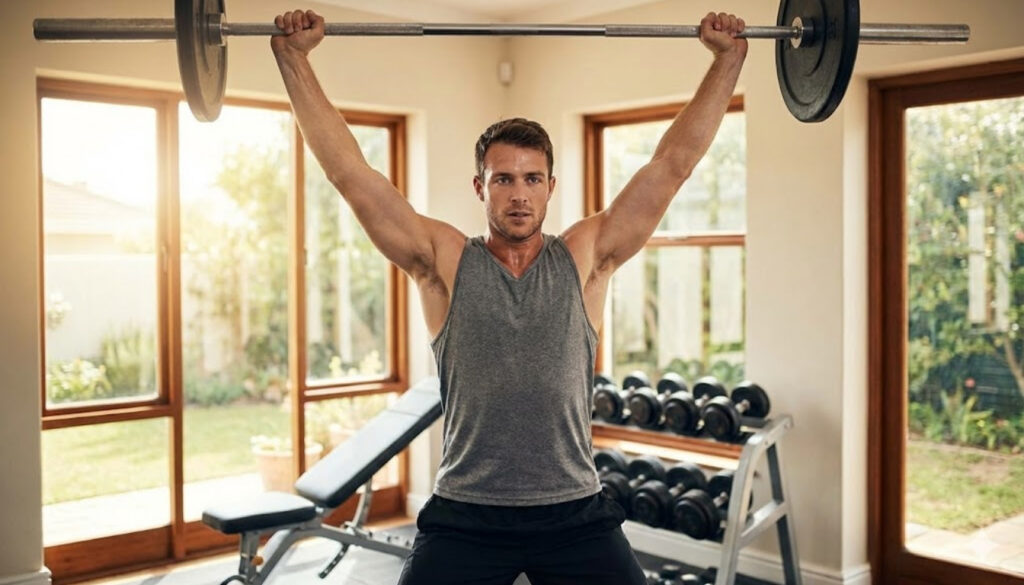
The overhead press is key for building strong shoulders. It works not just the shoulders but also the triceps and core. This makes it great for strengthening your upper body.
Adding the overhead press to your workouts will help with daily tasks and other exercises. You’ll see big improvements.
Mastering Safe and Effective Press Technique
Proper technique is vital for the overhead press to avoid injury. Stand or sit with your feet apart, holding dumbbells at shoulder level. Your palms should face forward.
Press the dumbbells straight up, extending your arms but not locking your elbows. Lower them back down slowly. Remember to squeeze your shoulder blades and engage your core for stability.
Seated and Standing Press Variations
The overhead press can be done seated or standing. Each has its own benefits. The seated media focuses on the shoulders, while the standing press works your core and legs more.
Switching between these variations keeps your workouts interesting and challenges your muscles in different ways.
Protecting Your Shoulders During Presses
To keep your shoulders safe, warm up well before starting. Use a weight that lets you keep proper form. Don’t arch your back or use momentum, as this strains your shoulders.
Make sure your wrists rotate so your palms face forward at the top. This helps keep your shoulders aligned and reduces strain.
Mastering the overhead press and adding it to your workouts will strengthen your shoulders. This boosts your athletic performance and supports your health and function.
Deadlift: The Ultimate Full-Body Movement
The deadlift is a top exercise in weightlifting, working many muscles at once. It’s great for beginners looking to build strength and muscle. This exercise targets your back, legs, and core, making it effective for improving your physique and strength.
Deadlift Form for Beginners
To do a deadlift right, stand with your feet shoulder-width apart. Your toes should point forward or slightly outward. Hold the dumbbell or barbell with your hands shoulder-width apart, keeping your back straight and core tight.
Lift the weight by bending at the hips and knees, keeping it near your shins. Stand up straight, squeezing your glutes and pushing your hips back. Lower the weight slowly, maintaining control throughout.
Key tips for beginners: Keep your back straight, engage your core, and lift with your legs. Avoid rounding your back or using momentum to lift the weight.
Dumbbell and Romanian Deadlift Variations
If you’re using dumbbells, you can adjust the deadlift to fit your strength. Try single-leg deadlifts or sumo deadlifts to target different muscles. The Romanian deadlift primarily targets the hamstrings and glutes, with a smaller range of motion.
| Deadlift Variation | Target Muscles | Benefits |
|---|---|---|
| Conventional Deadlift | Back, Legs, Core | Full-body strength, muscle mass |
| Romanian Deadlift | Hamstrings, Glutes | Improved hip hinge, posterior strength |
| Sumo Deadlift | Legs, Glutes, Inner Thighs | Reduced lower back stress, leg strength |
Safety Considerations for Home Deadlifts
When deadlifting at home, safety is key. Make sure you have enough space to lift without hitting anything or anyone. Use a mirror to check your form, or ask a family member to spot you. Start with lighter weights and gradually increase the load as you become more comfortable with the movement.
Beginner Weightlifting: Creating Your Home Strength Training Program
To make consistent progress in weightlifting, it’s key to have a solid home workout routine. A home strength training program helps you focus on basic movements. These movements build overall strength and fitness.
Weekly Workout Structure for Beginners
Beginners should have a weekly workout plan that includes compound movements. These movements target different muscle groups. A good plan is to split your workout into three days, focusing on different muscles each day.
| Day | Focus | Exercises |
|---|---|---|
| Monday | Lower Body | Squats, Deadlifts |
| Wednesday | Upper Body | Rows, Overhead Press |
| Friday | Full Body | Squats, Deadlifts, Rows, Overhead Press |
Balancing Recovery and Progress
It’s vital to balance recovery and progress in your home strength training. Enough rest lets your muscles repair and grow. At the same time, keep improving your workouts to see better results.
Tips for Balancing Recovery and Progress:
- Make sure to have at least one rest day between hard workout days.
- Slowly increase the weight or resistance you’re lifting over time.
- Listen to your body and adjust your workout intensity as needed.
Progressive Overload: The Key to Continued Improvement
Progressive overload is a key principle in strength training. It means you gradually increase the intensity of your workouts. This helps you keep getting stronger and build muscle over time.
It’s essential for beginners’ strength training. It helps in building muscle gradually.
To use progressive overload, you don’t always need to lift more weight. There are many ways to increase the challenge of your workouts.
Beyond Adding Weight: Multiple Progression Methods
There are several ways to achieve progressive overload beyond just increasing the weight. These include:
- Increasing the number of repetitions or sets
- Improving the quality of your repetitions by focusing on form and control
- Decreasing rest time between sets
- Increasing the weight used for exercises
By changing these factors, you can keep challenging your muscles and improve your strength.
Tracking Your Strength Journey
To effectively use progressive overload, tracking your progress is key. Keeping a workout log helps you see how much weight you lift and how many reps you do. It also shows how you feel before and after working out.
This info helps you know when to make your workouts harder. By understanding and applying progressive overload, you can keep improving at strength training.
Metabolic Benefits of Foundational Strength Training
Strength training is more than just lifting weights. It’s a key to better metabolic health. Adding foundational strength training to your routine boosts your body’s ability to handle blood sugar. It also improves insulin sensitivity and overall metabolic function.
How Strength Training Improves Insulin Sensitivity
Strength training has a big plus for insulin sensitivity. Regular workouts make your muscles better at taking in glucose from your blood. This reduces the workload on your pancreas and improves your body’s insulin response. This is great for people at risk of type 2 diabetes.
Long-Term Metabolic Health Advantages
The benefits of foundational strength training last a long time. Keeping up with strength training boosts your resting metabolic rate. It also helps your body burn fat better and supports your metabolic health.
This can lead to better weight control, lower risk of chronic diseases, and more energy. You’ll be healthier and feel more alive.
Conclusion: Building Your Strength Foundation at Home
You now have the foundation to start your home strength training journey with confidence. Focusing on key weightlifting movements helps build a strong and functional body.
Using dumbbells can help you effectively build muscle and improve overall strength. As you progress, you can continue to challenge yourself and achieve significant gains with beginner weightlifting principles.
Committing to a regular home strength-training routine enhances physical strength, improves metabolic health, and supports overall well-being. Take the first step today and start your journey towards a stronger, healthier you.

4777cx? Oh yeah, solid platform. Easy to navigate and a good variety of stuff to do. Worth checking out if you’re looking for a new place to play. More info here 4777cx.