As you get older, your body might find it harder to stay balanced. This can make you more likely to fall. The CDC says one in four adults over 65 will fall this year. These falls can lead to serious injuries like hip fractures.
Boosting your sense of body position, or proprioception, can help a lot. You can do simple, progressive exercises every day. These can make you more stable and coordinated. By improving your proprioception, you can keep moving freely and stay independent as you age.
Key Takeaways
- Understand the importance of proprioception in maintaining balance and preventing falls.
- Learn simple exercises to improve proprioception and reduce the risk of falls.
- Discover how to incorporate these exercises into your daily routine.
- Improve your overall stability and coordination.
- Maintain your independence as you age.
Understanding Proprioception: Your Body’s Hidden Sense
Your body has a hidden sense called proprioception. It helps you move and stay balanced. Proprioception lets you walk without looking down and touch your nose with your eyes shut. It also keeps your posture right.
What Is Proprioception and How It Works
Proprioception is thanks to proprioceptors, special sensors in your muscles, tendons, and joints. These sensors work with your vision and balance systems. They help you know where your body is and how it’s moving.
When you move, your proprioceptors send signals to your brain. Your brain then uses this info to help you move right.
The Relationship Between Proprioception, Balance, and Coordination
Proprioception is key to balance and coordination. It helps you stay balanced by adjusting your posture and movement. It also ensures your body moves smoothly together.
For example, when you walk, your proprioceptive system helps you adjust your steps. It keeps you balanced on different surfaces.
| Proprioception Aspect | Role in Movement | Impact on Balance |
|---|---|---|
| Sensing Position | Guides precise movements | Helps maintain posture |
| Sensing Movement | Coordinates actions | Adjusts to changes in the environment |
| Integration with Other Senses | Enhances overall motor control | Improves stability |
How Proprioception Affects Everyday Movement
Proprioception impacts your daily activities, from standing up to dancing or playing sports. Good proprioception boosts your performance and lowers injury risk. It helps you move better and stay balanced.
Improving proprioception can make you more mobile and reduce your risk of falls, especially as you age. This is done through proprioceptive exercises. These exercises challenge your body’s sense of position and movement, enhancing motor control.
Why Proprioception Declines After 40
After 40, you might find it harder to balance. It’s not just your mind playing tricks on you. Our ability to sense our body’s position can weaken with age. This makes us more likely to fall and less coordinated.
This decline is due to several reasons. Our sensory systems change, our lifestyle choices impact us, and some medical conditions play a role.
Age-Related Changes in Sensory Systems
As we get older, our muscles, tendons, and joints change. These changes affect how we sense our body’s position and movement. Our sensory receptors decrease in number and become less sensitive.
Impact of Sedentary Lifestyle on Body Awareness
Being inactive can harm our proprioception. Exercise keeps our muscles strong and flexible, and keeps our nerves connected. Without it, our body’s sense of itself weakens.
Common Conditions That Affect Proprioception
Some health issues can also hurt our proprioception. Diabetes can damage nerves, while arthritis can inflame and damage joints. Neurological problems like stroke or Parkinson’s disease can also affect our sense of body position.
| Factor | Description | Impact on Proprioception |
|---|---|---|
| Age-Related Changes | Decrease in sensory receptors and their sensitivity | Reduced accuracy in sensing body position and movement |
| Sedentary Lifestyle | Lack of regular physical activity | Deterioration of muscle strength, flexibility, and neuromuscular coordination |
| Medical Conditions | Diabetes, arthritis, and neurological conditions | Damage to sensory nerves, joint inflammation, and neurological impairment |
Knowing why proprioception declines can help us stay aware of our bodies. We can take steps to prevent falls and maintain our coordination.
Assessing Your Current Proprioceptive Abilities
Before starting any balance training, it’s key to assess your proprioception. This check highlights your strengths and areas for improvement. It helps you improve your training plan.
Simple Self-Assessment Tests
You can do simple tests at home to check your proprioception. Try standing on one leg with your eyes shut. See if you can stay for 30 seconds. Another test is walking heel-to-toe like you’re on a tightrope. These tests are great for your balance and proprioception.
Interpreting Your Results
If you find it hard to balance or feel shaky, you might need to work on your proprioception. The table below helps you understand your results.
| Test | Good Proprioception | Needs Improvement |
|---|---|---|
| Standing on one leg | Can stand for 30 seconds | Loses balance before 10 seconds |
| Heel-to-toe walking | Can walk 10 steps without deviation | Steps off the line or loses balance |
When to Consult a Professional
If you really struggle or worry about your balance, see a healthcare expert or physical therapist. They can conduct a detailed check and suggest a plan tailored to you.
Knowing your current balance skills is the first step to better balance and fewer falls.
The Science Behind Effective Proprioception Training
Proprioception training changes how your brain works. It helps you better control your muscles. This is done through exercises that improve how your body feels and moves.
How Proprioceptive Exercises Rewire Your Brain
These exercises send signals to your brain from your muscles and joints. Over time, your brain gets better at understanding these signals. This leads to better balance and coordination.
Key changes in the brain include:
- Increased sensitivity of sensory receptors
- Improved processing of proprioceptive information
- Enhanced neuromuscular control
The Progressive Overload Principle for Balance
Just as strength training makes exercises harder, making exercises harder helps with balance. Start with simple exercises and gradually add more challenge.
| Progressive Overload Methods | Description | Example |
|---|---|---|
| Reducing Support | Gradually reduce the amount of support used during exercises | Moving from a double-leg stance to a single-leg stance |
| Increasing Complexity | Add complexity to your exercises | Adding arm movements to a balance exercise |
| Unstable Surfaces | Train on increasingly unstable surfaces | Progressing from a firm surface to a balance board |
Frequency and Duration Guidelines for Optimal Results
Do proprioception training often for the best results. Aim for 2-3 times a week, with each session lasting 10-20 minutes.
Being consistent is crucial. Even short daily sessions can help if you can’t do longer ones.
Foundational Balance Exercises for Beginners
Doing specific exercises can help you balance better and reduce your fall risk. Simple exercises can make a big difference in your stability. They’re great for beginners because they’re easy yet effective.
Single-Leg Stance Progression
The single-leg stance is a key exercise for balance and ankle strength. Stand on one leg, with the other foot in the air. Start by holding onto something for support.
Proper Form and Technique
For the best results, follow these steps:
- Keep your standing leg straight and firm.
- Engage your core muscles to help with balance.
- Keep your lifted foot close to the standing leg.
- Hold the position for 10-30 seconds before switching legs.
Common Mistakes to Avoid
Avoid these mistakes in the single-leg stance:
- Letting your standing leg wobble or buckle.
- Not engaging your core, leading to loss of balance.
- Keeping your lifted foot too far from your body can strain your muscles.
Heel-to-Toe Walking Drills
Heel-to-toe walking boosts balance and proprioception. Walk in a straight line, placing the heel of one foot in front of the other’s toes.
To do heel-to-toe walking:
- Start by standing with your feet together.
- Take a step forward, placing the heel of one foot directly in front of the toes of the other.
- Continue walking in this manner, focusing on precise foot placement.
Simple Standing Balance Challenges
Try standing balance challenges anywhere. Stand on different surfaces or with your eyes closed. These exercises improve your balance and stability.
| Exercise | Description | Benefits |
|---|---|---|
| Single-Leg Stance | Stand on one leg, holding onto support if needed. | Improves ankle strength and balance. |
| Heel-to-Toe Walking | Walk in a straight line, heel to toe. | Enhances proprioception and balance. |
| Standing on Foam | Stand on a foam pad or soft surface. | Increases stability and challenges balance. |
Adding these balance exercises to your routine helps a lot. Start with what feels easy and get better at harder ones.
Intermediate Proprioception Training for Stability
To boost your body’s awareness and stability, add intermediate proprioception exercises to your routine. At this level, you’ll face more complex movements and varied conditions. This will challenge your balance and coordination.
Dynamic Balance Challenges
Dynamic balance challenges test your balance while moving. Try walking on different surfaces like foam or a balance board. Single-leg squats are also great.
Single-Leg Squat: Stand on one leg, lifting the other off the ground. Slowly lower into a squat and then stand up. This exercise tests your balance, strength, and proprioception.

Proprioceptive Training with Household Items
Household items can help with proprioception training. For example, using a pillow or cushion as an unstable surface can challenge your balance.
- Stand on a pillow or cushion with your eyes closed to increase the difficulty.
- Use a broomstick or a cane for balance exercises, like standing on one leg while holding it for support.
Incorporating Directional Changes
Adding directional changes to your training is key to better stability. This means moving in different directions and planes of motion.
Multi-Plane Movement Patterns
Multi-plane movement patterns challenge your balance in various directions. Try exercises like lateral walks, backward walking, and diagonal steps.
| Exercise | Description |
|---|---|
| Lateral Walks | Walk sideways, keeping your body balanced and your feet aligned. |
| Backward Walking | Walk backward slowly, focusing on maintaining your balance. |
| Diagonal Steps | Step diagonally, alternating between different directions. |
Reaction-Based Balance Drills
Reaction-based balance drills test your ability to respond to external stimuli. For example, have a partner gently push or pull on your arms or shoulders while you’re standing on one leg. This challenges your reaction time and balance.
By adding these intermediate exercises to your routine, you’ll improve your stability, balance, and proprioceptive awareness. This reduces the risk of falls and enhances your quality of life.
Advanced Functional Movement Exercises
As you improve your proprioception, it’s time to try more challenging exercises. These exercises boost your balance, coordination, and body awareness. They help you move better and lower the chance of falling.
Unstable Surface Training
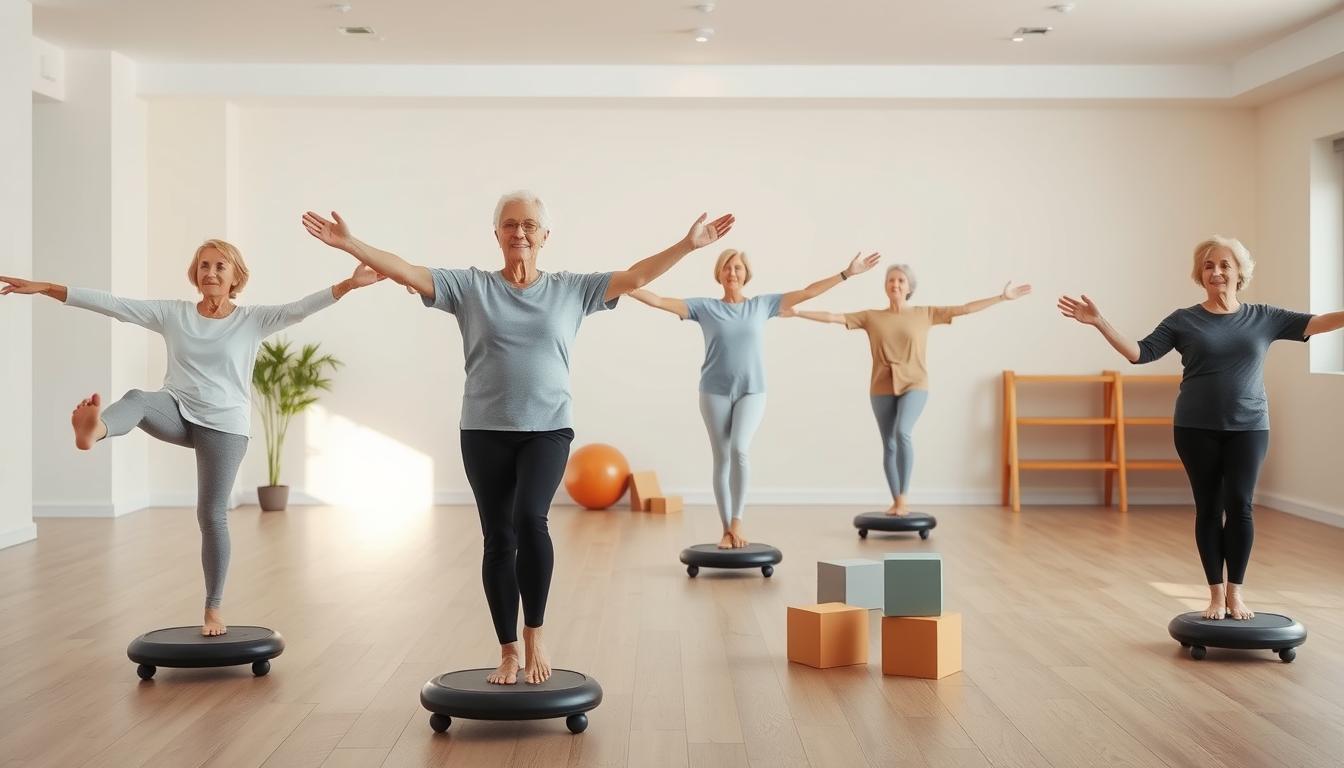
Unstable surface training means doing exercises on wobbly surfaces. You might use balance boards, BOSU balls, or foam pads. This makes your body work harder to stay balanced, improving your stability.
Example exercises include:
- Single-leg stance on a BOSU ball
- Squats on a balance board
- Planks on a foam pad
Dual-Task Balance Challenges
Dual-task balance challenges involve doing two things at once. Like walking and talking, or balancing on one leg while catching a ball. These mimic real-life situations where you often do many things at once.
Examples include:
- Walking on a balance beam while performing a cognitive task
- Balancing on one leg while tossing a ball back and forth
Complex Movement Patterns That Enhance Body Awareness
Complex movement patterns are detailed sequences of movements. They challenge your coordination and proprioception. Examples include dance, martial arts, or complex yoga.
Sport-Specific Applications
For athletes, training with sport-specific movements is great. It means practicing the actions of your sport, focusing on balance and control.
Recovery Techniques Between Sessions
It’s essential to rest well between training sessions. Foam rolling, stretching, and self-myofascial release help. They reduce soreness and improve flexibility, making you better for the next session.
Fall Prevention Strategies and Safety Considerations
To get the most from your proprioception training, knowing fall prevention strategies and safety tips is key. As you work on balance and proprioception, make sure you do so safely and under control.
Creating a Safe Training Environment
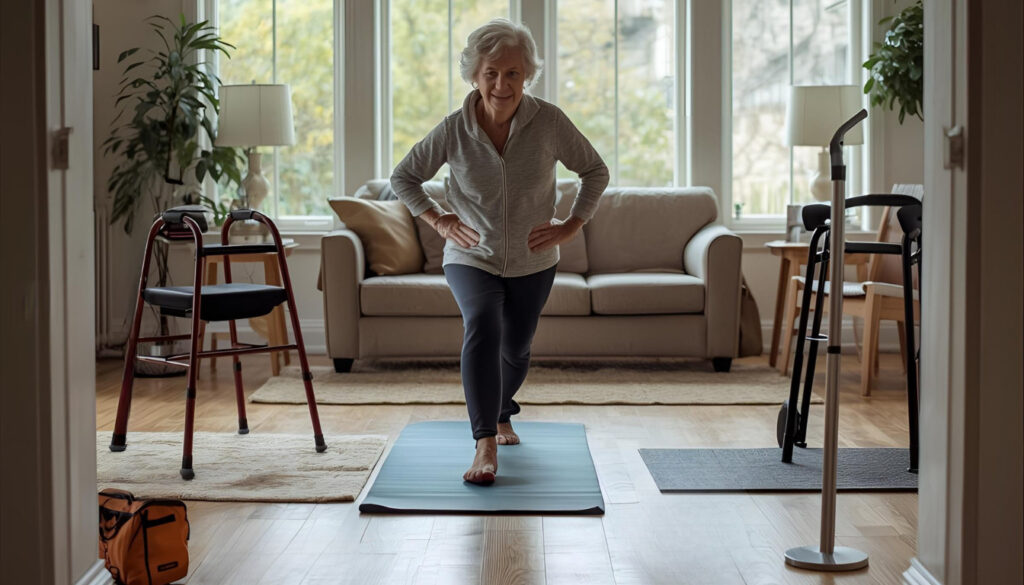
First, check your training area for dangers. Clear out any clutter or things that could trip you up. Make sure the floor is slip-resistant and use a mat or soft surface for exercises that might make you lose balance. Good lighting is also crucial for spotting hazards.
Emergency Preparedness and Fall Recovery
Falls can happen even with the best precautions. Always have a phone nearby and consider training with a buddy, especially if you’re new. Learning to fall safely is vital; roll with the fall and avoid breaking your fall with your hands to prevent wrist injuries.
Adapting Exercises for Different Mobility Levels
Everyone starts at a different level of mobility and balance. It’s essential to adjust exercises to fit your current abilities. For those with mobility issues, start with seated exercises or hold onto a stable object. As you get better, you can make the exercises harder by reducing support or adding more complex movements.
When to Scale Back or Modify Your Practice
Always listen to your body and be ready to adjust your exercises if you feel pain or discomfort. If you’re tired or off balance on a particular day, it’s safer to take it easy. Safety should always be your top priority.
Conclusion: Future-Proofing Your Mobility Through Proprioception
Proprioception is key to keeping your mobility and preventing falls, especially after 40. It helps you understand how your body moves. By training your proprioception, you can improve your balance and movement.
Improving proprioception is more than just avoiding falls. It’s about keeping your mobility strong for the future. Through exercises, you can prepare your brain for daily challenges and stay independent as you age.
Improving your proprioception and mobility takes time and effort. Start by checking where you are now. Then add more challenging exercises to keep improving balance and coordination.
Focus on proprioception and movement to maintain your mobility and health. This investment in your health will benefit you for many years. It will help you live a more active, confident, and independent life.