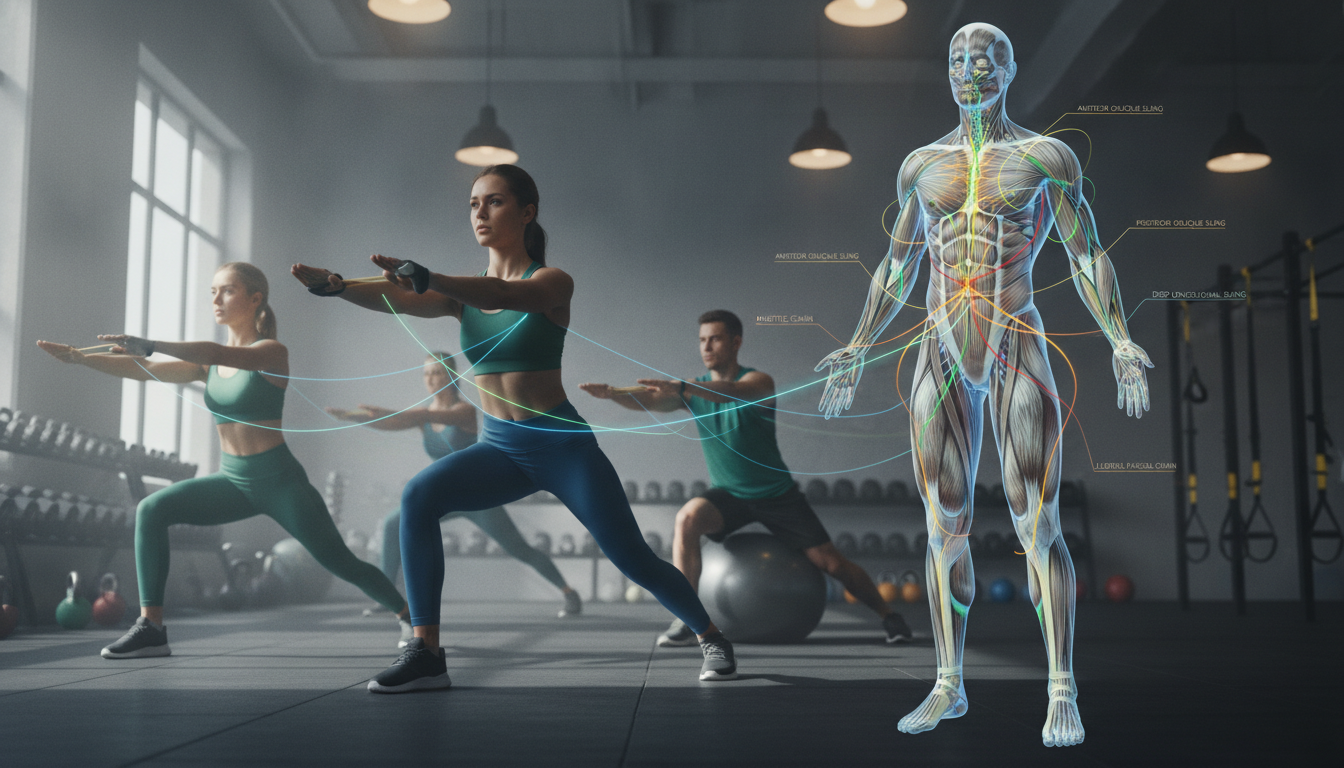
Most fitness programs focus on specific muscles, like your biceps or quads. But this approach misses how your body moves in real life. You are not separate parts; you are a unified system meant for smooth motion.
Your body uses fascial slings to distribute force throughout your body. These lines, known as anatomy trains, help you move efficiently. By focusing on connective tissue health, you build a strong, athletic body.
Knowing your kinetic chain improves your movement and lessens joint stress. Training your body as a whole unlocks lasting performance. It’s time to train your body to work the way it was meant to.
Key Takeaways
- Stop isolating muscles and start training your body as a single, integrated unit.
- Fascial slings act as diagonal pathways that transfer energy throughout your entire frame.
- Improving your movement patterns reduces joint stress and prevents long-term wear.
- Whole-body strength is essential for athletic longevity and daily functional tasks.
- Focusing on your internal connections creates a more resilient and capable physique.
Beyond Isolated Muscle Training
Modern biomechanics shows that your body functions as a single unit, not as separate parts. For years, fitness has focused on single muscles like biceps or quads. But this misses how you move every day.
The Myth of the Single-Muscle Focus
When you move, your brain doesn’t just tell one muscle to act. It sets off complex patterns that require full-body coordination. Training just one muscle misses the mark on holistic body mechanics.
Your brain favors global movements because they’re better for survival and doing well. Training this way makes you see your body as a whole, not just parts. It’s a fluid, responsive unit that works best together.
“The body is a single, integrated unit, and its movement is a symphony of coordinated effort rather than a collection of solo performances.”
Why Your Body Operates as a Unified System
The myofascial system keeps your body together, making sure force moves smoothly. This body’s interconnectedness means a movement in your foot can affect your shoulder. Using holistic body movement unlocks this hidden power.
Let’s look at how training methods differ:
| Feature | Isolated Training | Integrated Training |
|---|---|---|
| Primary Focus | Single Muscle | Movement Pattern |
| Nervous System | Minimal Engagement | High Coordination |
| Joint Health | Localized Stress | Distributed Load |
| Real-World Use | Limited | High |
Changing your view moves you past old-school bodybuilding. You build a base for lasting health and strength. This shift is key to moving with ease, power, and skill.
Understanding the Anatomy of Fascial Slings
To grasp true movement, you must explore the hidden structure beneath your skin. Your body is not a collection of separate parts but a unified system connected by a complex web of tissues. This functional anatomy guides how you move and stay stable every day.
Defining the Myofascial Network
The myofascial network is like a fast communication system that connects your muscles, bones, and organs. It’s not just a passive shell but a dynamic structure that spreads force throughout your body. Seeing your body as a continuous web helps you understand how tension in one area affects others.
This fascia network is crucial for maintaining your body’s structure. It helps your body store and release elastic energy, which is vital for efficient movement. Understanding the complexity of this body’s fascial network deepens your understanding of how your soft tissues support your goals.
How Connective Tissue Connects Your Extremities
Your limbs are connected through long, diagonal fascial lines that wrap around your torso and limbs. These fascial connections make sure the force from your feet reaches your shoulders and arms. This is why even simple actions like reaching or taking a powerful stride involve your whole body, not just one muscle.
These soft tissue connections form a cohesive unit for complex, multi-planar movements. By using these fascial networks, your body optimizes energy transfer and lessens the load on individual joints. Understanding your body’s connective web is key to achieving true functional strength and long-term mobility.
The Science of Fascial Slings, Anatomy Trains, Connective Tissue Health, and the Kinetic Chain
Modern musculoskeletal anatomy shows that your body functions as a single unit rather than as separate parts. When you move, a kinetic chain helps transmit force across your body. This view of fascial anatomy unlocks new efficiency and power.
This new way of seeing your body moves away from old bodybuilding ideas. It focuses on how fascial slings work together to support your joints and help you move. Knowing how these connections work is key to keeping your connective tissue healthy and avoiding common issues.
Mapping the Myofascial Meridians
The idea of anatomy trains shows how muscles are connected by fascia. These myofascial meridians are like tracks for force to move from your feet to your head. Each line has a role in your daily movements.
Your myofascial network is more than just a muscle cover. It’s a dynamic system that helps with actions like walking and lifting. By understanding these meridians, you see how your body stays balanced and upright.
The Role of Tension in Structural Integrity
Good fascia function depends on even tissue tension. When tension is balanced, your body stays strong. This balance stops any one joint or muscle from getting too much stress.
Uneven tension can lead to stiffness or less movement. Regular movement and proper use keep your connective tissue strong. Taking care of your whole system keeps your body ready for your active life.
How Energy Transfers Through Diagonal Lines
The secret to explosive athletic performance lies in how your body transfers force. Instead of moving in straight lines, your body uses fascial slings to generate power. These pathways act like cross-body rubber bands, storing and releasing energy during intense efforts.
Understanding the body’s biomechanics can unlock greater physical output. When you move, these lines send tension from your feet to your limbs. This is key to achieving biomechanical efficiency in all activities.
The Mechanics of Rotational Power
Rotational power isn’t just about your core muscles. It involves the whole kinetic chain. When twisting your torso, you engage myofascial lines around your spine and hips. This creates a loading phase where energy is stored.
As you release this tension, the energy snaps back like a spring. This propels your limbs forward. Training these diagonal connections improves your force production and safety.
Why Diagonal Patterns Mimic Real-World Movement
Most daily activities and sports require movement across multiple planes. Whether throwing a ball, swinging a racket, or running, we naturally use these diagonal fascial planes. These patterns are the basis of functional movement and reflect our evolution.
By focusing on these diagonal pathways, you enhance your body mechanics. You move beyond isolated muscle groups to a unified whole. This shift is crucial for mastering the biomechanics of movement and boosting athletic capacity.
Assessing Your Current Movement Patterns
Your body posture tells a story about your hidden muscle imbalances and structural efficiency. By observing how you move, you can identify areas where your body is compensating for weakness. This is key to long-term health and avoiding chronic pain.
Understanding the biomechanics of movement helps you see more than just looks. Daily habits show how certain tensions affect your kinetic chain. This knowledge is the first step to a stronger, more capable body.
Identifying Common Muscle Imbalances
Many people face muscle imbalances from daily tasks or sitting too much. These imbalances make your body use secondary muscles instead of the main ones. Over time, this disrupts your natural functional movement patterns and puts extra stress on your joints.
Look at how you sit, stand, and walk to spot these issues. If one side feels tighter or weaker, you have a compensation pattern. Fixing these problems early helps balance your body mechanics.
Testing Your Kinetic Chain Efficiency
Testing your kinetic chain efficiency means watching how force moves through your body during simple tasks. A good system moves energy smoothly from the feet to the core and out to the limbs. If you see a “break” in this flow, it means a weak link in your functional movement.
Use the table below to check common movement faults and their health effects:
| Movement Fault | Primary Impact | Systemic Consequence |
|---|---|---|
| Rounded Shoulders | Reduced thoracic mobility | Compromised breathing and neck strain |
| Anterior Pelvic Tilt | Weakened glute engagement | Lower back pain and hip tightness |
| Collapsed Arches | Poor ankle stability | Knee alignment issues and foot fatigue |
| Asymmetric Gait | Uneven load distribution | Chronic joint wear on one side |
Regularly checking your movement patterns lets you fix problems before they’re permanent. This ensures your body stays a unified, high-performing system. Stay curious about your physical habits for long-term health.
Techniques for Improving Fascial Awareness
Start by tuning into your body’s connective tissue. This shift from focusing on muscles to the myofascial system opens up a new way of moving. It’s key for a holistic approach to health.

Developing Proprioception Through Movement
Proprioception lets you know where your body is in space. Fascial awareness training sharpens this skill. It makes your movements smoother and more coordinated.
Slow down and feel how your body talks through fascial connections. Try slow, challenging movements to find tension spots. This will boost your myofascial fitness.
Mindful Engagement of the Myofascial System
Mindfulness is crucial for fascia and movement. Moving with purpose activates your whole body, not just muscles. This holistic bodywork approach strengthens and flexes your body.
Pay attention to your breath and smooth transitions. Adding fascia-release exercises to your day helps your body move more freely. This keeps you agile and ready for life’s challenges.
Be consistent with these techniques. They will become natural, making your movements easier and more stable. These methods change how you interact with the world and support your health.
Integrating Myofascial Release into Your Routine
Adding soft-tissue therapy to your daily routine can unlock greater freedom in your body. Maintaining your connective tissue health is key to better movement and injury prevention. By setting aside time for myofascial release, you help your body stay strong in the face of daily stress.
Tools for Soft Tissue Therapy
The right tools can greatly improve your soft tissue network work. You don’t need a fancy gym to practice fascia-release techniques at home. Simple tools let you take charge of your recovery and keep your soft tissue connections healthy.
Foam rollers are great for big areas like your legs or back. For smaller muscles, lacrosse balls or massage spheres are better. Regular use of these fascia-release exercises helps relieve chronic tightness that limits your movement.
Targeting Tension Points for Better Mobility
First, find the tight spots in your body. Then, apply gentle pressure to help the tissue relax. Use fascial release techniques while breathing deeply to relax your nervous system.
Work on areas like your hips, shoulders, or calves where you feel tight. By focusing on these spots, you balance your body’s movement. This keeps your body moving smoothly and efficiently.
| Tool Type | Primary Use | Best For |
|---|---|---|
| Foam Roller | Broad fascial therapy | Large muscle groups |
| Lacrosse Ball | Targeted manual therapy | Deep trigger points |
| Massage Gun | Rapid fascia therapy | Post-workout recovery |
Training for Whole-Body Kinetic Power
To reach your athletic peak, train your body as one unit. Move past single-muscle exercises to fascial integration, the heart of myofascial fitness. Focus on functional integration to make your fascial slings work together for strong, efficient movements.
Transitioning from Integration to Integration
Changing from muscle-by-muscle training to whole-body fascia network work is a big shift. You’re not just getting bigger; you’re improving full-body coordination. This method ensures your lower and upper body work together smoothly in every move.
Seeing your body as one unit boosts your performance. This change makes you move better and lowers injury risk. Your strength will be more useful in everyday life and sports.
Exercises That Engage the Entire Fascial Web
For top functional movement patterns, do exercises that need rotation and diagonal energy flow. Try medicine ball throws or rotational lunges. These exercises make your body’s connective web work hard to stabilize and power up simultaneously.
Soft tissue integration comes from dynamic, multi-planar movements that test your balance. These fascial networks make your body strong and ready for any challenge. Sticking to these patterns builds a powerful, adaptable body.
Reducing Joint Wear Through Better Biomechanics
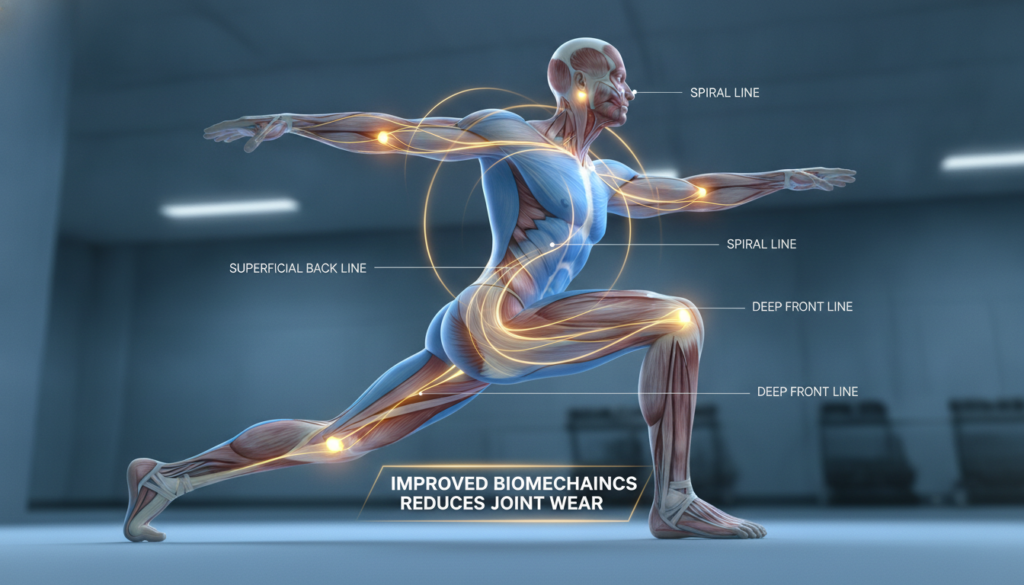
Your body works as one unit, and keeping it that way is key to healthy joints. By focusing on structural integration, you move naturally. This is crucial for keeping your muscles and bones healthy and preventing wear.
The Relationship Between Fascia and Joint Longevity
Fascia is like a shock absorber for your muscles and bones. Knowing how it works helps you move better. Healthy fascia keeps your joints stable and moving smoothly.
Healthy tissue protects your joints from rubbing against each other. But if your fascia is tight or dry, your joints take the full force of every move. This can damage your cartilage over time.
Distributing Load Across the Kinetic Chain
Moving well means spreading force across your whole body. For example, when you throw a ball, your body uses fascial slings to move energy. This makes sure no joint takes too much stress.
Good biomechanics integration protects your weak spots, like your shoulders and lower back. It turns potential injury areas into strong points. This keeps your soft tissues healthy while you perform at your best.
| Movement Type | Load Distribution | Joint Impact | Efficiency Level |
|---|---|---|---|
| Isolated Lifting | Localized to one joint | High | Low |
| Integrated Rotation | Distributed across the kinetic chain | Low | High |
| Static Posture | Concentrated on ligaments | Moderate | Medium |
Moving your whole body helps your joints stay strong for a long time. Consistent practice of these movements makes your body strong and durable.
Advanced Strategies for Structural Integration
To achieve true structural integration, you need to go beyond simple exercises. You must challenge your body with complex movements. This forces your nervous system to improve its control over your body.
This process is key for anyone wanting to improve from basic muscular integration to top athletic performance.
Progressing Toward Complex Movement Patterns
To take your training to the next level, include movements that need coordination across many myofascial meridians. Look for exercises that help your body stabilize and generate force simultaneously. This enhances your biomechanics integration, making your limbs work together smoothly.
Begin by adding rotational elements to your usual workouts. Exercises with diagonal loading patterns are great for engaging your fascial trains. By doing these complex movement patterns regularly, you teach your body to handle tension well. This is what functional integration is all about.
Maintaining Tissue Flexibility and Resilience
As you increase the intensity of your training, maintaining your soft tissue integrity is crucial. High-performance movements need your connective tissues to be flexible and quick to respond. Seeing tissue flexibility as a must, not just a goal, is essential for your long-term health.
Regularly check how your structure and function relate to each other to spot stiffness. Adding specific mobility exercises helps maintain smooth fascial integration. This prevents tightness from building up. By keeping this balance, your body stays strong against the demands of tough training and everyday life.
Common Mistakes in Fascia Training
Many people start fitness with excitement, but hit roadblocks. It’s key to move past old fitness myths. By improving your fascia training methods, you can avoid setbacks and build lasting strength.
Over-Stretching Versus Functional Loading
Static stretching is often used to improve tissue flexibility. But it doesn’t really address soft-tissue integrity during complex movements. Instead, focus on functional loading to work the whole body.
Functional loading means moving with tension. It teaches your body to better handle forces. This method corrects muscle imbalances that static stretching misses. It helps your body adapt and get stronger.
Ignoring the Importance of Rest and Recovery
Your connective tissue needs time to heal after hard workouts. Many think that doing more is always better, which can lead to tissue tension. But ignoring recovery stops the progress you’re working for.
Good fascial therapy and recovery include staying hydrated, sleeping well, and taking rest days. Using tools like foam rollers or massage balls helps too. Resting enough lets your body handle future challenges.
| Training Approach | Primary Benefit | Common Risk |
|---|---|---|
| Static Stretching | Temporary relaxation | Reduced structural stability |
| Functional Loading | Increased kinetic power | Potential for overtraining |
| Myofascial Release | Improved tissue glide | Excessive pressure on nerves |
| Active Recovery | Enhanced tissue repair | Inconsistent application |
To get the best results, focus on quality over quantity in fascial awareness training. Using professional bodywork techniques or fascia release exercises can be safer. Always remember, consistent and mindful movement leads to lasting success in any fascial release techniques program.
Conclusion
True physical mastery means moving away from just training muscles. It’s about seeing your body as one, connected unit. This view changes how you see your muscles and bones working together.
By taking a holistic approach, you can improve your movement. Your posture will get better as you align your body with your actions. Regular soft tissue therapy keeps your body flexible and ready to move.
Working on full-body coordination makes you stronger and more resilient. You build lasting health by making your limbs work together. This leads to better performance in everything you do.
Your path to better body mechanics starts with small steps. Apply these ideas to your workouts to find your hidden potential. You can move with grace, strength, and total integration.