
You can build muscle without counting reps by judging effort, keeping your form controlled, and gradually increasing the challenge. Rep counting is optional, not a requirement for muscle growth.
Effort-based training helps you decide when to stop by checking how hard a set feels and how well you move. These strength training effort cues can guide workout intensity without a fixed rep target.
RIR, or reps in reserve, is the number of clean repetitions you believe you could still perform at the end of a set. You will also learn how to use technical failure, tempo, and simple progress notes.
A basic workout note can track three things without tallying reps: exercise, load, and set quality. These cues offer another way to train, not a promise of better results than rep-based workouts.
Key Takeaways
- Use effort and form to guide each set.
- End a set when your movement loses control.
- Keep tempo steady enough to use a helpful range.
- Track exercise, load, and set quality.
- Make one manageable change when you want to progress.
Treat each set as a quality effort to evaluate, not a number you have to reach.
Build Muscles Without Counting Reps: What Should You Track Instead?
A rep-free set still needs a progress check: note the exercise, the load, and whether you kept the target muscle working with controlled form. Three checkpoints can guide the set: effort, form, and whether the target muscle is doing its intended work.
Assess those checkpoints as you move, then stop when you reach your planned effort limit. You can use this no-count workout method with machines, free weights, resistance bands, or bodyweight exercises.
Keep one movement standard long enough for your notes to show a real change.
Progressive overload without rep counting can mean using more load, choosing a harder variation, or improving your form on the same movement. Better control can make a familiar exercise more demanding without adding weight.
Your basic log can record the exercise, load, set quality, and how the set felt. You don’t need to tally every repetition to notice when a load feels easier, or your movement looks steadier.
For example, note whether the final part of a set stayed smooth or became uneven. That detail helps you compare sessions more usefully than a bare number of repetitions.
Keep the same exercise and movement standard long enough to tell whether your effort and execution are improving.
How Do You Use RIR as an Effort Cue?
RIR gives you a simple way to judge whether a set still has clean repetitions left. Reps in reserve means the number of clean repetitions you believe you could still perform at the end of a set.
Two RIR means you estimate that two more clean reps were possible; zero RIR means none remained. The estimate is useful for deciding whether to stop reps short of failure, but it is not a guaranteed count.
Estimate RIR by the clean repetitions you could still perform
Imagine finishing a set and asking how many more repetitions you could complete with the same clean form. If you could manage two, you would call the set 2 RIR.
RIR training uses that judgment to help you control how close you get to failure. The closer a set gets to its limit, the harder it is to estimate what remains.
The National Academy of Sports Medicine recommends that hypertrophy training generally end at 1-3 RIR. Treat that as a useful coaching range, not a test you must score perfectly.
Use RPE as a rough translation, not a perfect measurement
Rating of perceived exertion, or RPE, offers a related scale for describing how hard a set feels. The National Academy of Sports Medicine maps common RPE scores to approximate RIR:
| RPE | Approximate RIR | What that effort means |
|---|---|---|
| 8 | About 2 RIR | Two clean reps left |
| 9 | 1 RIR | One clean rep left |
| 10 | 0 RIR | No clean reps left |
A 2024 exploratory meta-regression found that muscle growth increased as sets ended closer to failure. It found a negligible relationship between estimated RIR and strength gains.
The researchers also warned that RIR estimates can be uncertain. Use the scale as a consistent coaching cue, rather than a precise measurement of your ability.
If you are unsure of your estimate, choose a repeatable effort target instead of pretending the number is exact.
When Should You Stop at Technical Failure?
If your form changes enough that you cannot perform the next repetition as intended, end the set even if you planned to continue. Technical failure is the point when your form is no longer controlled.
End the set when technique breaks, regardless of your planned effort target. A failed repetition is different: you force an attempt after control has already gone.
End the set when controlled form breaks down
Watch for changes that show the movement is no longer matching your intended technique. A shorter range or a new way of moving can signal that the set has reached its limit.
- You shorten the range of motion.
- You bounce the weight to get through a hard point.
- You swing your body to move the load.
- You lose a stable body position.
These signs matter even when you planned to continue. They can appear before a repetition completely fails, so do not wait for a forced lift to end the set.
A muscle pump can signal that a muscle has been working, but it cannot replace effort and technique when you choose when to stop. Use controlled movement as your main check.
Use safe final sets to calibrate your estimate
Occasionally, take the final set of a safe, simple exercise to technical failure. The National Academy of Sports Medicine recommends this practice to help lifters learn what their RIR estimates feel like.
Choose an exercise where a lost repetition does not put you in danger. A simple machine movement may be easier to judge than a heavy lift that needs a spotter.
Do not chase a failed repetition on an exercise where losing control could put you at risk.
Does Time Under Tension Change Muscle Growth?
A longer set isn’t automatically a better muscle-building set, because duration doesn’t tell you how much force the target muscle produced. Time under tension, or TUT, means how long a muscle works under load.
TUT describes duration, while mechanical tension describes the force muscle fibers produce under load. A stopwatch can track the first, but it cannot directly show the second.
A 2025 meta-analysis of 14 studies found broadly similar hypertrophy with faster and slower repetition tempos. Differences between the conditions were trivial.
A 2026 American College of Sports Medicine position stand reviewed 137 systematic reviews covering more than 30,000 participants. It reported that TUT did not consistently affect training outcomes.
Earlier evidence also found similar hypertrophy across repetition durations from 0.5 to 8 seconds. A 2015 meta-analysis raised a limited-evidence concern about repetitions lasting longer than 10 seconds.
Together, these findings support a broad range of usable rep speeds. They do not prove that every speed works equally well in every exercise or situation.
Very slow repetitions may add fatigue and discomfort without automatically improving the muscle-building stimulus. A slower pace can still help when you need to learn a movement or stay in control.
For TUT hypertrophy, duration is only one part of the set. Rep speed and muscle growth do not follow a simple rule that says longer is always better.
Keep tempo controlled enough to preserve useful range and tension, but do not treat seconds under load as the goal.
What Tempo Should You Use for Controlled Reps?
For ordinary hypertrophy work, lower the weight under control, avoid bouncing, and lift with intent rather than forcing every repetition to move slowly. A steady tempo can help you keep your positions and range consistent.
A 2-3-second lowering phase is a practical control cue, not a proven requirement for muscle growth. Use it when it helps you perform controlled eccentric reps.
Use a controlled tempo for hypertrophy work
A 3-1-1-0 tempo describes each part of a repetition. The numbers name the time spent lowering, pausing at the bottom, lifting, and pausing at the top.
| Phase | Time in 3-1-1-0 | What you do |
|---|---|---|
| Eccentric | 3 seconds | Lower the weight |
| Bottom pause | 1 second | Pause at the bottom |
| Concentric | 1 second | Lift the weight |
| Top pause | 0 seconds | Do not pause |
Ten repetitions at this tempo take about 50 seconds. The often-cited 40-60 seconds per set is a coaching heuristic, not a magic threshold for growth.
You can use a 2-3-second eccentric without timing every part of every repetition. It is a simple way to practice control during tempo training.
Change your lifting intent for strength and power
Controlled repetitions suit many hypertrophy training methods, but strength and power work call for a different intent. In power work, try to lift the weight fast during the concentric phase.
The 2026 American College of Sports Medicine position stand reports that power improves with moderate loads and a fast concentric phase. A controlled lowering phase can still set up a strong lift.
Tempo training is a tool, not a test of patience. Use a slower lowering phase when it improves control, not just to make the set last longer.
Can a Muscle Pump Tell You When a Set Is Finished?
A muscle pump can feel satisfying, but it cannot tell you whether a set was hard enough to support growth. That fullness is temporary, not a direct measure of muscle growth.
A pump can confirm that a muscle has worked, but it cannot prove the set was challenging enough. It may also help you notice whether the target muscle is doing the intended work.

For example, a 45-second set that ends eight repetitions short of failure can be less useful for hypertrophy than a 25-second set performed close to failure. Duration and burn alone do not settle the question.
Muscle pump training may feel rewarding, and a mind-muscle connection can help you focus on the working area. Neither cue alone shows whether your training is progressing.
Bodybuilding pump technique can be an optional way to focus on a muscle. It is not a dependable endpoint for every set.
Use the pump as optional feedback, then base your stopping decision on effort and controlled form.
How Do You Progress Without Counting Reps?
Progress without rep counting by making a controlled change in load, range, difficulty, or how much hard work you can recover from. Choose one change so you can tell what affected the next workout.
Adding repetitions and adding weight are both progression methods, but they change training demand differently. You can favor either based on the movement, your goal, and how well you recover.
Progress with load, range, sets, or movement difficulty
Progressive overload can take several forms. If you decide to count repetitions, that is one option, but it is not the only way to make an exercise harder.
- Add load to the movement.
- Add repetitions when you choose to count them.
- Add sets to the exercise.
- Use a fuller, controlled range of motion.
- Reduce momentum as you move the weight.
- Move to a harder variation.
More weight raises the load you must move; more repetitions extend the work you do at that load. Either may fit, but the movement and your strength goal can shape the choice.
For example, you might use a harder push-up variation when you have no heavier dumbbells. A fuller range can also change the challenge without changing your equipment.
Use a simple log to spot repeatable improvement
Record the exercise, load, set quality, effort, and any deliberate variation. Those details make progressive overload tracking useful even when you do not write down each repetition.
You can adapt double progression by keeping the same movement and load until the set feels controlled and appropriately challenging. Then make a modest change rather than chasing numbers.
Note whether you changed a band, stance, range, or other variation. A clear workout log helps you compare like with like across sessions.
Change one feature at a time so your log can show whether the new challenge improved the set.
How Many Hard Sets Should You Do Each Week?
Start by counting hard sets for each muscle group across the week, not by forcing every exercise to last longer. Hard sets give you a practical way to track workout volume without counting every repetition.
A standard recommendation for trained men aged 18-35 is 12-20 weekly sets per muscle group. That range is not a universal prescription for every person or muscle.
A 2022 review of trained men aged 18-35 recommended 12-20 weekly sets per muscle group for hypertrophy. Your own useful amount depends on whether you can recover and keep making progress.
A separate 2022 systematic review found no significant difference between moderate and high weekly volumes for quadriceps or biceps hypertrophy. In the included studies, high volume favored triceps hypertrophy.
That result shows why more work is not automatically better for every muscle. Extra sets only help if you can perform them well and recover between sessions.
Count hard sets across your training week, including work split between different days. A set that feels easy may add less useful work than a challenging set.
If you have stalled, check your current routine and recovery before adding sets. A training log can show whether the same work is still moving forward.
Increase weekly work only when your current sets are recoverable and your training has stopped progressing.
Should You Use More Reps or More Weight to Build Muscle?
For muscle gain, you can use heavier or lighter loads if the set is challenging and controlled; favor heavier loads when strength is the priority. Both approaches can support hypertrophy.
About 5-30 repetitions per set is a common practical range, not a hard boundary. A 2021 network meta-analysis found no clear hypertrophy differences between low, moderate, and high loads when sets reached volitional failure.
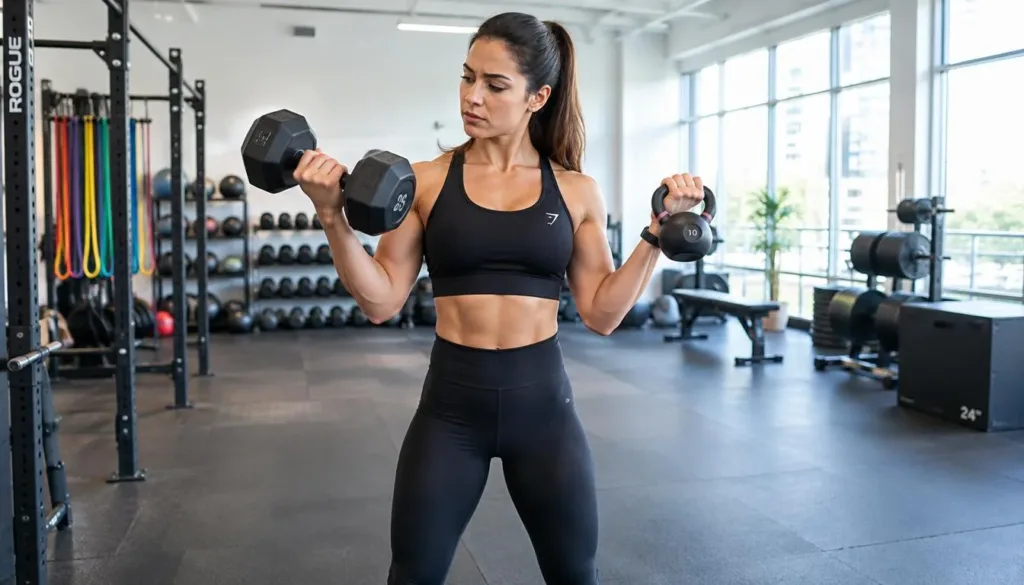
These practical ranges overlap, and they are examples rather than fixed rules. Choose the load and repetition style that lets you use controlled technique.
| Loading approach | Common practical range | Best fit |
|---|---|---|
| Heavier | About 5-8 reps | Strength-specific practice |
| Moderate | About 8-15 reps | General hypertrophy work |
| Lighter | About 15-30 reps | Challenging, comfortable hypertrophy work |
Heavy lifting does not automatically build muscle faster. More repetitions can build mass when you use suitable effort and technique.
If your main goal is strength, heavier loads have an edge because they let you practice lifting heavy weights. That practice matches the skill you want to improve.
People often ask whether lifting heavier weights with fewer reps or doing more reps builds mass. Both can support muscle growth, but heavier loads better match strength practice.
Pick a load you can control through a useful range and bring it close enough to your effort target.
How Do Nutrition and Age Affect Muscle Growth?
Resistance training creates the stimulus, while sufficient protein and recovery help you support that work. Extra protein during resistance exercise can produce a small additional gain in lean body mass.
Protein needs linked with significant effects differed by age in a 2022 meta-analysis. Those findings describe study groups, not personal targets for everyone.
Use daily protein intake to support resistance training
A 2022 review of 74 randomized trials found small additional lean-body-mass gains when people added protein during resistance exercise. The evidence was rated moderate.
In that review, the effect was significant for adults aged 65 and older who consumed 1.2-1.59 grams of protein per kilogram daily. For adults younger than 65, it was significant at 1.6 grams per kilogram daily or more.
These study conditions are not universal targets. Your needs can depend on your health, diet, and training demands.
- Dairy, such as milk or yogurt.
- Eggs.
- Meat or fish.
- Soy foods or legumes.
Keep resistance training useful as you get older
Resistance training can still increase muscle mass in older adults with sarcopenia, a condition marked by low muscle mass and strength. A 2025 review of 14 studies involving 528 older adults found a small increase in muscle mass.
In that review, age was the only significant moderator of muscle-mass gains. This means age affected the size of the gains, not that one age marks a sudden end to muscle growth.
Manageable progression, recovery, and steady training matter more than matching a younger lifter’s pace. If fatigue builds, make the workload easier to recover from before adding more demands.
If you have a medical condition or a specific protein target, ask a qualified clinician or dietitian for individualized guidance.
What Does a Rep-Free Workout Look Like?
A rep-free workout can use the same basic movement patterns as a conventional strength session, with your effort and form deciding when each set ends. Two weekly sessions are a manageable place to start.
Use equipment you can control, such as dumbbells, resistance bands, or your bodyweight. Include at least two strength training sessions per week.
A full-body session can cover these four movement patterns:
- A squat or lunge.
- A push, such as a push-up or dumbbell press.
- A pull, such as a band row or dumbbell row.
- A hinge, such as a Romanian deadlift or bodyweight hip hinge.
Higher weight with fewer repetitions fits strength-specific practice. More repetitions with a lighter load can still support hypertrophy when the set is challenging.
Rest long enough to keep your next set steady. A practical starting point is 2-4 minutes for heavy compound lifts and 1-2 minutes for isolation lifts.
Longer inter-set rest can offer a small hypertrophy advantage when it helps you preserve performance and training volume. Don’t aim for short rests if they reduce the quality of your next set.
Record the exercise, load or variation, set quality, and effort in a paper workout log or workout tracking app. That note makes strength progression easier to compare without counting reps.
Choose a movement version that lets you keep control from the first repetition to the last.
Choose a version of each movement you can control today, then record enough detail to repeat or appropriately progress it.
Conclusion
You do not need a rep counter to make a set productive; you need controlled effort and a way to notice progress. Rep quality matters more than chasing a number on the clock.
After your workout, record the exercise, load or variation, and set quality. Those simple notes can show whether you are moving with better control or handling a harder challenge.
Do not make every set a test. Choose a suitable effort, keep the movement steady, and adjust your training when your notes show a clear reason.
In your next workout, choose one exercise, finish each set with controlled technique, and record how the set felt.