The squat press exercise, also called a thruster, combines a front squat and an overhead press in one coordinated repetition. It suits people who want an efficient way to pair lower-body work with an overhead press. Beginners should use a light load and learn the timing before adding weight.
That simple pairing can support strength and conditioning at home or in a gym. You can use it in a home workout when you have suitable weights and room to press overhead. It can also add a demanding movement to a full-body workout, though it cannot replace a complete training plan. The goal is to move well, not to race through repetitions. Control comes first, especially while you learn to link the squat and press.
In the sections ahead, you will learn what the movement involves, how to perform it, and how to fit it into training. Choose a version that matches your equipment and current skill. Begin with a load you can move smoothly, since precise timing matters more than speed.
Key Takeaways
- A thruster links a front squat with an overhead press.
- Your legs help drive the weights overhead.
- Use a load you can control through the full repetition.
- Dumbbells, barbells, and kettlebells offer different training options.
- Thrusters can support conditioning, but they do not train every movement pattern.
What Is the Squat Press Exercise?
Each repetition links a front squat to an overhead press rather than treating them as two separate exercises. This compound movement joins a lower-body action and an upper-body press in one flowing rep. Start with the weights at your shoulders in the front rack position, with your elbows lifted.
The legs generate force that continues into the overhead press. That link makes the thruster exercise useful when you want to train strength, power, and conditioning in one movement. That doesn’t mean one exercise works every muscle fully or replaces a balanced plan.
Keep the squat and press connected, but never let speed take control of your position.
The names squat press and thruster describe the same combined action. They do not refer to a leg-press machine, where you push a platform away while seated or reclined. Here, you stand, squat with the weight held at your shoulders, and press it overhead.
Because the lower-body drive feeds into the press, your timing affects the whole repetition. The weights should travel from the shoulder position to overhead as you rise from the squat. You are not simply finishing a squat, pausing, then starting an unrelated shoulder press.
This pattern can suit a strength session when you use a load that challenges you without changing your form. It can also raise the pace of a conditioning workout, since you repeat both the squat and the press. Your load and pace choices change the demand.
A squat to press can feel natural once you coordinate the rise and the arm action. It still asks for control at both ends of the movement. The defining feature is the continuous transition from standing out of the squat into the press.
Which Muscles Does the Thruster Work?
Your quadriceps, glutes, and hamstrings power the squat, while your shoulders and triceps finish the press. The linked effort trains these groups in one repetition, rather than asking each to work alone. Your core also helps steady your trunk as the weights move overhead.
The thruster combines several muscle groups, but it does not isolate them. That distinction matters if your goal is balanced strength or full-body muscle growth.
The squat drives the lower body
Your quadriceps straighten your knees as you rise from the squat. Strong quadriceps activation depends on a controlled squat, not a fast drop into the bottom position. Your glutes help extend your hips and bring your body upright.
Hamstrings also contribute as you bend and straighten your hips and knees. Together, the quadriceps, glutes, and hamstrings do most of the work in a squat. Glute engagement can change with your depth, stance, and how you move through the repetition.
Dumbbell squat press benefits include working the legs and upper body in one linked pattern. Squat-to-shoulder press benefits also come from coordinating the lower-body drive with an overhead action. Neither version replaces targeted work when you need to focus on one muscle group.
The press and trunk complete the rep
Your shoulders raise the weights overhead, while your triceps help straighten your elbows. The press adds an upper-body demand after the squat, so your arms must finish the movement without losing control.
Your core muscles help keep your ribs and pelvis steady under the load. That support matters because the weights move overhead while your legs and hips extend. If your trunk shifts or arches too much, the press becomes less stable.
A thruster can build coordination alongside strength, since the legs and arms must work in sequence. It offers a broad training effect, not the same focused challenge as a shoulder press or leg exercise done alone. The core’s role is to keep your torso steady while force moves from your legs to your arms.
How Do You Perform a Dumbbell Thruster?
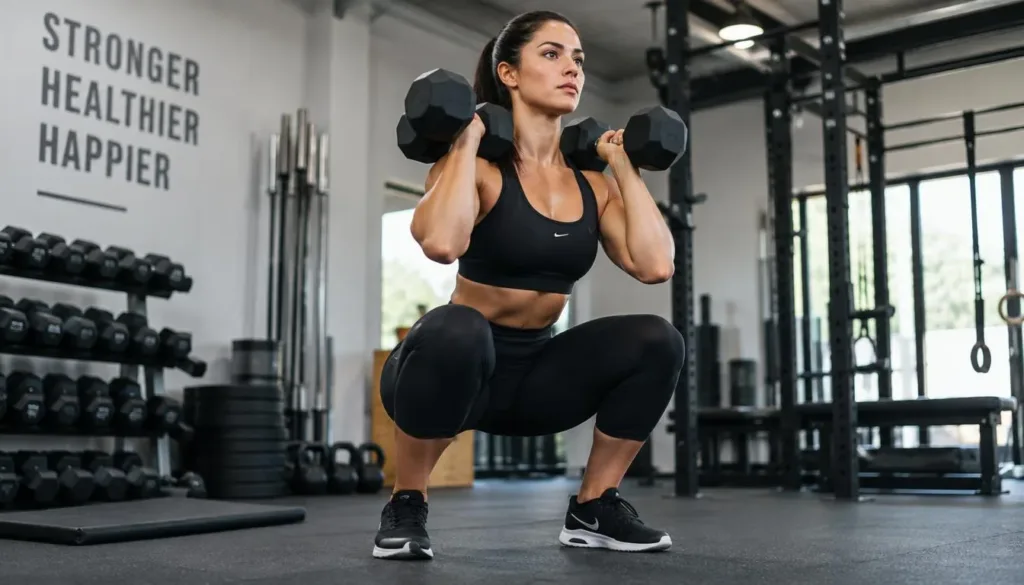
Start with a light pair of dumbbells at your shoulders and make sure you can hold the position comfortably. Your elbows should point forward and sit parallel to or slightly above the floor. This shoulder-held position is the front rack.
Use a smooth squat and let your leg drive help start the overhead press. Keep the dumbbell thruster controlled from the start position to full lockout. A dumbbell squat press works best when both weights stay steady, rather than swinging away from your body.
Follow these five steps for one repetition:
- Set the dumbbells at shoulder height, lift your elbows, and brace your trunk.
- Squat to a comfortable depth near or just below parallel.
- Drive up through your feet and begin standing with a steady chest.
- Use the leg drive to press both dumbbells overhead as you finish standing.
- Lower the dumbbells under control until they settle at your shoulders.
Squat deep enough to keep your heels grounded and your torso steady. Near parallel means your thighs approach a level line with the floor. Going just below that point can work if your mobility and control allow it.
As you rise, let the motion flow into the overhead press. The squat-to-overhead press should feel connected, but each part still needs a clear finish. Do not throw the weights up or let them drift far in front of your body.
At the top, straighten your arms without forcing your back into an arch. Keep your ribs from lifting as you reach overhead. A stable finish gives you a clear place to reverse the movement and lower the weights.
Breathing can follow the effort: breathe in before the squat, then breathe out as you drive up and press. If you need a pause, take it with the dumbbells secure at your shoulders. Finish each repetition with the dumbbells controlled at shoulder height before beginning the next squat.
What Form Mistakes Should You Avoid?
A thruster is no longer a good repetition once you have to sacrifice your posture or control to finish it. Small setup changes can make the squat or press less stable. Watch your elbows, trunk, knees, and timing as fatigue builds.
Keep your knees tracking in line with your feet, and your trunk braced without an excessive back arch. Those checks help preserve exercise form through the full movement.
Setup and posture errors
Dropping your elbows can shift more strain to your shoulders and make the front rack less secure. A rounded torso also weakens your position under the weight. Keep your chest lifted and your back from rounding as you move.
Your core stability comes from bracing around your trunk, not from leaning back to make the press easier. If your lower back arches sharply, reduce the load or stop the set. Your knees should follow the line of your feet instead of collapsing inward.
Timing and fatigue errors
Pressing before your legs finish rising breaks the flow and may leave you pressing from a weak position. Rushing can also stop the dumbbells from settling at your shoulders before the next repetition. Take the brief reset you need to regain control.
Use these corrections when you spot common technique mistakes:
- Elbows drop: lift them back toward the front rack position.
- Torso rounds: lower the load and keep your chest lifted.
- Knees move inward: track them in line with your feet.
- Press starts early: finish driving upward before pressing.
- Reps get rushed: let the dumbbells settle before moving again.
A load that once felt manageable can become too heavy as your legs or shoulders tire. Stop rather than forcing a final repetition with poor control. End the set when clean timing and position cannot be maintained.
Which Thruster Variation Fits Your Equipment?
Choose the version that lets you hold the starting position and control the overhead finish. A two-dumbbell setup often suits home workout equipment, while a barbell supports heavier resistance training. Your best fit depends on what you can hold securely.
Use a lighter option if shoulder mobility or shoulder stability limits your front rack or overhead position. Movement regressions can help you practice the squat-to-press pattern before using a harder version.
These options change how you hold the load and manage each side:
| Variation | Equipment and hold | Main distinction | Practical consideration |
|---|---|---|---|
| Two-dumbbell thruster | Dumbbells at both shoulders | Independent arm loading | Accessible setup |
| Barbell thruster | Bar in front rack | Can allow heavier loading | Press may cap the weight |
| Single-arm kettlebell thruster | One kettlebell at one shoulder | Offset loading | Match at least 8-10 reps per arm as one example |
| Double-kettlebell thruster | One kettlebell per shoulder | Two-sided kettlebell front rack | Requires control on both sides |
| Goblet or medicine-ball thruster | One implement held at the chest | Simpler squat-to-press pattern | Useful for pattern practice |
A barbell squat press exercise uses a bar in the front rack, with your elbows held high. Squat to at least parallel, then drive the bar overhead as you rise. At lockout, the bar should sit over the middle of your feet.
You can load the barbell more heavily than in some other versions, but the press may limit the weight you can use. Do not choose the load based only on what your legs can squat. Your ability to control the bar overhead also matters.
For a squat-to-overhead press with a kettlebell, hold one bell at a shoulder and resist leaning toward it. Single-arm kettlebell thrusters use a squat to parallel, then a press as your knees finish extending. At least 8-10 repetitions per arm is one example, not a fixed rule for every workout.
Other choices include the two-arm goblet thruster, a single-kettlebell clean-to-thruster, and a band thruster. A band can change resistance through the press, while a clean adds a lift into the shoulder rack. With a barbell, confirm that the lockout stays stacked over your midfoot.
How Should You Program Thrusters?
Match the repetition scheme to your goal, because a strength set and a conditioning interval ask for different pacing. Your first priority is a plan that keeps every repetition controlled. Choose the load based on your overhead press, not only your squat.
For strength, muscle, and power, try 3 sets of 6-8 reps; for conditioning, try five minutes of alternating 30 seconds of work and 30 seconds of rest. These are starting templates, not rules for every lifter.
Use the goal that best matches your session:
| Goal | Example prescription | Load or pacing emphasis |
|---|---|---|
| Strength, muscle, and power | 3 sets of 6-8 reps | Press overhead with control |
| Conditioning | 5 minutes, 30 seconds work and 30 seconds rest | Keep repetitions technically sound |
| Beginner practice | A few low-repetition sets with light dumbbells | Prioritize smooth coordination |
The strength option can help you build muscle if the load challenges you while you keep proper lifting form. It can also support explosive power, but speed should not replace control. Stop each set before fatigue changes your movement.
During timed work, the clock does not outrank resistance training form. End the work interval early if your posture, balance, or timing starts to break down. A heavy load can also limit the press, even when your legs could handle more.
Progress in this order:
- Establish consistent form with the load you already use.
- Add repetitions while retaining control from start to finish.
- Increase the load gradually after your technique stays steady.
Workout programming works best when it fits the rest of your training week. Give yourself enough time to recover before repeating a demanding session. Keep enough recovery between sessions to repeat the work with sound technique.
Can Thrusters Replace a Full-Body Workout?
Thrusters can challenge strength and conditioning in one set, but they don’t cover every part of a balanced workout. Repeated whole-body work can raise your breathing and heart rate. That makes it useful for metabolic conditioning, but not a complete plan on its own.
A thruster does not train every movement pattern, especially pulling, so pair it with other exercises. Your weekly routine should include more than one type of strength work and activity.
What the movement contributes to conditioning
A fast series of thrusters can feel like a cardiovascular workout because your legs and arms work repeatedly. It can also serve as a HIIT exercise when you alternate hard work with planned recovery. Keep the pace suited to your skill and load.
The CrossFit benchmark Fran pairs barbell thrusters and pull-ups in a 21-15-9 repetition pattern. It shows how a CrossFit thruster can appear in a demanding workout, not a routine everyone needs to copy. Its pull-ups also show why thrusters alone do not cover all training needs.
A 2025 study of 29 healthy young adults compared two squat protocols: 3 sets of 12 squats at 75% of 1RM, and 3 sets of 30 at 50% of 1RM. In both protocols, energy use, oxygen use, and heart rate tended to decline across sets.
That study measured squat protocols, not thrusters. It does not establish a thruster-specific effect, so it cannot show exactly how a thruster changes heart rate or energy use.
What a balanced weekly routine still needs
For full-body strength and functional fitness, pair the squat-and-press action with pulling work and other useful movement patterns. You might also include exercises that train balance and aerobic fitness. The right mix depends on your ability and training goals.
The CDC recommends that adults 65 and older do muscle-strengthening activity on at least 2 days each week, alongside aerobic and balance activities. Thrusters may count as one strengthening choice when they suit your ability, but they do not replace those other activity types.
Use thrusters as one part of a broader routine, not as the only way you train.
For older adults, include the thruster only as one possible strengthening activity within the broader weekly recommendations.
How Is a Thruster Different From a Push Press?
The key difference is depth: a push press uses a short dip, while a thruster includes a full front squat. The push press uses a 3-6-inch dip to help drive the weight overhead. A thruster adds a deeper squat before its press.
The thruster includes more lower-body work because it uses a full squat rather than a brief dip. That changes the effort and the timing needed to move the weight overhead.
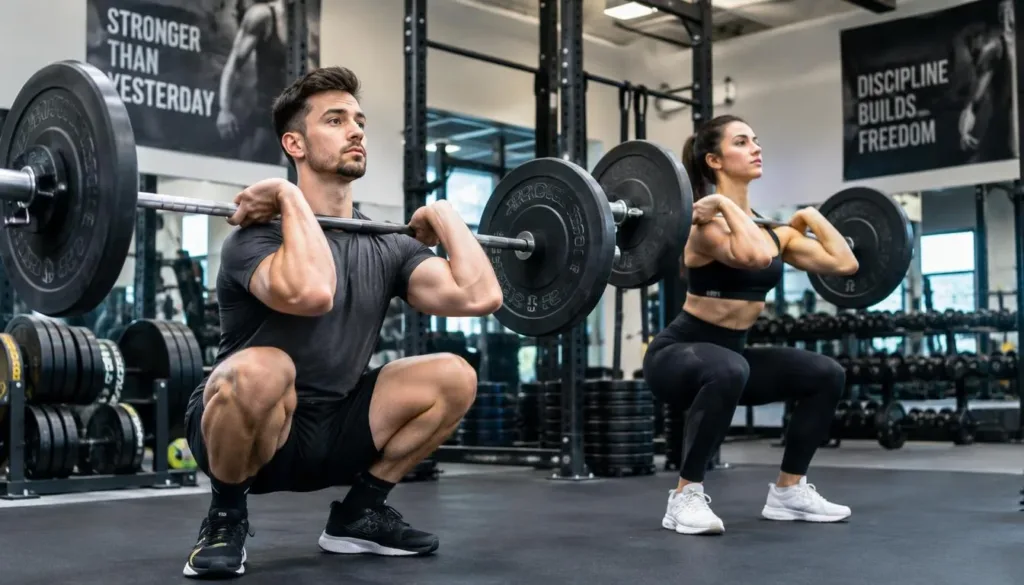
In a push press, you bend your knees a few inches, then drive through your legs to help press the weight overhead. You do not lower into a full front squat. The short dip gives you leg drive, but the movement has less squat depth.
A thruster makes the squat a larger part of the repetition. You descend into the front squat, then use the rise to help power the overhead press. That added lower-body strength demand can make each rep feel harder, especially when the press follows a deep squat.
Overhead press mechanics still matter in both exercises. You need to control the load overhead and keep your trunk steady. The main difference is how much leg movement comes before the press, not whether the arms work.
The term squat thrust names a separate exercise, not another word for a thruster. A squat thrust generally involves lowering your body and moving your feet back and forward, rather than pressing weights overhead. Avoid using the names as if they mean the same movement.
Both exercises can support muscle building when they fit a sound resistance plan. Pick one based on the movement you want to practice and the load you can control. Choose the thruster when you want the squat-to-press link, and the push press when you want to practice a shorter leg-driven press.
Conclusion
A well-executed thruster turns a controlled squat into a coordinated overhead press. The squat press can train strength and conditioning, but its value depends on your control and timing. Your legs should help drive the weights, while your trunk stays steady.
Practice with a light load before choosing a strength or conditioning approach. Make sure the movement stays smooth before adding more weight or pace. Start your next practice set with a light load and stop when you can no longer keep the movement controlled.