The 2026 finding that most sampled healing-frequency tracks lacked their promised tones, yet listeners still felt better, offers a striking entry point. A track can ease tension without a special tone or a proven medical effect. Sound therapy means practices that use sound, tones, rhythms, or vibrations to support relaxation, focus, sleep, or symptom relief. You may turn to anxiety relief music or a mindfulness sound practice when stress keeps you awake. These tools may be worth trying, but they aren’t cures for disease and cannot repair DNA. Brainwave entrainment and the relaxation response offer plausible ways sound might shape an experience. Neither one proves broad claims about healing frequencies. The key is to separate a calming moment from a promise of lasting change. That distinction starts with recognizing that people use the same name for very different sound practices.
Key Takeaways
- Sound practices may support relaxation, focus, or a sleep routine.
- They do not replace medical care or cure disease.
- Binaural beats use separate tones delivered to each ear.
- Research on brainwave entrainment remains mixed.
- A frequency label does not prove a special health effect.
What Counts as Sound Therapy?
Sound therapy is an umbrella term, not one standardized treatment. Different formats use instruments, music, or electronic tones, and their effects don’t necessarily match.
A sound bath, binaural beat, and single-tone track are different listening experiences. Each may support relaxation for some people, but the name alone does not establish a treatment effect.
Sound therapy includes distinct practices, not one proven treatment. A benefit from one format does not prove that another works the same way.
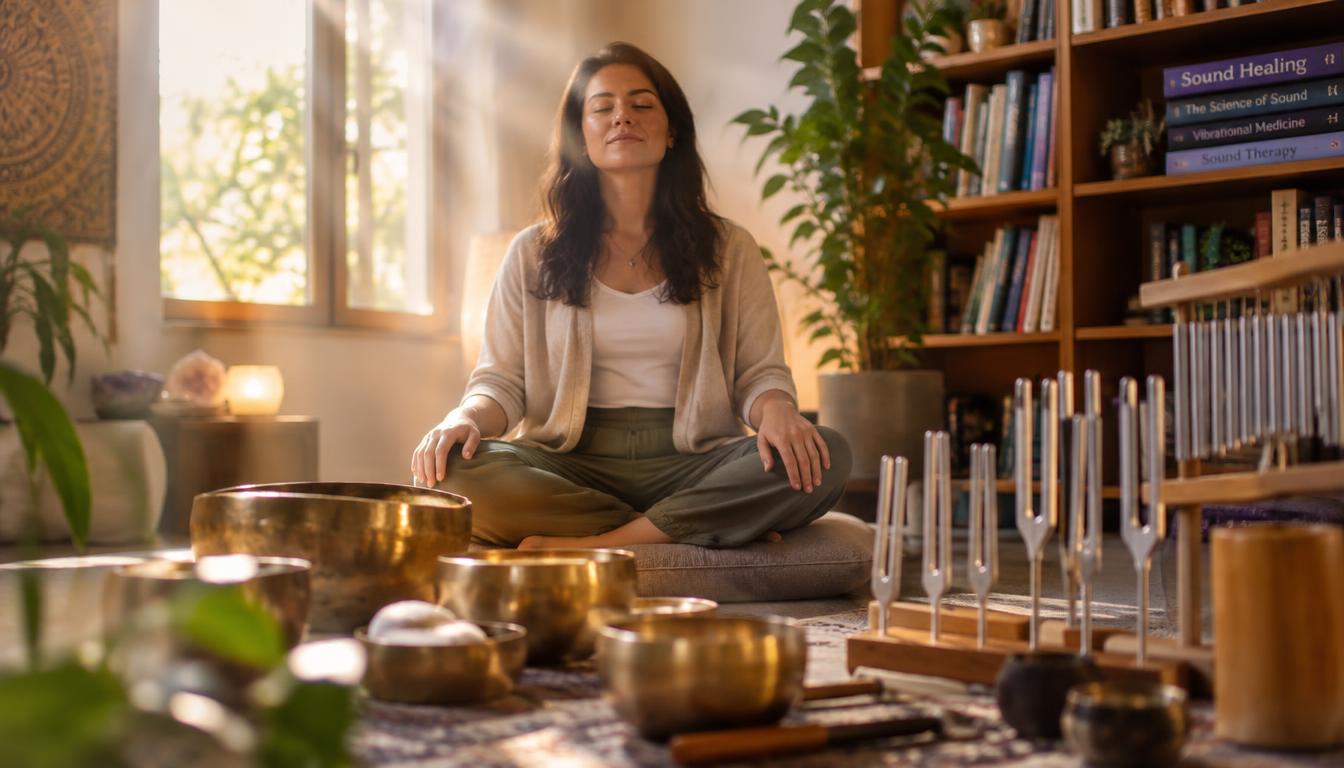
A sound bath is an immersive session that uses resonant instruments such as crystal or brass singing bowls, chimes, and gongs. Meditation music may use recorded instruments or ambient sounds. Binaural beats, by contrast, rely on two tones delivered separately through headphones.
Some tracks market a single tone as a healing frequency. That label applies to an audio product, not a standard therapy. The table compares the basic formats and their limits.
| Practice | How it is produced | Headphones needed | Evidence boundary |
|---|---|---|---|
| Sound bath | Resonant bowls, chimes, or gongs | No | Some studies report possible benefits |
| Binaural beats | Different tones, one per ear | Yes, stereo | Brain effects remain inconsistent |
| Single-tone healing-frequency tracks | Recorded tone with a frequency label | No | Label does not prove healing |
Calling all three audio therapy can hide important differences in how the sound reaches you. Singing bowl therapy uses acoustic resonance from physical instruments, while binaural beats depend on separate audio signals. Vibrational healing is another common wellness phrase, but it doesn’t name a single agreed method.
These differences matter when you compare sound bath benefits with a meditation soundtrack on headphones. The next question is how a sound might feel calming without proving a cure.
Sound Healing Science, Brainwave Entrainment, Binaural Beat, Relaxation Frequency: What Research Actually Supports
Two tones played separately to each ear can create a beat you don’t hear in either ear alone. The perceived pulse is one possible way rhythmic audio may affect your attention, but it does not prove a health benefit.
Brain activity can respond to sound, yet consistent brainwave entrainment is not established. A measured response does not show that sound will reliably change your mood, anxiety, or sleep.
How rhythmic audio may influence brain activity?
Imagine a 200 Hz tone in your left ear and a 208 Hz tone in your right. With stereo headphones, your brain may perceive a pulse at the 8 Hz difference.
That pulse is a binaural beat. It is not an extra tone playing through the headphones, and each ear must receive its own signal for the effect to occur.
Researchers can use EEG (electroencephalography) to record electrical activity in the brain. They may look for neural oscillations or a frequency following response during auditory stimulation.
A change in an EEG reading can show that the brain responded during a test. It does not prove that the response lasts or brings anxiety relief, better sleep, or sharper focus.
This is a common mistake: treating a laboratory measure of brain activity as proof of a clinical benefit. The two questions need different tests.
Why slow, ambient sound can support relaxation
Slow, gentle audio may help by giving your attention a steady focus and making a listening space feel calm. Sustained sound can also support the relaxation response for some listeners.
When you feel safe and settled, parasympathetic activity may rise. This part of the autonomic nervous system helps the body rest, but no single tone reliably switches it on.
Context matters. A quiet room, a familiar sound, and time away from daily demands may contribute as much as the audio itself.
A listener might find a gong soothing while another finds it startling. Acoustic resonance, how an object responds to sound at certain frequencies, doesn’t guarantee a calm reaction.
These plausible mechanisms can explain why you may feel calmer without confirming every claim made for a track. Having separated possible mechanisms from promised outcomes, turn to what clinical research has measured.
What Have Clinical Studies Found About Singing Bowls and Sound Baths?
The clinical picture is promising in places, but it is not strong enough to treat a singing bowl session as a proven therapy. Some studies suggest benefits, though their results do not show that every person or outcome improves.
A 2025 review analyzed 19 clinical studies and found possible benefits in some groups. The authors also noted that many studies were small, methods varied, and the risk of bias was high.
The outcomes researchers have reported
The review found possible reductions in anxiety and depression. Some studies also reported better sleep, mood, or cognitive function.
Other reports noted changes in heart rate. These outcomes did not appear in every trial, and a change during one session does not establish lasting improvement.
Sound therapy research covers different groups and settings. A group session with singing bowls may differ from a recorded track or a personal meditation practice.
So the results offer a reason to study sound baths, not a promise that sound bath benefits will apply to you. Clinical studies of sound therapy need clear methods and comparable outcomes.
Why the findings remain uncertain
The limits of the evidence matter when you weigh a relaxing experience against a medical claim. Three common issues make the results hard to interpret:
- Small samples may not reflect a wider group of listeners.
- Interventions and participants varied across studies.
- Bias may make an effect look stronger than it is.
These limits do not mean every reported effect is false. They mean researchers cannot yet say how much of an outcome came from the bowls, the setting, expectation, or other care.
Stronger research is needed, including larger studies with consistent methods and suitable comparisons. A placebo-controlled trial could test whether the sound adds benefit beyond expectation and attention.
For now, singing bowls may comfort some people, but they aren’t a proven way to treat a condition. Use those limits as a reason to examine whether specific frequency labels add anything reliable.
Do 432 Hz and 528 Hz Have Healing Effects?
A frequency label can tell you what a track claims to contain, but it can’t prove the track heals a disease. The number alone does not show a unique medical effect or make one recording better for your health.
Audible frequencies have not been shown to repair DNA or cure disease. You may feel more relaxed or in a better mood while you listen, but no special frequency causes that change.
What the 432 Hz and 528 Hz labels can tell you
A track labeled 432 Hz or 528 Hz makes a claim about its sound. The label doesn’t explain what you will feel, and it doesn’t prove a biological effect.
A 2026 analysis found that 92% of tracks marketed with healing frequencies did not contain the frequencies they promised. Listeners still reported feeling better.
That finding points to an important distinction: people may enjoy or relax to a track even when its advertised number is wrong. Expectation, the music itself, or the listening setting may shape that experience.
Why frequency-based healing promises go too far
No evidence supports ranking 432 Hz as healthier or more effective than 528 Hz. Claims about 432 Hz music or a 528 Hz frequency should not be treated as clinical advice.
People often ask, “What are the 7 healing frequencies?” No scientifically established universal set of seven healing frequencies exists. Different lists use different numbers, which reflects marketing and tradition, not a shared medical standard.
Debunking frequency healing does not mean music cannot affect your mood. It means a pleasant response doesn’t prove a tone repairs cells or treats an illness.
Relaxation frequencies may describe audio that feels calming to you. That personal response is real, but it cannot support a broader claim of healing. Next, separate brainwave frequency labels from the audio frequencies used in such claims.
What Do Brainwave Frequency Labels Actually Mean?
Brainwave labels describe electrical rhythms measured in the brain, not a universal list of healing tones. They are measurements, and their names don’t guarantee you are in a certain mental state.
EEG records electrical activity in the brain, while audio tracks have their own sound frequencies. The two are related only when a study measures how the brain responds to sound.
The conventional brainwave bands
Researchers often group EEG readings into bands based on their rate. These conventional ranges provide a shared way to describe brain activity, but they don’t directly reflect thoughts.
| Band | Approximate range | Commonly associated state |
|---|---|---|
| Delta | 0.5-4 Hz | Deep sleep |
| Theta | 4-8 Hz | Meditative or drowsy states |
| Alpha | 8-12 Hz | Relaxed alertness |
| Beta | 12-30 Hz | Active thought |
| Gamma | 30 Hz and above | Higher-level cognitive activity |
These bands help describe patterns seen in electroencephalography research. They do not divide the brain into five fixed modes that everyone enters in the same way.
Brain rhythms are not the same as track frequencies
A tone’s frequency describes how fast its sound wave repeats. Brainwave frequencies describe rhythms in electrical activity measured with an electroencephalogram.
A 3 Hz rhythm falls within the delta range. That match alone does not prove that a 3 Hz beat will induce sleep or improve health.
Some studies measure an auditory steady-state response, a brain response that follows a repeated sound pattern. The response can show that the brain tracks a rhythm during listening.
It does not show that the listener will enter deep sleep, stay asleep, or feel better the next day. A frequency name is a measurement label, not a promise.
Once the labels are clear, consider what binaural-beat research says about everyday goals such as sleep, anxiety relief, and focus.
Can Binaural Beats Help With Sleep, Anxiety, or Focus?
Research does not identify a single binaural beat that reliably treats anxiety, produces deep sleep, or improves focus for everyone. You may still find a quiet listening routine calming, but that’s not the same as proven treatment.
A 2023 systematic review of 14 studies found mixed results on brainwave entrainment. Five studies supported reliable entrainment, eight contradicted it, and one had mixed results.
The review called for stronger and more standardized research. Possible short-term relaxation does not establish a lasting clinical effect or show that a particular beat treats a disorder.
Binaural beats for sleep and anxiety
If anxiety keeps your mind busy, a steady audio routine may give you something simple to focus on. Stress-reduction audio might help you settle, especially if you already find the sound pleasant.
That experience does not show that binaural beats permanently changed your autonomic nervous system. The parasympathetic nervous system supports rest, but a track is not a proven switch for it.
For sleep, the audio may form part of a quiet bedtime routine. It cannot ensure you fall asleep or stay asleep, and it shouldn’t replace care for ongoing sleep problems.
Best binaural beats for deep sleep
There is no proven universally best binaural beat for deep sleep. The phrase best binaural beats for deep sleep often describes a listener’s preference, not a clinical ranking.
One track may feel soothing, while another may keep you alert. A sleep sound therapy routine works best as a personal aid, not a guaranteed brain-state tool.
Best binaural beats for meditation
The best binaural beats for meditation depend on what helps you stay with your practice. Some people prefer a low, steady tone; others focus better in silence or with instrumental music.
Use these checks before settling on a track:
- Choose audio you can hear comfortably.
- Match the sound format to your goal.
- Use stereo headphones for binaural delivery.
- Stop if the sound distracts or bothers you.
These checks help you judge the listening experience, not the strength of a medical claim. A person may enjoy the routine even if brainwave entrainment doesn’t occur.
Before trying a track, separate personal preference from claims about a particular frequency’s power.
Does a Specific Binaural Beat Frequency Work Better?
A number like 5.8 Hz describes a beat rate, but it doesn’t tell you whether that track will help you sleep. Frequency alone cannot predict a personal or medical result.
No specific binaural beat has a proven advantage for sleep, healing, or meditation. A beat rate may describe the audio, but it doesn’t determine what your brain or body will do.
Binaural beats for sleep and healing
The phrase binaural beats for sleep and healing does not establish a medical effect. It may describe how a track is marketed, rather than what controlled research has shown.
A listener can find a recording relaxing without a beat rate causing that response. Personal comfort and expectation can shape how the sound feels.
Some tracks use isochronic tones, which create regular pulses in a single sound. This is a different rhythmic audio format, not a proven superior option for sleep or healing.
What a 5.8 Hz binaural beat means
A 5.8 Hz binaural beat falls within the conventional theta range of 4-8 Hz. That classification does not give 5.8 Hz a special benefit or make it a reliable sleep aid.
The beat represents the difference between tones delivered to your ears. If the tones are 200 Hz and 205.8 Hz, the perceived difference is 5.8 Hz.
The beat rate is not necessarily the pitch of either tone. A “sleep frequency” may refer to that perceived difference, rather than the carrier tones you hear.
Binaural beats for sleep frequency
Searches for binaural beats for sleep frequency often assume that one number works best. Research has not established a single rate that reliably promotes sleep or healing.
Instead, consider whether the sound helps you settle without pulling your attention away. You can use headphones for binaural delivery, but the label alone cannot tell you whether the track suits your meditation practice.
A recorded beat may sound different from a sound bath or ordinary calming music. Once the limits of frequency choice are clear, address practical risks and how to approach freely available tracks.
Are Binaural Beats Safe, and Can You Trust Free Tracks?
A free track can be an inexpensive way to try a listening routine, but its frequency label doesn’t guarantee safety or effectiveness. For most listeners, binaural beats are widely regarded as safe when used as a supplementary practice.
Sound is not a replacement for medical care. Keep playback at a comfortable level, and stop if the audio feels unpleasant or causes discomfort.
Free binaural beats for sleep and anxiety
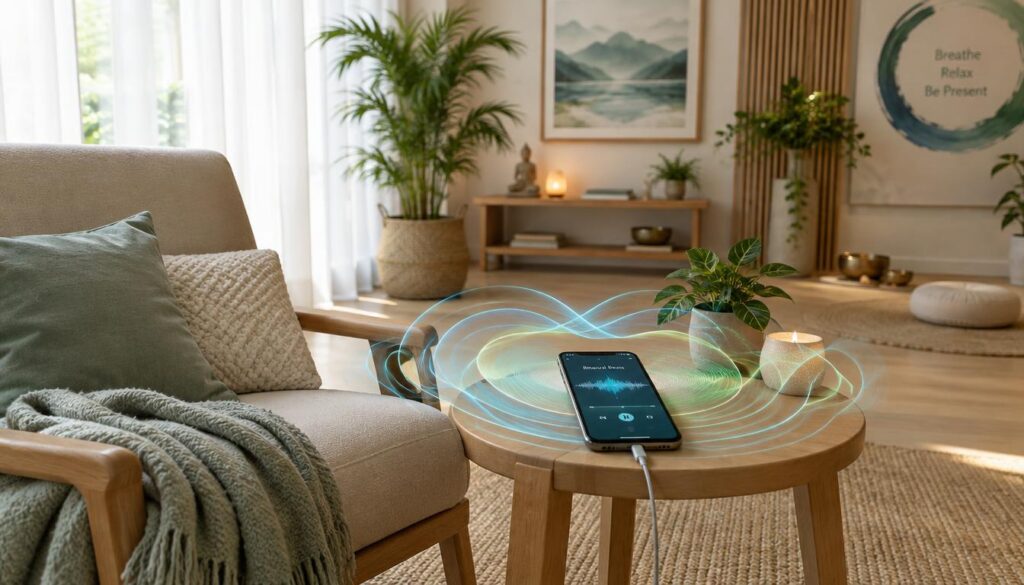
Free binaural beats for sleep and anxiety can help you test whether you enjoy listening before making it part of a routine. Judge a track by comfort, not by claims that it treats disease or has special healing power.
A free recording may include ads, a spoken introduction, or sounds that don’t suit your goal. You can stop or switch tracks if the experience becomes distracting.
Vagus nerve stimulation is a separate topic from listening to a binaural beat. A sound track may prompt an auditory cortex response, but that does not prove vagus nerve treatment.
Binaural beats danger
There is no universal safe listening duration established here, and no special danger tied to one beat rate. That does not mean every track will feel comfortable to every listener.
Keep the volume at a level that feels easy to hear. Stop if the sound causes discomfort, and seek care for symptoms that persist or worsen.
Placebo effects may shape how a listening routine feels, as can mood and expectation. That does not make your calm response imaginary; it means a positive feeling alone cannot confirm a treatment effect.
Use sound as a modest support alongside care that has evidence behind it. Build those cautions into a simple, realistic routine that supports, rather than replaces, evidence-based care.
How Can You Use Sound for Relaxation Without Replacing Care?
Treat sound as one optional part of a calming routine, not as a substitute for care. Sound can support rest or mindfulness, but it is not a medical cure for persistent symptoms.
Keep sound therapy complementary, and ask a clinician about ongoing problems. A simple routine can help you test whether a sound practice fits your day.
Use sound to support relaxation, not to replace evidence-based treatment. Ongoing symptoms deserve care from a qualified clinician.
- Choose a sound you find comfortable.
- Use it alongside relaxation or mindfulness.
- Talk with a clinician about persistent anxiety, depression, pain, or sleep problems.
Sound may offer a gentle cue to pause, but it should not delay help for a health concern. The next step can be small and low-pressure.
Conclusion
Sound can be worth trying for calm, as long as you keep its limits in view. It may support relaxation or a sleep routine, but special frequency claims do not establish healing.
Your experience matters, but it cannot show that a particular number treats a condition. A comfortable sound may help you make space for rest without promising more than it can deliver.
Try a sound practice if it appeals to you, and keep it separate from medical treatment. If symptoms persist, talk with a clinician about evidence-based care.