

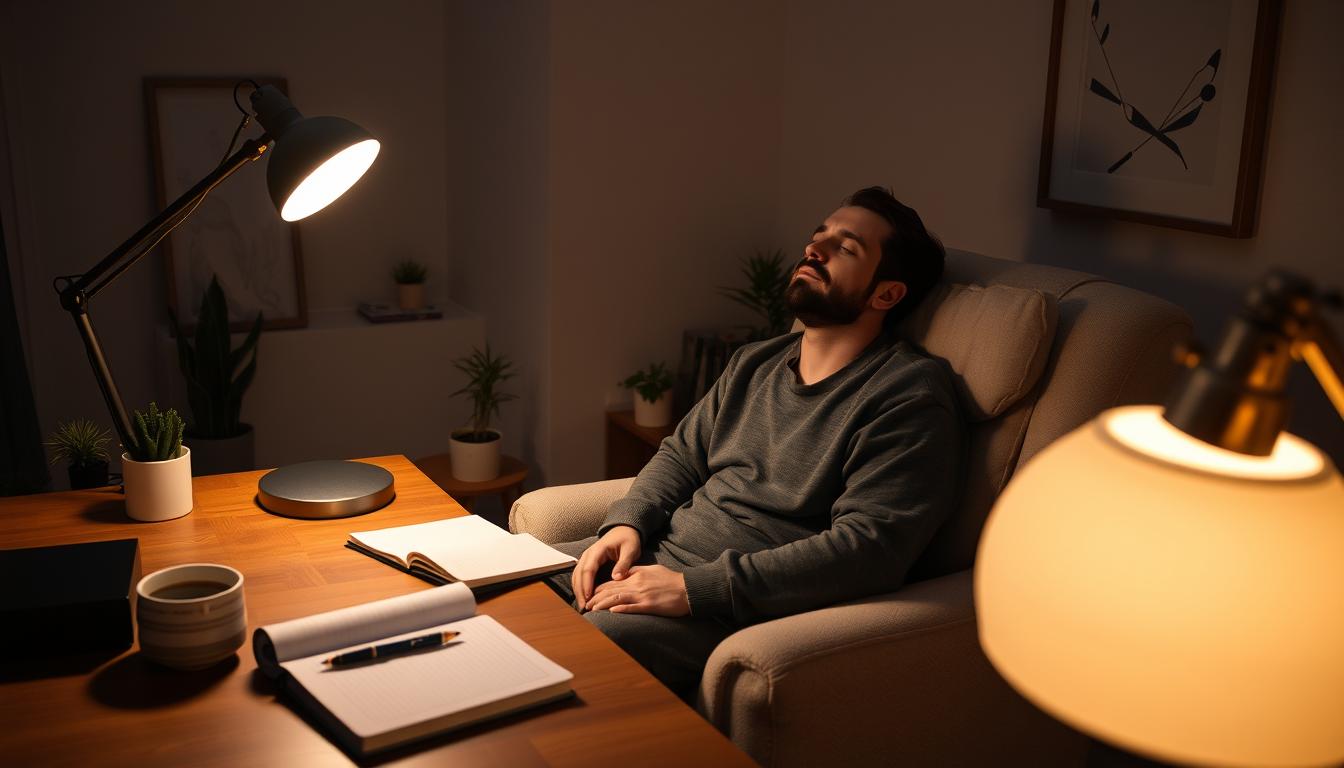
As your day comes to an end, taking a moment to reflect is very helpful. A structured routine at the end of the day can help you feel complete. It also prepares your mind for a good night’s sleep. Just 10 minutes of reviewing your day can help you process your experiences and clear your mind.
This simple daily review can be a powerful tool in your life. It helps you stay focused and calm. Studies show that a short journaling routine can significantly reduce stress and improve focus. By adding this to your evening, you can wake up feeling refreshed and mentally clear.
Key Takeaways
- A 10-minute daily review can help you achieve emotional closure.
- Incorporating a daily review into your routine can improve your mental clarity.
- This simple practice can help reduce stress and improve focus.
- Dedication to a daily routine can lead to better sleep.
- A structured routine can help you stay calm and focused.
The Mental Burden of an Unfinished Day
The end of the day often brings unaddressed emotions and tasks. Not processing your feelings and experiences can weigh on your mind. It can harm your mental health and overall well-being.
Unprocessed emotions can make you feel more stressed and anxious. This makes it hard to relax and get ready for bed. The mental load can be overwhelming, affecting many aspects of your life.
How Unprocessed Emotions Affect Sleep Quality
Unresolved feelings can really mess with your sleep. Studies show that those who don’t deal with their emotions before bed sleep poorly. They also feel more stressed.
“The mind is a wonderful servant, but a terrible master.” –
This saying shows why it’s key to manage your mind, especially before sleep.
| Emotional State | Sleep Quality | Stress Levels |
|---|---|---|
| Processed Emotions | Improved | Reduced |
| Unprocessed Emotions | Poor | Increased |
The Science Behind Mental Carry-Over
Mental carryover occurs when you can’t shake unprocessed emotions and thoughts. It’s because your brain keeps thinking about unresolved issues. This makes it hard to focus on new things.
Effective stress reduction techniques and emotional well-being practices can help. They let you start the next day with a clearer mind and better focus.
Why a Structured End-of-Day Routine Matters
Having a set end-of-day routine can really change your mental health. It helps you separate work from rest. This makes your mental health better.
Creating Boundaries Between Work and Rest
A routine helps you switch from work to relaxation. This stops work stress from ruining your personal time. It’s key to good mental health and rest for tomorrow.
The Psychology of Closure
Closure is significant for mental health. A routine gives you a sense of finishing the day. This lets you deal with any unfinished business, reducing worries.
Studies show that a daily routine boosts mental health. Here are some benefits:
| Benefit | Description |
|---|---|
| Improved Sleep Quality | A routine tells your body it’s time to sleep, leading to better rest. |
| Reduced Anxiety | Processing your day helps lower anxiety and makes you feel more stable. |
| Enhanced Next-Day Focus | A clear mind and closure help you focus better the next day. |
Dr. Laura Markham, a clinical psychologist, says, “A routine makes you feel more grounded and in control.”
“The way we spend our evenings can significantly impact our overall well-being and set the tone for the next day.”
Adding a structured end-of-day routine to your life can bring these benefits. It leads to better mental health and well-being.
The Benefits of a Daily Emotional Release Routine
A daily emotional release routine is a simple yet powerful tool for improving your mental clarity and reducing stress. By incorporating this practice into your daily life, you can experience a range of benefits that enhance your overall well-being.
Improved Sleep Quality
One significant advantage of a daily emotional release routine is improved sleep quality. Processing your emotions before bed helps clear your mind. This reduces mental clutter that often interferes with sleep. As a result, you can enjoy more profound, more restorative sleep, leading to better overall health.
Reduced Anxiety and Rumination
Regular emotional release can also help reduce anxiety and rumination. By addressing your emotions in a structured way, you can prevent them from spiraling out of control. This reduces the likelihood of anxiety-driven thoughts dominating your mind. You’ll feel more peaceful and calm.
Enhanced Next-Day Focus
Furthermore, a daily emotional release routine can enhance your focus for the next day. Clearing your mind of emotional baggage lets you approach the next day with a clearer mind. You’ll have a greater sense of purpose. This can improve your productivity and help you tackle challenges more effectively.
| Benefits | Description | Impact |
|---|---|---|
| Improved Sleep Quality | Processing emotions before bed | Deeper, more restorative sleep |
| Reduced Anxiety and Rumination | Addressing emotions in a structured way | More peaceful and calm state of being |
| Enhanced Next-Day Focus | Clearing emotional baggage | Improved productivity and clarity |
By incorporating stress relief strategies and mindfulness exercises into your daily emotional release routine, you can maximize these benefits. This improves your overall quality of life.
Preparing for Your 10-Minute End-of-Day Review
Before starting your daily review, get your space and mind ready. A clean area helps you focus and lowers stress. This makes reflecting on your day easier.
Setting Up Your Environment
Begin by clearing your workspace. Turn off phone notifications and find a quiet place. Use a comfy chair and a special notebook for your thoughts.
Tips for a conducive environment:
- Dim or soft lighting to promote relaxation
- A calming scent, such as lavender, to enhance the ambiance
- A quiet, comfortable space free from distractions
Choosing the Right Time
Be consistent with your daily review. Pick a time that fits your schedule. Many prefer reviewing their day before bed for a good night’s sleep.
Gathering Your Tools
The right tools make your review better. Use a journal or a phone app. Having a calming drink nearby can also help.

With the proper setup, time, and tools, you’re ready for your 10-minute review. This simple prep can make your daily reflection more meaningful.
The 10-Minute Emotional Release Routine: Step-by-Step Guide
Try a 10-minute emotional release routine to balance your evening. It helps you manage emotions, reduces stress, and prepares you for sleep.
Minutes 1-2: Celebrating Daily Wins
Start by celebrating your daily achievements. This sets a positive note for the rest of the routine.
Identifying Even the Smallest Victories
Even small wins, like finishing a task on time or eating well, are essential. Recognizing these small victories can lift your mood and make you feel accomplished.
Techniques for Genuine Appreciation
Reflect on how you achieved your wins and how they made you feel. Write down three things you’re grateful for to keep the positive vibes going.
Minutes 3-7: Processing Challenges and Lessons
After celebrating, spend a few minutes on the challenges and lessons you’ve learned.
Acknowledging Difficult Emotions
It’s key to accept your challenging emotions rather than hide them. Let yourself feel these emotions without judging, seeing them as part of your journey.
Extracting Valuable Lessons
Think about the challenges and what you learned from them. Ask yourself what you could do differently next time to learn and grow.
Release Techniques for Persistent Worries
For worries that won’t go away, use a release technique like writing them down and then letting go of the paper. This can help you let go of the worry.
| Technique | Description | Benefit |
|---|---|---|
| Journaling | Write down your thoughts and feelings | Clarifies emotions and thoughts |
| Deep Breathing | Focus on slow, deep breaths | Reduces stress and anxiety |
| Physical Release | Engage in physical activity, such as a short walk | Releases tension and improves mood |
Minutes 8-10: Planning One Meaningful Action for Tomorrow
End your routine by planning a meaningful action for tomorrow. This helps you start the next day with purpose and clarity.
Choosing an Impactful Priority
Find a task that will make a big difference in your day. Think about what needs to be done and focus on it.
Setting a Clear, Achievable Intention
Once you’ve picked your priority, set a clear goal. Be specific about what you want to do and imagine yourself doing it well.
This 10-minute routine can help you manage stress, process emotions, and get ready for a better tomorrow.
Enhancing Your Emotional Release Routine with Mindfulness Practices
Mindfulness can make your emotional release practice even better. Try brief breathing exercises, gratitude, and body scans. These can boost your emotional health.
Brief Breathing Exercises
Start with simple breathing exercises to calm down. Deep, controlled breathing slows your heart and lowers stress. Inhale for four counts, hold for four, and exhale for four. Do this for a few minutes to relax.
Gratitude Integration
Adding gratitude to your day can change your outlook. Think of three things you’re thankful for. It could be a good coffee or a friend. Focusing on gratitude makes your brain more positive.
Body Scan for Physical Release
A body scan helps release physical tension. Lie down or sit and focus on your toes. Move your body up, noting any tight spots. Exhale and imagine letting go of tension. This practice makes you more aware of your body and stress.
| Mindfulness Practice | Benefits | Duration |
|---|---|---|
| Brief Breathing Exercises | Reduces stress, calms the mind | 2-3 minutes |
| Gratitude Integration | Shifts focus to positive aspects, enhances positivity | 2 minutes |
| Body Scan | Releases physical tension, increases body awareness | 5-7 minutes |
Adding mindfulness to your emotional release routine can bring deeper relaxation and greater clarity. Regular practice improves emotional well-being and balances your life.
Adapting the Routine for Different Personality Types
Different personality types can approach the emotional release routine in unique ways. This makes the practice more personalized and effective. By tailoring it to your individual traits, you can make it a lasting part of your daily self-care routine.
For Analytical Thinkers: Structured Reflection Approaches
Analytical thinkers can improve their emotional release by using structured reflection. Try using a journal or spreadsheet to track your daily progress. This helps you spot patterns and areas for growth, making your emotional release more focused and effective.
- Use bullet points or numbered lists to organize your thoughts
- Create a template for your daily reflections
- Set specific goals for the next day based on your analysis
For Emotional Processors: Feeling-Centered Techniques
For those who deeply process emotions, the routine can focus on feeling-centered techniques. This might include:
- Allowing yourself to feel and express your feelings during the routine fully
- Using visualization techniques to explore your emotional state
- Incorporating gentle physical movements to release tension
By fully engaging with your emotions, you can have a more authentic and cathartic experience.
For Busy Minds: Simplified Versions That Still Work
If finding 10 minutes for the routine is hard, try simplifying it. You can:
- Shorten the routine to 5 minutes, focusing on the most essential elements
- Combine it with another daily activity, such as during your morning coffee or right before bed
- Use a guided recording to help structure your practice
By adapting the emotional release routine to your personality and lifestyle, you can make it a consistent and valuable part of your mental health practices. Try different approaches to find what works best for you. Don’t be afraid to change your routine as needed.
Troubleshooting Common Challenges
Starting your 10-minute emotional release routine might face some common hurdles. These can include a racing mind, dealing with tough days, or staying consistent when tired. But there are ways to overcome these challenges.
When Your Mind Won’t Stop Racing
If your mind is racing, try brief breathing exercises to calm it. Focusing on your breath can slow down your thoughts. This makes it easier to process your emotions.
Dealing with Particularly Difficult Days
On tough days, be gentle with yourself. Let yourself fully feel your emotions without judgment. Using a feeling-centered technique can help you release your feelings more effectively.
Maintaining Consistency When Tired
Feeling tired can make it hard to keep up with your routine. Simplify by focusing on the most critical parts. For example, celebrate your daily wins or plan one meaningful action for tomorrow. This keeps you consistent without feeling overwhelmed.
Knowing these common challenges and how to tackle them helps keep your emotional release practice going. It supports your overall well-being.
Conclusion: Transform Your Evenings, Transform Your Life
Adding a 10-minute emotional release routine to your day can change your life. It helps you deal with your feelings, let go of the day’s stress, and get ready for a good night’s sleep.
Doing this routine regularly can make you feel clearer and calmer. It helps you face life’s ups and downs better. Just a few minutes each day can change your evenings and help you succeed in the long run.
Now, you know how to make your own emotional release routine. Start tonight and see how it can change your life for the better.

I appreciate how you compared different approaches — very helpful.
very informative articles or reviews at this time.
You’ve made some good points there. I looked on the internet to learn more about the issue and found most individuals will go along with your views on this website.
Very energetic post, I enjoyed that a lot. Will there be a part 2?
Generally I do not learn article on blogs, but I wish to say that this write-up very forced me to try and do so! Your writing taste has been amazed me. Thank you, very nice post.
Wonderful beat ! I would like to apprentice even as you amend your website, how could i subscribe for a weblog website? The account aided me a acceptable deal. I were tiny bit familiar of this your broadcast provided vibrant transparent concept
I think this is among the most vital information for me. And i’m glad reading your article. But wanna remark on some general things, The web site style is wonderful, the articles is really great : D. Good job, cheers
Greate article. Keep posting such kind of information on your site.
Im really impressed by it.
Hi there, You have performed an incredible job.
I’ll definitely digg it and individually recommend to my friends.
I am sure they’ll be benefited from this website.
There’s definately a lot to learn about this issue. I love all the
points you’ve made.
Write more, thats all I have to say. Literally, it
seems as though you relied on the video to make your point.
You clearly know what youre talking about, why throw away your intelligence on just posting videos
to your blog when you could be giving us something
informative to read?
Having read this I thought it was extremely enlightening.
I appreciate you finding the time and energy to put this informative article together.
I once again find myself spending a significant amount of time
both reading and commenting. But so what, it was still worth it!
magnificent post, very informative. I ponder why
the opposite specialists of this sector do not realize this.
You should proceed your writing. I’m confident, you’ve a great
readers’ base already!
I’m truly enjoying the design and layout of your site.
It’s a very easy on the eyes which makes it much more
pleasant for me to come here and visit more often. Did you hire out a designer to create your theme?
Fantastic work!
Howdy! Someone in my Myspace group shared this website with us so I came to give it a look. I’m definitely enjoying the information. I’m bookmarking and will be tweeting this to my followers! Fantastic blog and superb design.
I’m extremely impressed with your writing skills and also with the layout on your blog. Is this a paid theme or did you customize it yourself? Either way keep up the nice quality writing, it’s rare to see a great blog like this one today.
Hi, I do think this is an excellent site. I stumbledupon it 😉 I will revisit once again since i have book-marked it. Money and freedom is the best way to change, may you be rich and continue to guide other people.
Very good blog post. I definitely love this website. Keep writing!
Hi there friends, fastidious paragraph and pleasant urging commented at this place, I am actually enjoying by these.
Appreciation to my father who shared with me regarding this weblog, this web site is truly amazing.
Hey, I think your blog might be having browser compatibility issues. When I look at your blog site in Ie, it looks fine but when opening in Internet Explorer, it has some overlapping. I just wanted to give you a quick heads up! Other then that, excellent blog!
Amazing blog! Do you have any suggestions for aspiring writers? I’m planning to start my own blog soon but I’m a little lost on everything. Would you recommend starting with a free platform like WordPress or go for a paid option? There are so many choices out there that I’m totally confused .. Any suggestions? Cheers!
Heya! I just wanted to ask if you ever have any problems with hackers? My last blog (wordpress) was hacked and I ended up losing months of hard work due to no data backup. Do you have any solutions to protect against hackers?
I’m really enjoying the design and layout of your website.
It’s a very easy on the eyes which makes it much more pleasant for
me to come here and visit more often. Did you hire out a designer to create your
theme? Superb work!
Quality articles is the crucial to attract the users to go to see the website, that’s what this website is providing.
What’s up to every body, it’s my first visit of this website; this weblog contains remarkable and in fact excellent stuff in support of visitors.
With havin so much written content do you ever run into any problems of plagorism or copyright infringement? My site has a lot of completely unique content I’ve either created myself or outsourced but it looks like a lot of it is popping it up all over the internet without my authorization. Do you know any methods to help stop content from being ripped off? I’d certainly appreciate it.
I have read so many content regarding the blogger lovers however this article is truly a good article, keep
it up.
My partner and I stumbled over here coming from a different website and thought I might as well check things out. I like what I see so now i’m following you. Look forward to going over your web page for a second time.
First of all I would like to say excellent blog! I had a quick question which I’d like to ask if you do not mind. I was interested to find out how you center yourself and clear your thoughts before writing. I’ve had trouble clearing my thoughts in getting my thoughts out there. I do take pleasure in writing however it just seems like the first 10 to 15 minutes are generally wasted simply just trying to figure out how to begin. Any suggestions or hints? Thanks!
This is a topic which is near to my heart… Thank you! Where are your contact details though?
Howdy! I understand this is somewhat off-topic however I had to ask. Does running a well-established website like yours require a lot of work? I’m completely new to writing a blog however I do write in my journal on a daily basis. I’d like to start a blog so I can easily share my personal experience and thoughts online. Please let me know if you have any suggestions or tips for new aspiring bloggers. Thankyou!
What’s up i am kavin, its my first occasion to commenting anyplace, when i read this post i thought i could also create comment due to this sensible piece of writing.
Terrific work! That is the type of info that should be shared across the net. Disgrace on Google for not positioning this publish upper! Come on over and visit my site . Thank you =)
Hi there, You have performed an incredible job. I will certainly digg it and in my opinion recommend to my friends. I am sure they will be benefited from this site.
Oh my goodness! Awesome article dude! Thanks, However I am having issues with your RSS. I don’t know why I cannot join it. Is there anybody getting identical RSS problems? Anyone that knows the answer can you kindly respond? Thanks!!
This paragraph provides clear idea designed for the new people of blogging, that truly how to do blogging.
Your style is very unique in comparison to other folks I have read stuff from. Thanks for posting when you’ve got the opportunity, Guess I will just book mark this blog.
I’m not that much of a internet reader to be honest but your blogs really nice, keep it up! I’ll go ahead and bookmark your site to come back in the future. All the best
We stumbled over here from a different web page and thought
I might check things out. I like what I see so now i’m following you.
Look forward to checking out your web page repeatedly.
Pretty great post. I just stumbled upon your blog and wanted to mention that I’ve truly enjoyed surfing around your weblog posts. After all I’ll be subscribing on your feed and I hope you write once more very soon!
Hi there this is kind of of off topic but I was wanting to know if blogs use WYSIWYG editors or if you have to manually code with HTML. I’m starting a blog soon but have no coding experience so I wanted to get advice from someone with experience. Any help would be enormously appreciated!
Hi my loved one! I want to say that this article is amazing, great written and come with almost all important infos. I’d like to peer extra posts like this .
I’m not that much of a online reader to be honest but your sites really nice, keep
it up! I’ll go ahead and bookmark your website to come back
down the road. All the best
Woah! I’m really enjoying the template/theme of this site. It’s simple, yet effective. A lot of times it’s difficult to get that “perfect balance” between user friendliness and visual appearance. I must say you have done a great job with this. Additionally, the blog loads super fast for me on Firefox. Excellent Blog!
Hey superb blog! Does running a blog like this take a large amount of work? I have absolutely no expertise in coding however I was hoping to start my own blog soon. Anyhow, if you have any recommendations or tips for new blog owners please share. I know this is off topic nevertheless I just had to ask. Appreciate it!
magnificent points altogether, you just won a brand new reader. What might you suggest about your put up that you made some days ago? Any sure?
I think the admin of this web page is actually working hard for his web page, because here every stuff is quality based stuff.
I’ve been surfing online more than 3 hours today, yet I never found any interesting article like yours. It’s pretty worth enough for me. In my view, if all website owners and bloggers made good content as you did, the internet will be a lot more useful than ever before.
If some one needs to be updated with most recent technologies therefore he must be go to see this web page and be up to date all the time.
I savour, cause I discovered exactly what I used to be looking for. You’ve ended my 4 day lengthy hunt! God Bless you man. Have a great day. Bye
Oh my goodness! Incredible article dude! Thanks, However I am encountering troubles with your RSS. I don’t know the reason why I cannot join it. Is there anybody else having the same RSS issues? Anyone that knows the answer will you kindly respond? Thanx!!
Hi there! I realize this is sort of off-topic but I had to ask. Does building a well-established blog like yours take a large amount of work? I am completely new to blogging but I do write in my journal everyday. I’d like to start a blog so I can share my own experience and thoughts online. Please let me know if you have any kind of recommendations or tips for brand new aspiring bloggers. Thankyou!
That is a very good tip especially to those new to the blogosphere. Short but very precise info… Thanks for sharing this one. A must read article!
I am curious to find out what blog system you happen to be working with? I’m experiencing some minor security issues with my latest site and I’d like to find something more risk-free. Do you have any recommendations?
Hello! I just wanted to ask if you ever have any trouble with hackers? My last blog (wordpress) was hacked and I ended up losing many months of hard work due to no data backup. Do you have any solutions to protect against hackers?
hello there and thank you for your info – I have definitely picked up something new from right here. I did however expertise some technical points using this site, since I experienced to reload the web site lots of times previous to I could get it to load correctly. I had been wondering if your hosting is OK? Not that I am complaining, but slow loading instances times will very frequently affect your placement in google and could damage your high-quality score if ads and marketing with Adwords. Well I am adding this RSS to my email and can look out for much more of your respective exciting content. Make sure you update this again soon.
It’s very trouble-free to find out any matter on web as compared to textbooks, as I found this paragraph at this web site.
Fastidious response in return of this issue with firm arguments and explaining everything on the topic of that.
Hey there! I just wanted to ask if you ever have any issues with hackers? My last blog (wordpress) was hacked and I ended up losing many months of hard work due to no backup. Do you have any solutions to stop hackers?
Heya i’m for the primary time here. I found this board and I in finding It really helpful & it helped me out a lot. I am hoping to provide something back and aid others like you helped me.
It’s truly very difficult in this busy life to listen news on TV, therefore I simply use the web for that purpose, and obtain the hottest information.
Hi, I do believe this is a great web site. I stumbledupon it 😉 I’m going to revisit once again since I book-marked it. Money and freedom is the greatest way to change, may you be rich and continue to guide other people.
It’s going to be ending of mine day, but before end I am reading this enormous article to increase my experience.
Very rapidly this website will be famous amid all blog users, due to it’s good articles
Have you ever thought about writing an e-book or guest authoring on other blogs? I have a blog centered on the same topics you discuss and would love to have you share some stories/information. I know my readers would enjoy your work. If you are even remotely interested, feel free to send me an e mail.
First off I want to say excellent blog! I had a quick question which I’d like to ask if you don’t mind. I was curious to find out how you center yourself and clear your thoughts prior to writing. I’ve had a hard time clearing my thoughts in getting my ideas out. I truly do enjoy writing however it just seems like the first 10 to 15 minutes are generally wasted just trying to figure out how to begin. Any ideas or tips? Thanks!
Good info. Lucky me I ran across your blog by accident (stumbleupon). I have book-marked it for later!
You should take part in a contest for one of the finest blogs online. I most certainly will highly recommend this web site!
Saved as a favorite, I like your web site!
I’m really enjoying the design and layout of your blog. It’s a very easy on the eyes which makes it much more enjoyable for me to come here and visit more often. Did you hire out a designer to create your theme? Exceptional work!
Right away I am ready to do my breakfast, when having my breakfast coming again to read further news.
Hi there, all the time i used to check blog posts here early in the daylight, for the reason that i love to find out more and more.
This design is incredible! You most certainly know how to keep a reader entertained. Between your wit and your videos, I was almost moved to start my own blog (well, almost…HaHa!) Excellent job. I really enjoyed what you had to say, and more than that, how you presented it. Too cool!
Good day! I could have sworn I’ve been to this website before but after reading through some of the post I realized it’s new to me. Nonetheless, I’m definitely glad I found it and I’ll be bookmarking and checking back often!
Have you ever considered creating an e-book or guest authoring on other sites? I have a blog centered on the same ideas you discuss and would really like to have you share some stories/information. I know my viewers would value your work. If you’re even remotely interested, feel free to shoot me an e-mail.
I think this is one of the most significant information for me. And i’m glad reading your article. But should remark on some general things, The web site style is ideal, the articles is really excellent : D. Good job, cheers
Have you ever considered publishing an e-book or guest authoring on other sites? I have a blog based on the same topics you discuss and would love to have you share some stories/information. I know my subscribers would appreciate your work. If you’re even remotely interested, feel free to shoot me an e-mail.
bookmarked!!, I love your site!