Yes, dance exercise for fitness can raise your heart rate while still feeling like fun. If running or stationary cycling feels dull, music and rhythmic movement may help you keep going.
Start with simple routines at home or in a class, then adjust the pace and impact to suit your fitness level. Moderate intensity means an effort that raises your breathing and heart rate while still allowing you to talk.
A dance cardio workout can be low-key or high-energy, depending on the steps and pace. Choose suitable footwear, use controlled form, and add strength training to build a balanced routine.
Music can make movement for mental health feel more inviting, and some people use dancing as a stress-relief workout. This tutorial offers a practical path from choosing a style to building a routine you can stick to.
Key Takeaways
- Dance workouts can provide aerobic activity.
- You can scale pace, range of motion, and impact.
- Dance fitness focuses on exercise, not perfect choreography.
- Choose footwear that suits your floor and movement.
- Pair dance with strength work for a balanced plan.
What Is Dance Cardio and How Does It Work?
Follow a song’s steps for several minutes, and your breathing may pick up as your arms and legs keep moving. Dance cardio uses rhythmic movement to keep your heart rate elevated.
Aerobic activity is sustained movement that challenges your heart and lungs. Dance sessions can provide aerobic exercise without requiring precise choreography, since fitness-focused classes prioritize movement over performance technique.
Keep moving at a pace that challenges your heart and lungs, not your ability to copy every step.
Dynamic movement may include stepping, reaching, turning, and simple repeated combinations. You can keep the basic rhythm even when you change a move or take a brief pause.
- Warm up with easier movements.
- Follow instructor-led dance movements.
- Adjust effort as needed.
- Give yourself recovery time afterward.
The pace and mix of movements can change from one class to another. Different dance formats also emphasize different steps, impacts, and fitness goals.
What Are the Benefits of Dance Exercise for Fitness, Dance Cardio Workout, Zumba Benefits, High Energy?
Dancing can train multiple fitness qualities at once. A regular routine may combine aerobic work, movement skills, and a high-energy effort, though results vary.
Dance workouts can support fitness, but they cannot guarantee a specific health or weight outcome. Your pace, routine, starting fitness, and consistency all shape what you gain.
How dancing supports heart and lung fitness
Repeated steps keep your body moving and can challenge your heart and lungs. Over time, aerobic conditioning can build cardiovascular endurance, especially when sessions keep you breathing hard for sustained periods.
Many routines use full-body cardio, with arm patterns layered over steps. You can slow down when needed and still keep moving, instead of trying to match every fast sequence.
Dance may also contribute to metabolic health as part of an active lifestyle. No single workout guarantees change; the effect depends on your broader habits and health.
How dance engages muscles and coordination
Arm reaches, core turns, leg steps, and glute movements ask several muscle groups to work together. Repeating these actions can support muscular endurance, or your ability to keep using muscles over time.
Dance routines also ask you to shift direction, reach across your body, and match steps to music. Those tasks can build coordination, agility, and mobility through varied movement.
Some people want to burn calories dancing, but calorie expenditure varies with effort, duration, body size, and other individual factors. A class cannot promise a set calorie total or weight loss.
How movement can support mood and mental focus
Music and enjoyable movement may help you stay engaged. Exercise can also affect mood through endorphin-related processes, while dancing may offer stress-relief workouts that fit your preferences.
Following choreography gives your attention a task: listen, watch, remember, and move. Dance classes have been associated with improvements in thinking and memory among older adults with mild cognitive impairment.
That finding does not mean every person will see the same change. The mix of physical and mental demands depends partly on the dance style you choose.
Which Dance Fitness Style Fits Your Goals?
If you enjoy music but want manageable movements, look for a class that matches your comfort with pace and impact. Different formats give you distinct ways to explore dance fitness.
Choose a style by its movement base, intensity, and training focus, not just its name. The table compares five options, though effort can still vary by instructor and session.
| Style | Movement base | Stated intensity or impact | Main training emphasis |
|---|---|---|---|
| Barre | Ballet-inspired repeated movements | Moderate to intensive; impact not specified | Muscle strength and endurance |
| Cardio dance | Instructor-led combinations from different dance styles | Varies by class | Cardiovascular fitness and toning |
| Hip-hop fitness | Simplified hip-hop moves | Low impact | Expressive calorie-burning cardio |
| Mind-body dance | Movements inspired by yoga, martial arts, and tai chi | Low to moderate intensity | Flowing movement, flexibility, and relaxation |
| LES MILLS DANCE | A mix of dance styles | Medium-high intensity; moderate impact | Full-body cardio |
LES MILLS DANCE is listed as a 45-minute format that requires no equipment. Dance aerobics and hip hop fitness offer other fun cardio alternatives, including choreography-based workouts.
If fast combinations feel like too much, a gentler class can still offer high-energy movement at a pace you control. Comparing formats also helps explain what sets Zumba apart from broader dance fitness.
What Makes Zumba Different From Other Dance Workouts?
A broad playlist-led dance class may mix many moves, while a Zumba session draws on Latin-inspired dance steps. That difference can shape how the class feels.
Zumba is a dance-based workout with more defined dance elements and a more intense feel than some general classes. The format uses Latin dance styles as part of its movement base.
Dance fitness is the broader category, not a single fixed choreography. A class can use simple repeated steps or more choreographed movement, depending on the format and instructor.
Zumba may suit you if you like Latin-inspired music and want a structured dance workout. Intensity and impact still depend on the session, and you can adapt the steps to suit your needs.
You do not need to choose Zumba to get started. Once you know what you enjoy, look for a first class that feels approachable.
How Can You Start Dance Workouts as a Beginner?
Your first class is about moving safely, not performing the choreography perfectly. You do not need dance experience to begin, and you can scale the workout instead of matching every move.
Choose a manageable session and let your effort guide your pace. Many group fitness classes start with a warm-up, then an instructor guides routines to music and may offer intensity changes.
Choose a manageable first class
Look for a beginner-friendly class with a clear pace and simple combinations. Short beginner workouts can help you learn the format without following a long routine.
Group-class motivation may help you keep going, but a class isn’t the only way to start. Online sessions let you pause, replay a move, or choose a shorter routine.
Make your first session easier to follow
Give yourself permission to use the basic steps while the instructor adds variations. Missing a turn or arm pattern doesn’t cancel out the benefits of moving.
Use this checklist before and during your first session:
- Select a short, manageable class.
- Preview whether it is online or in person.
- Follow the instructor’s basic steps instead of chasing every variation.
- Take a break or lower intensity when needed.
Your first few sessions can feel unfamiliar as you learn the rhythm and class style. Small changes to movement and effort can make a lively routine more comfortable.
How Can You Scale Intensity and Protect Your Joints?
Replace a jump with a grounded step to keep the beat without leaving the floor. Low-impact movement lets you change the challenge while following the same rhythm.
Scale the session to your current fitness and joint stability, rather than trying to copy every move at full speed. Wanting to move fast does not mean your joints are ready for fast turns or jumps.
Reduce impact while keeping the rhythm
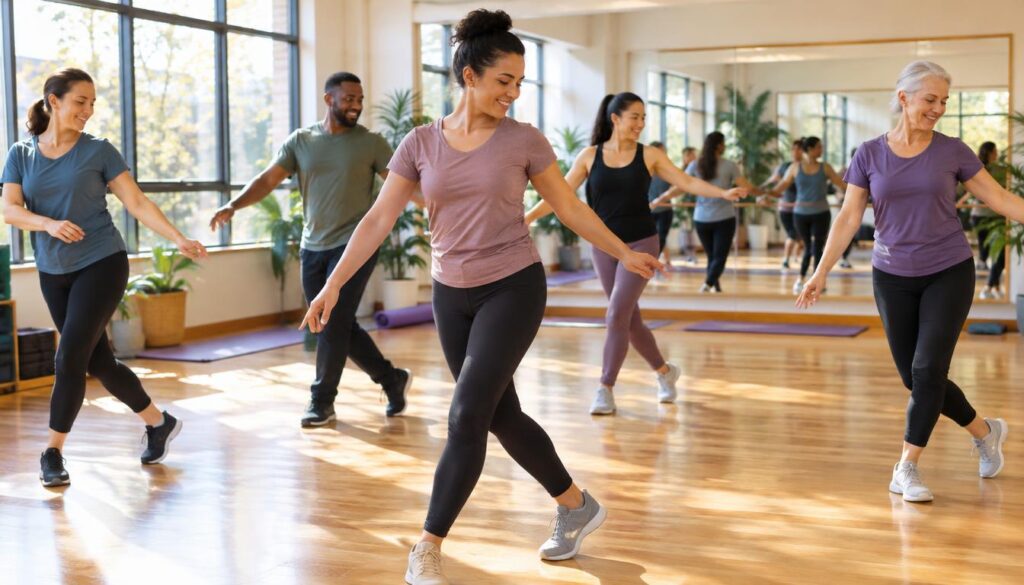
Step instead of jumping, reduce your arm or leg range of motion, or choose a slower pace. These low-impact modifications can keep a sequence familiar while reducing its demands.
Some low-impact routines already avoid jumps, but you can still change individual moves. A smaller step may feel more controlled than a deep lunge or quick pivot.
Use effort cues before chasing speed
At moderate intensity, your breathing and heart rate rise while you can still talk. If you can’t say a short sentence, slow down or take a brief recovery break.
Speed can make a routine feel exciting, but control matters more than keeping up. Increase duration or intensity gradually, rather than adding several harder changes at once.
Support your joints with form, footwear and recovery
Use supportive footwear suited to the surface, and keep your steps controlled. Shoes that grip too much on a turning surface can make pivots feel awkward.
Check this safety list before starting:
- Use supportive footwear suited to the surface.
- Clear the floor.
- Prioritize controlled steps and comfortable form.
- Stop if you feel sharp pain, dizziness, or unusual shortness of breath.
Joint-friendly exercise should allow recovery between harder sessions. Safe scaling also helps you decide how often and how long to dance.
How Do You Build a Weekly Dance Fitness Plan?
U.S. guidelines recommend 150 minutes of moderate-intensity aerobic activity each week for overall health. Dancing can count toward that total.
You do not need to reach 150 minutes through dance alone. If you are new to exercise, use walking or another moderate activity to fill gaps as you build up.
Start with sessions you can recover from, then add time or another day when the current week feels manageable. The example below pairs dance with strength workouts, walks, and recovery.
| Week | Dance sessions | Dance duration | Other activity and recovery |
|---|---|---|---|
| Week 1 | Two sessions | 20 minutes each | Two 30-45-minute strength workouts, walks, and rest or recovery days between dance sessions |
| Week 2 | Two sessions | 20-30 minutes each | Two 30-45-minute strength workouts, walks, and recovery days |
| Week 3 | Three sessions | 30 minutes each | Two 30-45-minute strength workouts, walks, and rest or recovery days |
| Week 4 | Three sessions | 30-40 minutes each | Two 30-45-minute strength workouts, walks, and recovery days |
The detailed example includes optional rests where shown. If your recovery is poor, hold at an easier week rather than following the calendar at any cost.
You can split moderate activity across the week and use intervals if that suits your routine. You don’t need a heart rate monitor or specific heart rate zones to begin.
Pay attention to your breathing, energy, and how you feel after each session. Heart rate monitoring can offer another measure, but a device should not replace those basic cues.
Rest or recovery days give your body time between dance sessions. Strength work adds another useful part of the week and can make the overall plan more balanced.
Why Add Strength Training to Dance Workouts?
Dance cardio and strength training complement each other. Dance can challenge your heart and muscles, while dedicated strength work gives you a planned way to train major muscle groups.
Aim for a couple of strength workouts each week that address all major muscle groups. This work complements dance cardio rather than replacing it.
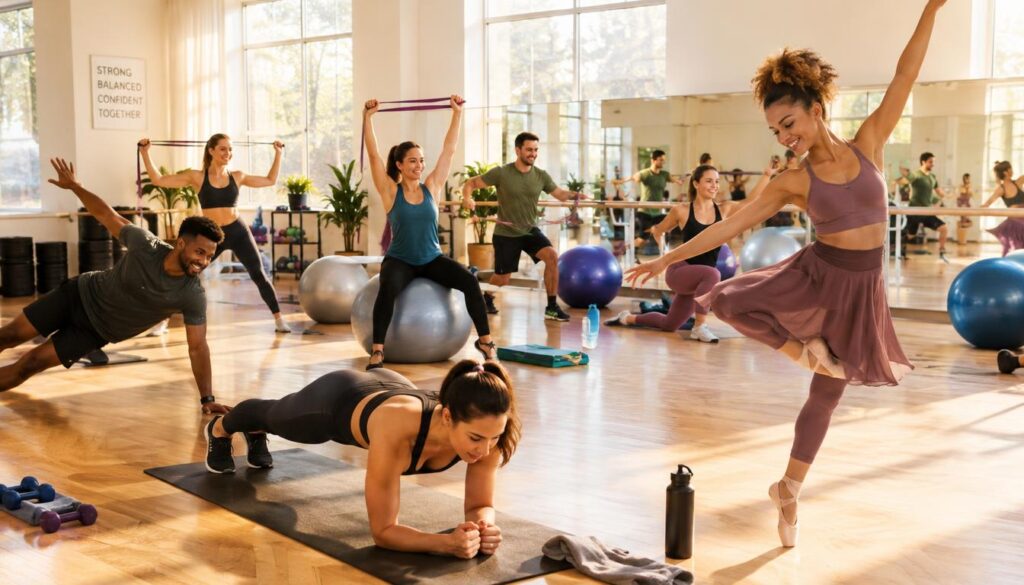
Dance movement can build muscular endurance as you repeat steps, reaches, and turns. Strength exercises let you focus on controlled resistance and functional strength for everyday tasks.
Include work for these areas:
- Abdominal and core muscles
- Arms and upper body
- Glutes
- Other leg muscles
Core strength exercises can be one part of a broader plan, not the whole routine. Dance may affect full-body muscle tone, but it cannot promise a specific look or degree of change.
A balanced plan can pair a class with at-home strength work, or fit both into a gym schedule. You can do the routine in a class, at home, or with a mix of both.
Where Can You Do Dance Workouts at Home or in a Group?
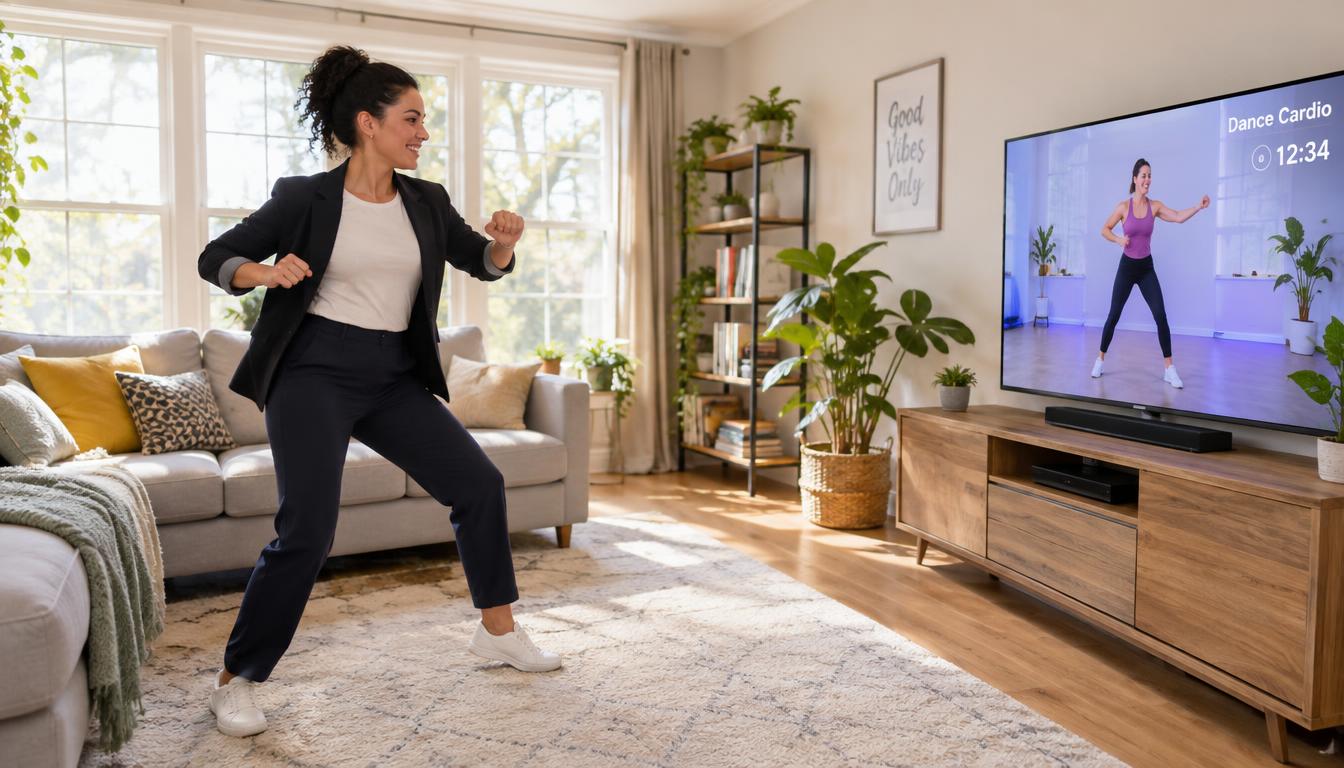
You can join an in-person class or press play at home. Both settings support dance workouts, so choose based on convenience and the guidance you prefer.
A group is an option, not a requirement. Compare how each format provides instruction, flexibility, and social contact.
| Format | Where or how it works | Guidance or social setting | Best fit |
|---|---|---|---|
| In-person class | Gym or athletic center | Instructor-led group | Readers who value shared class energy |
| Online class | At home using an online workout | Instructor guidance through the screen | Readers who want a scheduled routine at home |
| Self-curated playlist | At home or wherever you have safe space | Self-directed | Readers who want flexible dance breaks |
| Interactive dance video game | At home with friends or family | Game-led and social | Readers who enjoy a playful group option |
Home routines can come from a playlist, an online class, or short dance breaks between other tasks. You can use aerobic exercise at home without following a live instructor.
A class provides a shared rhythm, while self-directed rhythm-based training lets you choose the songs and pace. Interactive options can add a playful challenge with friends or family.
Choose the setting that makes it easiest to return. No matter where you dance, track a few simple signs of progress.
How Can You Tell Your Dance Fitness Is Progressing?
You may follow a routine with fewer pauses than before. Smoother steps can show progress even without a heart rate device.
Notice how your movement and recovery change over time, rather than judging a session by a calorie estimate. Progress can show up in several small ways.
Use your ability to move, recover, and return to class as progress markers, not a calorie number alone.
You might maintain comfortable effort for longer, recover more easily between sessions, or move with better balance and coordination. Rhythm and coordination can also improve as familiar sequences become easier to follow.
Calorie expenditure differs between people and sessions, so a tracker’s number is an estimate, not proof of success. No single calorie-burn figure applies to every dance workout.
Do not increase duration, frequency, and intensity all at once. Persistent pain or poor recovery are reasons to scale back and rest more.
Let consistency and enjoyment shape your next step. If you finish sessions feeling ready to return, a small increase may be more realistic than a major jump.
Conclusion
Choose a dance style that feels enjoyable and manageable. Adjust the intensity to match your current ability, then add strength work and recovery as your routine grows.
Start with one short, beginner-friendly routine this week. Schedule a recovery day, keep the first week modest, and put your first session on your calendar.