Do you want to build strong physical power without moving much or using heavy weights? Many think you need to keep moving to get stronger. But true structural integrity often comes from staying still. Using static tension lets you rebuild strength without weights and keeps your body safe from injury.
This guide shows how Shaolin isometric holds change your workout routine. These methods use intense, sustained muscle work rather than big movements. Whether you’re looking for horse stance benefits for your core or a wall sit for knee stability, these techniques lead to lasting gains.
Choosing low-impact strength training helps you heal from injuries or fight the harm of sitting too much. You’ll learn to integrate these ancient practices into your daily life to boost your strength-training efforts. Get ready to discover a new level of physical strength through stillness.
Key Takeaways
- Static tension builds deep muscle fiber engagement without joint impact.
- Isometric training is an ideal method to rebuild strength without weights.
- Specific poses, such as the horse stance, provide significant core and leg benefits.
- Wall sits are highly effective for improving knee stability and alignment.
- Low-impact strength training supports long-term joint health and injury prevention.
The Science of Static Tension and Shaolin Isometric Holds
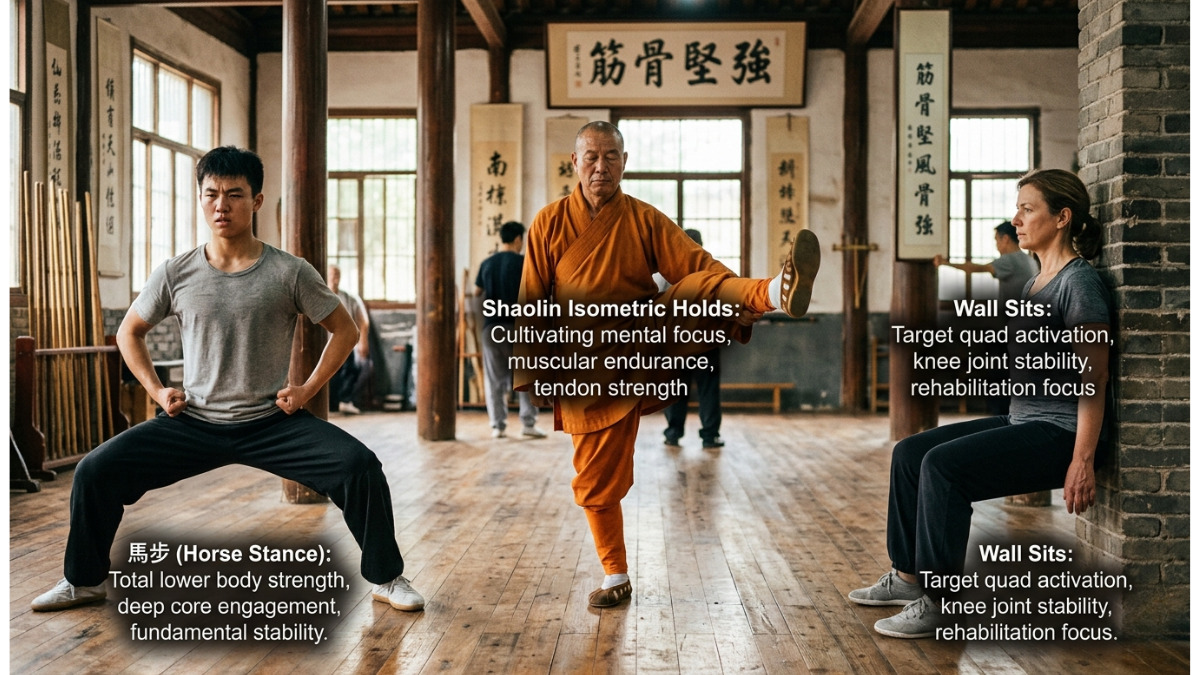
Shaolin monks know that true power comes from stillness, not movement. By doing shaolin isometric holds, you join a long tradition of traditional Chinese training that values strength. These methods, from traditional Chinese martial arts, build strength in a way that’s different from modern gyms.
Why Stillness Builds Profound Strength
Isometric exercises keep your muscles tight without moving. This way, more muscle fibers are used than in many other exercises. These Shaolin exercises build endurance that’s hard to get with weights alone.
Adding martial arts isometrics to your Shaolin workouts helps find and fix weak spots in your posture. Holding a position strengthens your body’s ability to stay stable. This builds functional strength that helps in all sports.
The Role of Tendon Loading in Joint Health
One big plus of this practice is the isometric tendon exercises. Unlike lifting, which mainly works muscles, static holds strengthen tendons and ligaments. This is key to keeping your joints healthy.
These traditional Chinese exercises focus on the glute-ankle connection, which helps absorb shock. Strengthening these areas lowers your injury risk. You’re making your joints more resilient against daily wear and tear.
Understanding the Mind-Body Connection in Shaolin Training
The mind-body connection is crucial in Shaolin Kung Fu techniques. It’s what turns simple stillness into explosive power. The mind controls tension in the body, making a basic hold into a powerful training session.
Using shaolin meditation techniques helps stay calm even when muscles shake. This mental focus is key in holistic fitness practices. As you get better at these Shaolin training techniques, you’ll see your physical limits are mostly about focus and intent.
Mastering the Horse Stance for Lower Body Power
Learning the Horse Stance is key for those serious about martial arts strength training. Known as Ma Bu, it’s a core move in Shaolin Kung Fu techniques. These isometric exercises build endurance that fast movements can’t match.
Correct Alignment and Posture Mechanics
Start by standing with your feet about double shoulder-width apart. Point your toes forward. Lower your hips until your thighs are almost parallel to the ground, making a stable base.
Keep your back straight and chest open for good spinal alignment. Your weight should be evenly spread on both legs. Don’t lean to one side, as this lessens the stance’s effectiveness. Maintaining this rigid posture is crucial for developing the strength required for advanced training.
Maximizing Horse Stance Benefits for Stability
The benefits of the horse stance go beyond just muscle fatigue. Holding this stance works the deep stabilizers of the hips and core. These horse stance benefits include better posture and a stronger connection to the ground.
“The strength of the tree is found in the depth of its roots, just as the power of the warrior is found in the stillness of the stance.”
Try different horse stance variations to challenge your muscles more. Whether you hold it for thirty seconds or several minutes, focus on balance and stability exercises. Regular practice boosts your power in everyday activities.
Common Mistakes to Avoid During Your Hold
Many beginners make mistakes that hinder their progress. One common error is letting the knees cave inward, which strains the joints. Make sure your knees stay over your toes to protect your joints.
Another mistake is leaning too far forward, which takes the load off your legs. Keep your spine straight to get the most out of leg strength exercises. Fixing these posture issues unlocks the full potential of your martial arts strength.
Wall Sit for Knee Stability and Structural Integrity
Mastering the wall sit is a safe, effective way to strengthen the ligaments around your knee. It’s great for anyone wanting to boost knee stability or recover from injuries. By sitting still, you build strong lower-body muscles without harming your joints.
Setting Up the Perfect Wall Sit for Knee Stability
Start by standing with your back against a strong wall. Slowly slide down until your thighs are parallel to the floor. Make sure your knees are directly above your ankles.
Keep your feet shoulder-width apart for better lower-body stability exercises. Hold a neutral spine and press your lower back into the wall. This is key for knee strengthening. Breathe deeply while holding to keep your quadriceps tense.
Progressing from Basic Holds to Advanced Variations
When you can hold a standard wall sit for 60 seconds, try new wall-sit variations. Lift one heel off the ground or place a weight on your lap for more challenge.
These leg-strengthening techniques help you grow beyond basic endurance. Adding these drills keeps your progress steady. Always focus on proper form to avoid injury.
Why This Exercise is Essential for Injury Recovery
The wall sit is a top knee strength exercise for injury recovery. It’s a static movement that builds muscle without the impact of running or jumping. It’s a key part of many knee stability drills to protect the joint.
If you’ve been sitting a lot, this exercise helps you safely build your lower-body strength. It strengthens the tissues that support your knees during everyday activities. Use the table below to track your progress through different levels.
| Variation | Difficulty | Primary Focus |
|---|---|---|
| Standard Wall Sit | Beginner | Basic Endurance |
| Single-Leg Hold | Intermediate | Unilateral Stability |
| Weighted Wall Sit | Advanced | Muscle Hypertrophy |
| Heel-Raise Hold | Advanced | Calf and Knee Integration |
Developing a Rock-Solid Core with the Hollow Body Hold
Learning the hollow body hold changes how you handle tension and stability. It’s a key move for building a rock-solid core that supports your body. Adding this exercise to your routine makes your center more stable, improving your performance in all activities.
Engaging the Deep Transverse Abdominis
To do this move right, focus on the deep transverse abdominis. Lie flat on your back and press your lower back into the floor. This eliminates any gap between your spine and the ground, activating your core.
This is the base of your core strength. Keeping this contact forces your deepest abdominal muscles to work harder. It’s a key part of isometric strength training, aiming to build internal pressure without moving.
“True strength is not found in the speed of your movement, but in the intensity of your stillness.”
Techniques for Maintaining Tension Without Movement
Keeping constant tension is key to success in these static strength exercises. Press your back down, then lift your shoulders and legs slightly. Extend your arms overhead to make it harder.
You’ll feel your midsection shaking as you try to hold it. This means your muscles are getting stronger. Adding these Shaolin exercises to your fitness routine boosts control, which dynamic movements often lack.
Scaling the Difficulty for Beginners and Athletes
Adjust the intensity of the hollow-body hold to suit your fitness level. Beginners should keep their knees toward their chest and lower back pressed down. This makes it safer to build core strength.
As you get better, extend your legs until they’re straight. Athletes can move their arms closer to their ears or hold it longer. These bodyweight workouts follow the principles of traditional Chinese exercises, focusing on structure over ego. Regular practice of these Shaolin workouts will give you a strong core for life.
Full-Body Tension with the Bear Crawl Hold
If you want to boost your martial arts conditioning, try the bear crawl hold. This move keeps you in a four-legged stance, requiring your entire body to stay stiff. Adding it to your bodyweight workouts builds strong martial arts strength.
Establishing a Stable Base of Support
Start by placing your hands under your shoulders and your knees under your hips. Lift your knees an inch off the ground to start the bear crawl hold. Keeping this position steady is key to good isometric training.
Keep your spine straight and look a bit ahead of your hands. A solid base stops energy loss and keeps muscles working hard. This static stance is key to martial arts fitness.
Distributing Tension Across Shoulders and Hips
The key to this hold is evenly distributing the tension. Push the ground away with your hands and engage your glutes and core. This makes a strong, united structure that supports your joints.
Sharing the load between your shoulders and hips stops one area from getting too tired. This method is crucial in martial arts training because it mirrors the structural needs of combat. Right tension lets you stay firm even when shaking.
Breathing Patterns for Sustained Isometric Effort
Many struggle because they hold their breath during martial arts isometrics. Instead, focus on steady, controlled breathing. Deep breaths help manage internal pressure and delay fatigue.
Use your exhale to tighten your core during tough moments. Getting this breath control right boosts your endurance in martial arts training. Staying calm under pressure unlocks your isometric training and martial arts fitness potential.
Building Upper Body Resilience with the Isometric Push-up
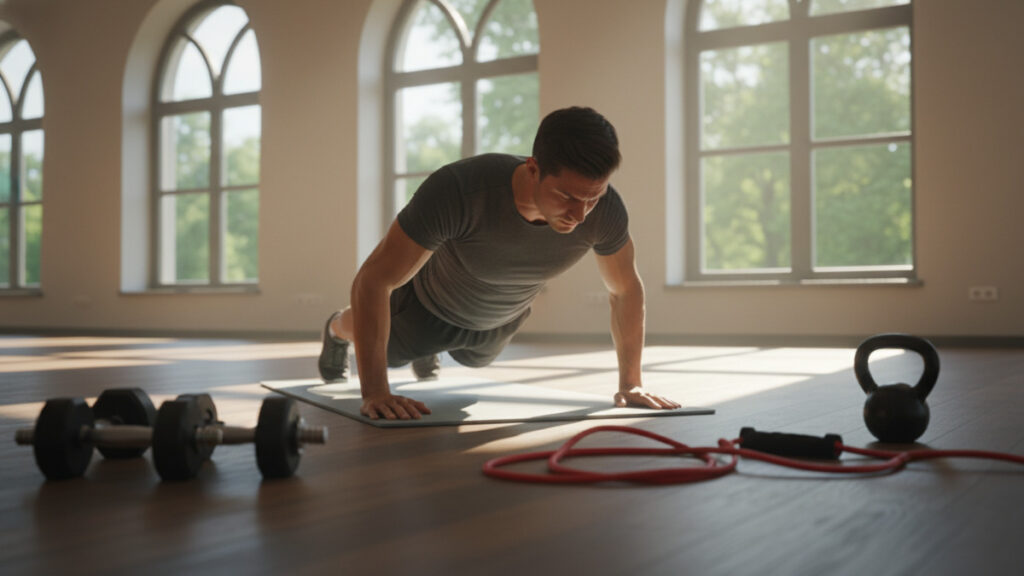
Building strong upper body muscles needs more than just doing the same thing over and over. The isometric push-up is a key to success. It makes your muscles work hard against gravity without any help from movement.
Targeting Chest and Shoulders Through Static Loading
The isometric push-up focuses on your chest and shoulders. It does this by applying intense pressure. By holding at the hardest part, your muscles and tendons get stronger.
Unlike regular exercises, static strength keeps your muscles tight continuously. This is key for isometric training. It helps your tissues grow stronger over time.
Finding Your Optimal Depth for Joint Safety
When you do resistance training, safety is very important. You need to find the right depth to protect your joints while getting stronger. Going too deep can hurt your shoulders.
Pay attention to your body to find the right spot. It’s like doing knee-stability drills or knee-strengthening exercises. Staying in a safe, controlled spot helps you get the most out of the exercise without getting hurt.
How to Use Shaking as a Metric for Growth
When you do a push-up, you might start to shake. Many think this means they’re failing. But it’s actually a sign of getting stronger.
The shake means your body is using all its muscles to hold the position. Seeing this shake is a good thing. It shows you’re pushing yourself safely. Just like knee strength exercises show progress in your legs, the shake shows you’re getting stronger in your upper body.
Essential Training Principles for Long-Term Success
Follow these key guidelines for isometric training to unlock your body’s full potential. A disciplined approach helps you progress steadily and keeps your joints safe from harm.
The Importance of Short Starting Durations
Starting with patience is crucial when you begin low-impact strength training. Begin with holds of 15 to 30 seconds. This lets your tendons adjust to the new demands.
This slow start is key to safely rebuilding strength without weights. Short sessions prevent overworking your tissues while still stimulating growth.
Why Controlled Breathing is Your Greatest Tool
Controlled breathing is your main tool for managing intensity. Deep, rhythmic breaths calm your nervous system during holds.
This method is a core part of traditional Chinese training. It keeps you focused during each session. Here are the benefits of mindful breathing:
- Reduces muscle tension in areas not involved in the hold.
- Stabilizes your heart rate during high-intensity static efforts.
- Enhances mental clarity, which is essential for mastering strength training.
Establishing Daily Consistency for Structural Rebuilding
True change comes from daily dedication. A daily routine rebuilds your structure from the inside out.
These Shaolin training techniques focus on small, frequent efforts. This approach honors traditional Chinese martial arts. It ensures your strength training journey builds lasting resilience and improves joint health.
Integrating Static Holds into Your Existing Routine
You can make your workout routine better by mixing old movements with new ones. Adding Shaolin martial arts to your martial arts training makes your muscles and tendons stronger. This way, you get ready for both quick bursts of power and long holds.
Balancing Isometrics with Dynamic Movement
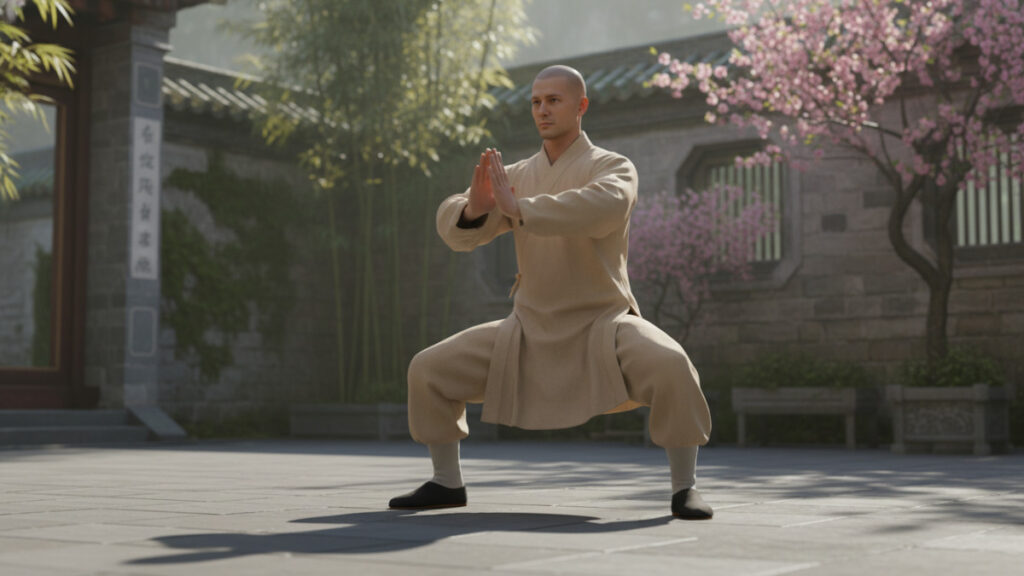
Success comes from mixing static holds with your active exercises. For example, do horse stance variations after squats to better target your muscles. These Shaolin kung fu techniques offer a special challenge that regular lifting doesn’t.
Using the benefits of the horse stance helps keep your joints stable before harder moves. This mix helps you keep good form throughout your workout. Your endurance will grow as you connect stillness with movement.
Creating a Progressive Overload Schedule
To keep improving, treat your isometric workout routine as seriously as you treat your weightlifting. Start with short holds, like 20-30 seconds. As you get stronger, try wall sit variations to test your balance at different angles.
Keep track of how long you hold each week. Increase the time or how hard you hold to keep your body adapting. This plan stops you from getting stuck and keeps your workouts exciting.
Listening to Your Body During Recovery Phases
True martial arts conditioning means knowing your limits well. Rest is key to letting your tendons and nerves heal from the hard work of static holds. Using Shaolin meditation techniques helps you stay in tune with your body and catch signs of overtraining early.
Building a strong mind-body connection is key to lasting health and avoiding injuries. If you feel too much pain or tiredness, slow down. Remember, resting is not weak; it’s a must for building lasting strength.
| Training Method | Primary Focus | Recovery Need |
|---|---|---|
| Dynamic Lifting | Explosive Power | Moderate |
| Static Isometrics | Structural Integrity | High |
| Martial Arts Fitness | Holistic Conditioning | Balanced |
Conclusion
Shaolin isometric holds are a special, low-impact way to build your strength. They help you get stable without needing big gym machines.
Sticking to this workout routine changes your tendons and joints for good. It’s great for athletes looking to improve or for people recovering from injuries. These exercises strengthen you from the inside.
Adding wall sit exercises to your morning routine boosts your endurance. These exercises are part of a holistic fitness approach. They connect your mind and body, strengthening your core.
Make this workout a regular part of your life to become more resilient. Begin your journey today. Your body will thank you with more strength and a longer life.