Regular exercise can support obstructive sleep apnea (OSA) treatment, even if weight loss isn’t your goal. Movement matters, but it does not clear every blocked airway during sleep.
Whole-body activity and targeted mouth and throat practice may add to your care. Neither approach replaces prescribed CPAP or oral appliance therapy. Benefits differ from person to person, and exercise is not a cure.
You may be looking for a way to sleep better, feel less tired, or support treatment without relying on weight loss alone. A steady routine can help your general health, and some people with OSA also see changes in symptoms. Your clinician can help you choose activity that fits your health and treatment plan.
Key Takeaways
- Exercise can support OSA care, but results vary.
- Keep using prescribed treatment unless your clinician changes it.
- Cardio and strength work can build fitness.
- Myofunctional therapy trains mouth and throat muscles while you are awake.
- Sleep testing, not snoring alone, helps clinicians assess OSA.
To understand where exercise may fit, first look at how OSA interrupts breathing and how clinicians measure its severity.
What Happens During Obstructive Sleep Apnea?
During a breathing pause, relaxed tissue narrows or blocks your upper airway while you sleep. Each blockage can disrupt sleep, and repeated events may lower oxygen levels.
A sleep study can help diagnose OSA and measure its severity. The apnea-hypopnea index (AHI) is the number of breathing pauses and reduced-breathing events you have per hour of sleep.
A sleep study can help diagnose OSA and measure its severity.
How airway blockage disrupts sleep
Your throat muscles relax as you sleep. In OSA, the airway can narrow or close repeatedly, despite your body’s effort to breathe.
These events can briefly wake you, even if you don’t remember waking. The resulting sleep fragments may leave you tired during the day. Upper airway resistance can also make breathing harder without a full blockage.
What an AHI result tells you
A home sleep apnea test or an in-lab sleep study can record breathing events. A clinician interprets your sleep study results with your symptoms and health history.
Common AHI ranges define mild OSA as 5-14.9 events per hour, moderate OSA as 15-30, and severe OSA as more than 30. These ranges describe event frequency, not your entire health or sleep experience.
Your clinician can explain what the result means for you and discuss care options. Regular activity may also affect OSA in ways that do not depend only on body weight.
How Can Exercise Affect Sleep Apnea?
A walk can strengthen your heart and lungs without directly removing an airway blockage. That indirect support may still matter for sleep and health.
Researchers propose several ways activity could affect OSA, but no single pathway explains every person’s results. Human mechanisms are not fully established.
Changes that may help keep the airway open
Exercise may affect the activity of muscles that help hold the upper airway open. Stronger or better-coordinated upper-airway dilator muscles could support airflow, but this effect is not guaranteed.
Activity may also change sleep architecture, or the pattern of sleep stages across the night. Some people may gain better cardiorespiratory fitness, which helps the body use oxygen during effort. Changes in systemic inflammation have also been proposed.
How movement may reduce fluid pooling
When you lie down, fluid can move from your legs toward your chest and neck. This nocturnal fluid shift may add pressure around the airway for some people.
Regular movement may support circulation and affect fluid balance. This is one possible explanation, not a proven cause of improvement for everyone.
- Airway muscle activity: training may support muscles that help keep the airway open.
- Sleep changes: activity may affect sleep stages and sleep continuity.
- Circulation and fluid movement: movement may affect fluid pooling as you lie down.
- Changes associated with body weight: activity may affect weight, which can matter for some people.
These proposed links help explain why exercise might help beyond weight changes. Studies and symptom reports offer another way to judge what activity may do.
What Benefits Can Exercise Provide?
Regular exercise may improve OSA severity and daytime sleepiness, but the size of the change differs. Some people improve, while others see little change.
Exercise does not guarantee a lower AHI or better sleep for everyone. Reports often describe AHI reductions of 20%-30% or more, but individual results vary.
A review found a mean AHI difference of -7.36 events per hour with combined aerobic and resistance training. Aerobic training alone showed a mean difference of -4.36 events per hour.
These figures describe group averages, not a promise about your test result. Exercise plans and study methods differ, so you may see less change or none.
One dose-response analysis linked 70-100 minutes of aerobic activity each week, spread over 3-5 days, with maximal benefit. This range is not a proven OSA prescription for every person.
Physical activity may improve sleep efficiency, or the share of time in bed spent asleep. It may also support slow-wave sleep, reduce daytime sleepiness, and raise peak oxygen consumption, a measure of fitness.
Some people may notice sleep apnea symptom relief without losing weight. Better fitness can still help even if your AHI doesn’t change, and exercise isn’t a cure.
Possible gains in sleep apnea deep sleep and energy are reasons to build a routine you can keep. A practical week can pair cardio with strength work.
Exercise for Sleep Apnea, Obstructive Sleep Apnea Exercise, Sleep Apnea Workouts: What Should You Do?
A workable week can pair brisk walking or another cardio choice with strength sessions. Start where you are, then add time as your body adjusts.
A practical target is 150 minutes of aerobic activity and resistance training 2-3 days per week. This is a general routine, not a proven OSA-specific prescription.
Which workouts are most effective?
No single workout is proven best for everyone with OSA. Choose activities that fit your health, access, and interests so you can keep doing them.
Brisk walking, cycling, swimming, and jogging are accessible aerobic activities. If walking feels best, try a flat route before adding hills or speed.
Resistance training for sleep apnea can use bodyweight moves, bands, or weights. Chair squats, wall pushups, and light dumbbells can work different muscle groups.
Weightlifting for sleep quality may support strength and fitness, but it does not treat airway blockage on its own. Short, comfortable sessions are a sensible start if you have not exercised lately.
How to fit cardio and strength training into a week
The schedule below reaches 150 minutes of cardio and includes three strength days. Adjust it to your fitness level, health needs, and your clinician’s advice.
| Day | Aerobic activity | Resistance training | Myofunctional practice |
|---|---|---|---|
| Monday | 30 minutes | Yes | 10 minutes |
| Tuesday | 30 minutes | No | 10 minutes |
| Wednesday | 30 minutes | Yes | 10 minutes |
| Thursday | 30 minutes | No | 10 minutes |
| Friday | 30 minutes | Yes | 10 minutes |
Saturday and Sunday can be recovery days or times for gentle movement, such as an easy walk. You do not need to make up a missed workout by doubling the next one.
Daily movement for sleep apnea can include taking the stairs or walking during a break. Choose a pace that lets you speak in short sentences, and build gradually.
Whole-body training can sit alongside mouth and throat practice. The next exercises focus on those smaller muscles.
Which Throat and Tongue Exercises Can You Try?
These exercises train mouth and throat muscles while you are awake; they do not hold your airway open during sleep. Practice is training, not a substitute for OSA care.
Discuss myofunctional therapy exercises with a clinician or trained myofunctional therapist. Myofunctional therapy is structured training for the tongue, face, and throat muscles.
A therapist can help you use the right motion and avoid strain. The table below lists three basic oropharyngeal exercises that train the muscles around the mouth and throat.
Tongue exercises for control and strength
Move slowly and stop if you feel pain. Tongue-strengthening exercises should feel controlled, not forced.
| Exercise | How to perform it | Repetitions |
|---|---|---|
| Front-to-back tongue slide | Place the tongue tip behind the upper front teeth and slide it backward along the palate. | 5-10 times |
| Tongue-to-palate press | Press the whole tongue to the roof of the mouth and hold for 10 seconds. | 5 times |
| Vowel sounds | Say A-E-I-O-U clearly, keeping each sound distinct. | 10-20 times each |
The tongue slide works on control along the roof of your mouth. The press asks the full tongue to hold steady against the palate.
Soft-palate and throat exercises
For an “ah” soft-palate lift, open your mouth and say “ah” clearly. Aim to lift the soft palate, hold for about five seconds, and repeat 5-10 times.
Vowel sounds also engage the soft palate and throat. Singers use similar mouth shapes, but singing is not a proven stand-alone OSA treatment.
Nasal and diaphragmatic breathing practice
For alternating nasal breathing, gently close one nostril and exhale through the open nostril. Switch sides and continue for about 10 breaths.
For diaphragmatic breathing, inhale through your nose while your abdomen moves outward. Practice for 5-10 minutes without forcing deep breaths.
Oropharyngeal exercise routines are commonly practiced for at least 10 minutes daily over about three months. Many people split practice into two or three sessions each day.
One reported result was a 39% reduction in apnea events after three months, but you should not expect the same result. Consistency takes time, so plan how to practice and judge progress realistically.
How Often Should You Practice, and When Might You Notice a Change?
Regular practice over weeks matters more than the exact time of day. Keep it steady, and use a routine that fits your day.
Mouth and throat training is often done for about three months, with at least 10 minutes daily. Many people divide that time into two or three short sessions.

Some people report changes within 2-4 weeks, but improvement is not assured. Tongue exercises for snoring and throat toning exercises may support muscle practice, but they do not guarantee less snoring or fewer OSA events.
You can do sleep apnea exercises before bed if that time suits you. Practice doesn’t have to happen at bedtime, and late practice isn’t known to work better.
Singing and clearly repeating vowel sounds engage mouth and throat muscles. Searches for “five anti-snoring exercises that really work” can suggest certainty that no exercise routine can promise.
Try tracking practice, snoring, daytime sleepiness, and sleep quality in a simple note. This helps you notice patterns without relying on memory alone.
Use the same simple record for diaphragmatic breathing exercises and other practice. Weight change is one possible part of care, not the only route to exercise benefits.
Can Exercise Help Even If You Do Not Lose Weight?
Weight loss is not required for every exercise-related benefit. Your effort still counts when your body weight stays the same.
Exercise may support fitness and sleep even without significant weight loss. Excess weight can narrow the airway for some people, but it is not the only cause of OSA.
When weight management may help
Weight management may be one part of a clinician-guided plan when it fits your health needs. Changes in body weight affect people differently, and weight loss alone does not cure OSA.
Losing 20 pounds does not guarantee a cure for OSA. The effect depends on the person and diagnosis, and OSA may remain after weight changes.
Benefits that may occur without weight loss
Exercise can build strength and stamina even if the scale does not change. Some people also find that regular movement supports mood and daily energy.
For manageable progress, choose options that fit your current routine:
- Take regular walks, even if each walk is brief.
- Increase activity gradually, rather than making sudden large changes.
- Add resistance training with bodyweight moves or suitable weights.
- Seek individualized nutrition or medical guidance if weight management is your goal.
Weight management for snoring may help some people, but no one needs to earn the right to exercise by losing weight first.
Position and other nighttime factors can also change airflow, so notice how your sleep habits affect your breathing.
Which Sleep Positions and Habits Can Affect Your Breathing?
For some people, snoring or breathing interruptions become more noticeable when they sleep on their backs. Position can matter, but it does not explain every case.
Side sleeping or clinician-guided positional therapy may help when OSA is position-dependent. A position change is not a substitute for diagnosis or prescribed care.
Supine sleeping, or sleeping on your back, can worsen obstruction for some people. Sleep position therapy is most relevant when testing shows that events cluster in that position.
Use these checks to guide a conversation about your sleep:
- Notice whether snoring or breathing symptoms change with your position.
- Discuss positional therapy if your events cluster while you sleep on your back.
- Talk with a clinician about nasal congestion that makes breathing difficult.
- Avoid alcohol or sedatives near bedtime unless a clinician advises otherwise.
A pillow trick is not a proven cure. A pillow can affect comfort or position, but your pillow choice cannot establish or treat an OSA diagnosis.
Positional therapy for snoring may help some people, but its effect depends on the cause of their symptoms. These habits fit alongside, not instead of, established OSA treatments.
How Should Exercise Fit With CPAP or an Oral Appliance?
Exercise belongs alongside prescribed treatment, not in place of it. Keep treatment in place unless your clinician recommends a change.
Do not stop or change prescribed CPAP or oral appliance treatment without your clinician’s guidance. Exercise can support health, but it does not reliably keep your airway open during sleep.
Keep prescribed treatment in place
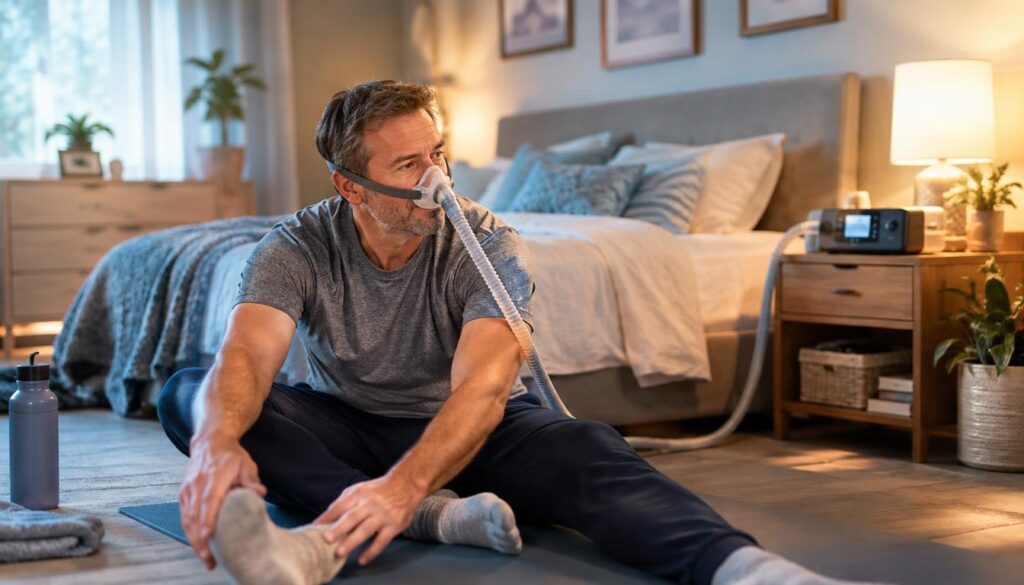
Continuous positive airway pressure (CPAP) sends pressurized air through a mask to help keep your airway open while you use it. Adherence to continuous positive airway pressure matters because the treatment works during use.
A custom oral appliance may suit some people. It positions the jaw or tongue to support airflow during sleep, and a clinician can check its fit.
Combine exercise with airway treatment
Exercise can improve fitness and may improve OSA outcomes for some people. It is an added support, not an alternative to prescribed airway treatment.
| Approach | Main role | How it fits with exercise |
|---|---|---|
| CPAP | Provides positive airway pressure to keep the airway open during use. | Continue as prescribed while exercising. |
| Oral appliance | Positions the jaw or tongue to support airflow during sleep. | Use as prescribed and review fit with a clinician. |
| Exercise | Supports fitness and may improve OSA outcomes. | Add it to, rather than substitute it for, prescribed treatment. |
CPAP exercise benefits can include stronger general fitness, but they don’t guarantee better mask use. Activity may support overall well-being and treatment adherence, but it does not ensure easier CPAP use.
Your full plan should be judged by symptoms and clinical follow-up, not exercise alone. You and your clinician can assess whether the plan is working.
How Can You Track Progress and Review Your Treatment?
A brief weekly record might note three walks, two practice sessions, snoring, daytime sleepiness, and treatment use. Small notes can reveal patterns over time.
A sleep diary or wearable can track patterns, but neither can diagnose OSA or replace a sleep study. Snoring alone also cannot show whether treatment works.
Record exercise sessions and mouth-exercise practice along with sleep and daytime symptoms. Note whether you used prescribed treatment, and whether anything made it hard to use.
A wearable may estimate sleep or movement, but those readings are not a diagnosis. Home natural sleep apnea tips, including breathing practice, cannot confirm that OSA has improved.
Discuss persistent symptoms, difficulty breathing through your nose, or poor treatment tolerance with your clinician. Nasal congestion management may help comfort, but your clinician should review ongoing trouble breathing through your nose.
Nasal breathing exercises may help you practice breathing patterns, but they do not prove that airway blockage has stopped. Your clinician can review your symptoms and decide whether you need further assessment.
Get medical attention for symptoms that feel severe or unsafe rather than waiting for a diary to show a pattern. The next section covers signs that warrant an OSA assessment.
When Should You Get Medical Advice?
Waking up gasping or feeling dangerously sleepy during the day is a reason not to rely on home exercises alone. Seek an assessment if possible OSA is affecting your sleep or safety.
Discuss possible OSA with a healthcare professional if you have loud snoring with gasping, choking, or snorting. Other reasons include marked fatigue, morning headaches, high blood pressure, or changes in mood, attention, or thinking.
Waking up gasping or feeling dangerously sleepy during the day is a reason not to rely on home exercises alone.
- Loud snoring with gasping, choking, or snorting during sleep.
- Notable daytime sleepiness or fatigue that affects daily life.
- Morning headaches or high blood pressure.
- Changes in mood, attention, or thinking that concern you.
Snoring alone does not prove OSA. A clinician can recommend testing and care based on your symptoms and health history.
Stop an exercise that causes pain. Ask a qualified professional about jaw soreness or tongue fatigue during mouth and throat practice.
Choose one manageable activity to start, then discuss it alongside your symptoms and treatment with a healthcare professional.
Conclusion
A sustainable routine can support an individualized OSA care plan. Regular movement and myofunctional practice may help, but results vary.
Prescribed treatment remains important, even when exercise supports your health or symptoms improve. Do not change treatment based on snoring or a home exercise routine alone.
Choose a comfortable first activity, such as a walk, and discuss an exercise and treatment plan with a healthcare professional.