
A spirit guide sleep meditation uses relaxation and intention-setting to make space for a personally meaningful spiritual experience as you fall asleep. It may offer a calm way to meet stress and bring a gentle focus to bedtime.
A sleep intention is a brief focus you choose as you settle in for the night. You might hope to feel supported, or simply welcome a quiet moment with your own thoughts.
A guided sleep meditation can lead your mind away from the day and toward rest. It does not promise that a spirit guide will appear, speak, or send a message. Your experience can be meaningful as relaxation and personal reflection, even without a clear encounter.
The practice offers an invitation, not a guaranteed result. Keep that distinction in mind as you decide what feels right for you.
The practice starts with what it is, then moves into how to set reasonable expectations.
Key Takeaways
- Use relaxation and a modest intention to create a calm focus before sleep.
- You do not need to see or hear anything for the practice to matter.
- Write down a dream or feeling without forcing a message.
- Pause or stop whenever the practice feels uncomfortable.
- Keep spiritual reflection separate from medical or psychological care.
Spirit Guide Sleep Meditation, Guided Sleep Meditation, Connect With Spirit Guide: How the Practice Works
A guided session begins with cues to settle your body and quiet your mind, then moves toward a visualization and an invitation to connect. The pace is gentle, giving you room to drift toward sleep.
You may picture a guide as a person, an animal, or a form of energy. You might sense a supportive presence without seeing a distinct shape. You do not need a clear image or voice for the practice to feel meaningful.
A guide may appear as a person, an animal, a sense of energy, or no distinct image at all. You can still find value in the quiet focus.
Some people imagine a welcoming place before making an invitation. Others follow the spoken guidance and let images come and go without trying to control them.
The word “guide” can mean different things in personal spiritual practice. You might understand it as a spiritual being, an inner symbol, or a comforting idea that helps you reflect.
No single scene is expected for every listener. Your thoughts may stay ordinary, or a memory, feeling, or image may arise as you become sleepy.
Making space to connect with spirit guide imagery does not require a special skill. You can simply listen, breathe at an easy pace, and keep the invitation open.
Different people experience the practice in different ways. Keep your expectations open as you consider what a session may bring.
What Can You Realistically Expect to Experience?
Your experience may feel vivid, subtle, or unremarkable. A session can bring relaxation, emotional comfort, imagery, or intuition, but it may also produce no noticeable spiritual experience.
You might feel warmth, calm, or love in your heart. You may picture energy around you, or notice thoughts fading as sleep approaches. None of these feelings proves that an outside guide sent a message.
Personal interpretations can help you explore what matters in your life. A peaceful image might reflect a need for rest, while a strong emotion might point to something on your mind.
The practice cannot guarantee a specific answer, healing, or a dream. It also cannot establish that an image came from the universe or from a spirit outside yourself.
If you have no clear experience, you have not failed. You may have rested, given your thoughts a break, or simply had an ordinary night.
Try meeting each session with curiosity rather than demanding proof. That leaves room for comfort while keeping your judgment clear.
Let the experience be personal, not a promise. Guided audio can offer a steady path from quiet attention toward sleep.
How Does Guided Sleep Meditation Lead You Into Sleep?
Most sleep tracks begin with spoken guidance and become less directive as you grow drowsy. The shift usually moves from a voice leading your attention to quieter ambient sound.
A track may use body awareness, gentle breathing cues, or a countdown to help you settle. The spoken part can then fade, leaving sounds intended to support rest. Some programs are designed to continue through the night.
Some programs describe their ambient sounds as aimed at the receptive REM stage. REM is a sleep stage linked with vivid dreaming. That design does not promise you will reach a certain stage or receive guidance.
Audio can give your mind one calm focus instead of the day’s loose ends. You can listen from bed, or choose a track that stops after its spoken guidance.
Sound levels matter at bedtime. Set a gentle level before you get drowsy, rather than reaching for your device after you settle in.
A spoken cue may ask you to notice your breath or soften your muscles. You can follow it loosely without making each instruction another task.
Prepare your space and intention before pressing play. That small step can make the change from listening to sleep feel easier.
How Do You Prepare Before Bed?
Choose one gentle question before bed, such as “What would help me feel supported?” One focus is easier to hold than asking for every answer at once.
Your preparation can stay simple. Settle the room, keep a way to record a dream nearby, and make sure your audio is ready before you lie down.
Set a clear intention for the night
Phrase your sleep intention in a few plain words. You might choose, “I welcome a calm sense of guidance,” or “I want to rest with an open mind.”
Keep the intention kind and modest. You are not asking your spirit guides to solve every problem or give instructions you must follow.
Keep a dream journal within reach
Set a dream journal and pen beside the bed before lying down. You can note a few words in the morning without searching for supplies.
A small notebook works well if it opens easily and does not need a bright screen. Write only what you recall; a fragment can be enough.
Choose a comfortable, undisturbed setting
Pick a comfortable position in a quiet place where you are unlikely to be interrupted. Adjust blankets or pillows before you begin so you don’t need to move later.
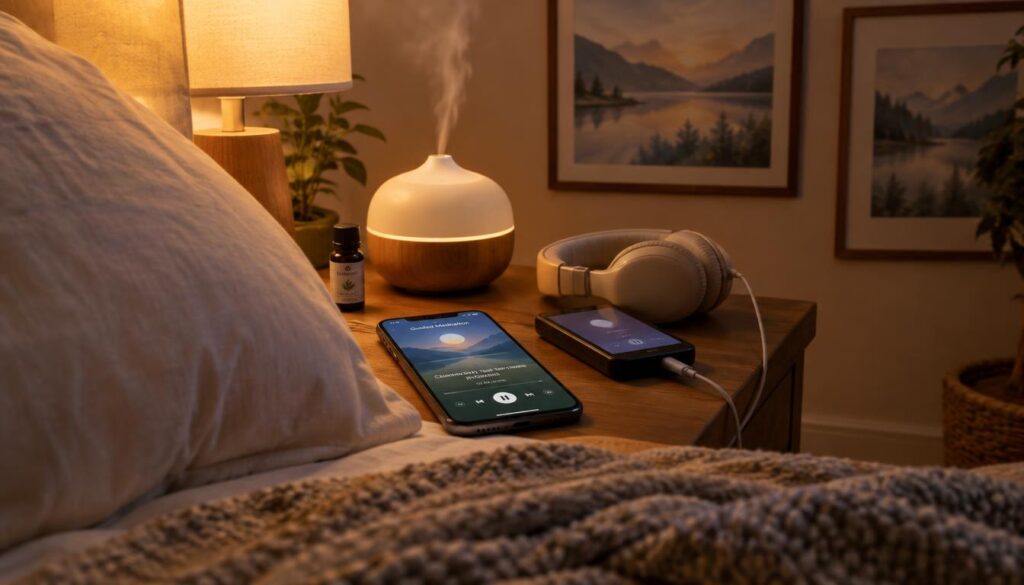
Set up your phone or audio player while you are still alert. Leaving a bright screen on or searching for a journal after you are drowsy can wake your mind back up.
Check these four details before settling in:
- Your intention is clear and gentle.
- Keep your journal and pen within reach.
- Your comfortable position feels easy to maintain.
- Set up your phone or audio before you lie down.
Once everything is set, you can quiet your body with an easy breath and a simple relaxation sequence.
What Relaxation Sequence Can Help You Settle?
Notice whether your exhale can slow and soften. No effort is needed; an easy breath is enough to begin settling.
Move your attention through a few parts of your body rather than trying to relax everything at once. Let each cue feel like an option, not a test.
| Stage | Focus area | Cue | Intended shift |
|---|---|---|---|
| Slow breathing | Breath | Let each exhale feel easy | Less effort |
| Face and jaw | Face | Unclench your jaw | Less tension |
| Shoulders and hands | Shoulders and hands | Let your shoulders sink | More ease |
| Torso and legs | Torso and legs | Feel the bed support you | Less holding |
Let the muscles in your face soften as you unclench your jaw. If your hands feel tight, allow your fingers to rest where they fall.
Notice the bed beneath your torso and legs. You don’t need to push your body down; simply let the mattress hold your weight.
Backward counting can help if daily thoughts keep pulling your attention away. Count slowly from ten, but skip it if counting feels like work.
You may notice some energy returning to your shoulders as they release. You don’t need to chase a special sensation or measure how relaxed you feel.
Keep the breath comfortable and unforced. With your body a little quieter, you can imagine a place that feels safe and welcoming.
How Do You Create a Safe Visualization?
Imagine a gentle glow around a comfortable chair in a quiet room. A simple scene can give your mind a restful place to pause.
You could picture a forest, a sheltered clearing, or a softly glowing room. Choose a place that feels welcoming to you, not one that seems spiritually impressive.
Notice a few details: the light, the temperature, and where you sit. You might sense cool air in a clearing or warm lamplight inside a room.
Let the scene stay spare. You do not need to make a detailed, cinematic image appear. Trying to build every leaf or shadow can turn a restful practice into a task.
If imagery comes easily, let a few details emerge at their own pace. If you cannot picture a scene, imagine its feeling or leave the space blank.
You can change the setting if it stops feeling calm. A familiar nature path might suit you better than a room, or you may prefer no picture at all.
Some people notice a sense of energy in a place they imagine. Others simply use the scene as a quiet focus for the mind.
Your inner place can be simple or wordless. From there, you can invite a guide without demanding a particular appearance.
How Can You Invite a Guide Without Forcing an Experience?
You might say, “I welcome a supportive presence that is aligned with my well-being.” This gentle invitation leaves room for your own experience without asking for a name, face, or message.
Hold the words lightly, then give yourself a quiet moment. You can invite support without insisting that anything appear.
Offer one clear invitation
Keep your request focused on support and well-being. You do not need to ask several questions or repeat the invitation until something happens.
If you feel unsure, you can leave the invitation out. Your intention and quiet attention can still make the practice a useful moment for reflection.
Allow a presence to take any form
A guide may be imagined as a person, an animal, or energy. You might feel company, warmth, or no clear form at all.
Some people notice a quiet sense in the body rather than a picture. Others have no distinct experience and simply become sleepy.
Let the experience remain uncertain
Not seeing or hearing anything is a valid outcome. Silence does not mean your spirit guides ignored you or that you performed the practice incorrectly.
You remain in charge of the exercise. Open your eyes, stop the visualization, or return your attention to the room whenever you choose.
A strong feeling can matter to you without proving where it came from. You can notice it and wait before deciding what it means.
Keep the invitation open and easy to leave. Different tracks guide this moment in different ways, so you can explore a format that suits you.
Which Sleep Meditation Audio Options Can You Explore?
You can choose an app or a named guided-audio offering; you don’t need to choose one. Format comes first, so consider what feels comfortable to use at bedtime.
These three resources fit this kind of practice. Their names and formats help you tell them apart without suggesting that one works better than another.
| Resource | Creator | Format | Identifying title or focus |
|---|---|---|---|
| Spirit Guide Sleep Meditation app | Joel Thielke | App | Spirit Guide Sleep Meditation |
| Meet Your Spirit Guides While You Sleep | Nicky Sutton | Guided meditation | Meet Your Spirit Guides While You Sleep |
| Hay House audio program | Dick Sutphen | Audio program | Hay House audio program |
Joel Thielke has a Spirit Guide Sleep Meditation app. Nicky Sutton’s Meet Your Spirit Guides While You Sleep is a guided meditation.
Dick Sutphen has a Hay House audio program. These names give you clear starting points for exploring spirit-guide sleep meditations.
A guided sleep meditation provides spoken cues, while an app offers a different way to access the practice. Choose based on the format you like using in bed.
No named resource is required to connect with spirit guide imagery. Choose a format that feels comfortable at bedtime, then think about what to do with a dream or impression in the morning.
What Should You Do With a Dream in the Morning?
If you remember one color or feeling before getting out of bed, note it first. Small details count, even when the dream has no clear story.
A dream journal can preserve images and thoughts before they fade. Write down what you recall, including gaps or uncertainty, rather than trying to make the memory complete.
Try these four steps:
- Write down any images or words you remember.
- Note the emotion you felt when you woke.
- Record the intention you set before bed.
- Revisit the entry later, when you feel settled.
You might remember a song, a face, or only the sense that someone was nearby. Record the part that remains without adding details you cannot recall.
Include uncertainty in your notes. “I think the room was blue” is more honest than turning a faint impression into a firm detail.
Do not force a message out of an incomplete dream. Dreams can reflect thoughts and feelings without offering instructions or guidance.
When you return to an entry later, you may see a link to something in your life. You can also decide that the dream was simply a dream.
After you record a dream, you can reflect on the sensations or cues that stood out.
What Kinds of Signs or Experiences Might You Notice?
A cue can be a feeling or image rather than a clear spoken message. Personal experiences may include people, animals, sounds, or a familiar sense of presence.
A dream image might feel bright and easy to recall, or it may pass quickly. Feathers, songs, and familiar-seeming signs are personal interpretations, not proof of a message.
Images, people, or animals
You may picture a person or animal during meditation or in a dream. The image might feel linked to a spirit guide, or it might bring up a memory or emotion.
Notice what the image means to you before deciding it came from outside yourself. A familiar face can point toward a feeling without carrying a fixed meaning.
A voice, phrase, or familiar sound
A short phrase, voice, or song may stand out in a dream. It can feel comforting, strange, or easy to forget when you wake.
Write the words as you remember them, even if the sound is unclear. A phrase does not become a direction just because it felt vivid.
A feeling of presence or intuition
You might sense company, warmth, love, or a calm feeling in your heart. Some people read that feeling as guidance; others see it as an inner response.
| Possible cue | How it might feel | Reflective question | Grounded next step |
|---|---|---|---|
| Image | Vivid or familiar | What does it bring to mind? | Record the image |
| Sound | Clear or fading | What words do I recall? | Note exact words |
| Felt presence | Warm or calm | What emotion came with it? | Wait before interpreting |
| Everyday coincidence | Striking or ordinary | Why did I notice it? | Consider other explanations |
A feather, a repeated song, or a familiar sign may seem linked to the universe. You can honor that personal meaning without treating it as evidence of a message.
The meaning may not be obvious at once. Reflect on the experience without reading more into it than you know.
How Can You Reflect on Dreams Without Overreading Them?
A powerful dream can feel important without having one clear meaning. Give it room before turning an image or emotion into a firm conclusion.
Dreams can reflect the mind’s thoughts, concerns, and hopes. A strong feeling may be worth noticing, but a striking dream is not proof or an instruction you must follow.
| Dream detail | Question to consider | Grounded response |
|---|---|---|
| A recurring image | What does it bring up for me? | Look for personal links |
| A strong emotion | Where do I feel this in life? | Name the feeling without judgment |
| A message about a decision | Does it fit my values and facts? | Check real-world information |
Imagine dreaming about a door that appears several nights in a row. It might bring up a choice, a wish for change, or nothing beyond the image itself.
Check an interpretation against your values and real-world information. If a dream seems to direct a major choice, take time to consider other viewpoints.
A dream can prompt reflection, not dictate a rule. You can find personal meaning while staying open to multiple explanations.
Let your judgment and lived experience guide decisions. That reflective approach can help the practice fit your routine without making bedtime feel demanding.
How Can You Fit the Practice Into Your Routine?
You can listen briefly or use audio designed to continue after the spoken guidance. The practical choice depends on whether ongoing sound helps you rest.
Some nights, a short meditation may feel calming; other nights, the voice may keep your mind alert. Start with the least disruptive option and notice whether it helps you settle.

Here are three ways to try the practice:
- Use a short spoken practice, then turn the audio off.
- Let a sleep track continue if that format suits you.
- Practice quietly with your own intention and breathing.
You do not need a fixed number of nights or a set duration. Give yourself room to adjust based on your sleep, stress, and comfort.
A meditation that feels helpful one night may feel distracting the next. Change the sound, shorten the practice, or choose quiet instead.
Your position in bed should support rest, not make you work to follow a voice. If you keep checking the audio, try a simpler approach.
Make the practice a small part of bedtime, not another task to complete. Its role is to support rest, not take its place.
Adjust the approach if it becomes distracting. If the experience feels unclear or uncomfortable, you can pause and choose what feels steady.
What If You Feel Uncomfortable or Nothing Happens?
Nothing appearing is a normal possible outcome, not proof you practiced incorrectly. Silence is allowed, and an ordinary dream does not mean you failed.
You may stay awake, see no image, or find the exercise uncomfortable. You can stop the track or return your attention to the room whenever you need.
If you stay awake
Resting calmly can still feel worthwhile, even if sleep takes longer to come. You do not need to keep listening if the audio is keeping you alert.
Let the session end or switch to quiet rest. Do not treat staying awake as a sign that your spirit guides are absent.
If no image or message comes
No image or message is required. Focus on the room, notice your breath, or let your thoughts pass without searching for meaning.
An ordinary dream is not a failed attempt. The mistake is treating silence or a familiar daily scene as proof that you did something wrong.
If the practice feels distressing
If the exercise brings distress, open your eyes and stop the track. You can return attention to the room by noticing where you are and what is around you.
Try this simple choice:
- Pause the audio.
- Orient yourself to the room.
- Choose whether to stop or try another time.
You do not have to finish a visualization or keep an invitation open. Your comfort matters more than reaching a particular state.
Use the practice in a way that feels personal and grounded. Reflection has limits, and professional support has a separate role.
How Do You Keep Spiritual Reflection Grounded?
A personal meditation can support reflection but cannot replace professional care. That boundary helps keep a comforting impression separate from advice or verified information.
You may find meaning in a dream or feel guided by an image. Those experiences belong to personal reflection, not proof that an outside force knows what is best for you.
Medical or psychological concerns belong with an appropriately qualified professional. A meditation can be calming, but it is not treatment or a substitute for care.
Use sleep audio only when you are safely settled. Do not listen while driving or doing another activity that needs your attention.
Keep practical choices tied to real-world facts, your values, and trusted support. An impression from the universe may prompt a question, but it cannot confirm a claim by itself.
If reflection starts to feel frightening or hard to manage, pause the practice. Return only if it feels comfortable and useful.
Sleep meditation works best as a gentle space for rest and thought, not as a source of orders. You remain free to accept, question, or set aside an impression.
Use the practice when relaxation and personal reflection feel helpful. Tonight, choose one simple intention before settling into bed.
Can You Practice Without an Audio Track?
An audio recording is optional because you can practice the essential steps in your own words. Your own pace may feel quieter than following a guided sleep meditation.
Set an intention, take a few mindful breaths, and imagine a safe, glowing place. If you wish, invite a supportive presence, then let the scene fade as you become sleepy.
Try these four steps:
- Settle into a comfortable position.
- Breathe gently for a few moments.
- Hold one simple intention.
- Release the visualization when you are ready.
You can skip any step that distracts you. If imagining a place feels awkward, leave it out and rest with a few easy breaths.
You can keep the invitation brief, or skip it. No special wording is required to welcome a calm moment with spirit guides.
Keep the practice flexible enough to support rest. A few quiet moments may suit you better than a long session.
You can use your own words, skip any step, and let the scene fade when you are ready. The practice does not need an audio track.
If you choose audio another night, let it guide you without expecting a certain result. Both approaches can give your mind a gentle place to rest.
Keep your first attempt simple, with one intention and a few comfortable breaths.
Conclusion
If it feels meaningful to you, connection does not need to be forced. A gentle focus can make room for rest, whether guidance feels clear, subtle, or absent.
You can begin with one clear intention and a few easy breaths. Let the night be ordinary if no image or message comes.
Place a dream journal beside your bed tonight and choose one simple intention. That small step is enough to begin.