
After a stressful day, you may pause at your doorway and want to reset your space. A simple salt ritual can mark that change and give you a moment to breathe. Its meaning is personal, not proof of a hidden force.
Salt’s spiritual significance spans many traditions, where people connect it with cleansing, protection, and grounding. This guide explains what the practice can mean, how you can use it with care, and where spiritual beliefs differ from established health effects. Intention can make a simple act feel grounding, but it doesn’t prove supernatural results.
An energetic boundary is a symbolic limit you set to represent what you welcome into your space or personal practice. Salt can help you picture that limit while supporting emotional grounding, inner peace and balance, and holistic wellness as personal aims.
Key Takeaways
- Salt has different meanings across cultures and spiritual traditions.
- A salt ritual may help you pause and reflect.
- Spiritual protection is a belief, not a proven physical shield.
- Salt rituals do not replace medical care or ordinary cleaning.
- Choose a practice that feels safe, simple, and useful to you.
Those meanings grew through distinct histories and beliefs. Looking at them with care helps explain why salt still holds a place in spiritual life.
How Salt Became a Symbol of Purification and Protection
Ancient Egyptians used salt in embalming, linking it with preservation and the passage between states. That meaning was specific to its setting, not a single rule shared by every culture.
Salt’s religious symbolism varies across traditions and communities. Shared symbols do not make different practices interchangeable. Jerry Clark’s “The Sacred Essence of Salt: A Global Tapestry of Spiritual Significance” explores salt’s historical and holistic role, rather than offering scientific proof.
Salt in Religious and Cultural Practices
Greeks and Romans used salt in sacrifices, while Jewish tradition uses salt as a symbol of covenant. Some Shabbat rituals include salt with bread, though customs differ among Jewish communities.
Catholic practices may use blessed salt, including adding it to holy water. African diasporic practices such as Hoodoo and Santería also use salt in varied ways. Those traditions have their own histories and meanings.
In Japanese Shinto practices, people may scatter salt after funerals. Salt also appears in sumo rituals. Neither example represents every Japanese practice, and its meaning depends on the context.
Salt as a Symbolic Boundary
In some traditions, salt can suggest purity, preservation, or a boundary between spaces. Folk magic may use it to mark protective boundaries or set apart sacred space.
These meanings are cultural and spiritual, not evidence that salt blocks a measurable force. The same material can carry different meanings, even within one broad tradition.
Salt can mark a sacred or protective boundary in a ritual, but that symbol does not prove a physical shield.
Today, you might choose a salt practice to pause, focus, or express a belief. Its history gives context, while your own purpose shapes what you reasonably seek from it.
Spiritual Significance of Salt, Salt Purification Ritual, Energy Cleansing
A salt ritual can represent protection without proving that salt blocks an invisible force. The meaning is symbolic, and no established measure shows that salt removes spiritual energy.
People may use salt to symbolize absorbing unwanted energy, setting an energetic boundary, or beginning again. These are spiritual interpretations, not demonstrated effects. A salt purification ritual describes an intentional act meant to express cleansing or renewal.
For some practitioners, salt suggests shielding against negative energy or removing it. Others describe the aim as removing a negative aura. These phrases describe beliefs about energy, not a substance shown to affect a measurable aura.
Someone might place salt near an entrance, set it beside a personal altar, or use it during prayer. The act can make a chosen limit visible. It can also give a person a clear point at which to start or end a practice.
No supplied evidence establishes salt as a measurable shield or energy-removal method. A ritual can reflect what you believe or hope for, but you shouldn’t present its symbolism as a tested physical effect.
That distinction leaves room for personal meaning without turning belief into fact. A focused practice can still feel useful because it gives attention direction and creates space for reflection.
A ritual’s emotional value comes from the experience you have during it. A quiet pause, a clear purpose, and a sense of choice may help you feel more settled.
What Salt Rituals Can and Cannot Do for Your Well-Being
After a demanding day, you might pause, take a few breaths, and choose one intention for the evening. That small routine can support reflection without producing a health effect.
A salt ritual may support focus or a sense of routine, but it is not medical care. Naming an intention can make a grounding practice feel clear and personal.
Grounding Through Attention and Intention
Some people use soul-searching rituals to set aside time for questions they have put off. You could name a feeling, write down a thought, or breathe quietly before returning to your day.
Ritual intention can help you decide what a practice means to you. For example, you might use the moment to mark a shift from work to rest. That choice can feel grounding without showing that salt changed your body or room.
Chakra balancing belongs to a spiritual framework that links energy centers to personal well-being. Some people include it in their practice, but it has no verified physiological effect.
Spiritual Meaning Is Not a Medical Treatment
Ritual salt does not establish detoxification, cure anxiety, or replace medical care. It cannot replace a clinician’s advice, prescribed care, or treatment for a health condition.
Do not rely on salt rituals to treat illness or remove toxins. If distress affects your daily life, seek help from a qualified health professional rather than expecting a ritual to resolve it.
Salt rituals can support holistic wellness when you treat them as personal reflection, not a cure. Their value may lie in the pause, the words you choose, or the routine itself.
Choosing salt is a practical decision based on the kind of practice you want. No particular material guarantees deeper spiritual meaning or better health outcomes.
Which Salt Should You Choose for a Ritual?
Choose salt based on whether your practice is dry or uses bathwater, not on claims of superior power. The material matters for comfort and care, while its spiritual meaning comes from your choice.
No clinical comparison here shows that one salt offers greater spiritual or health benefits. The names describe different materials, and their physical traits do not prove healing effects.
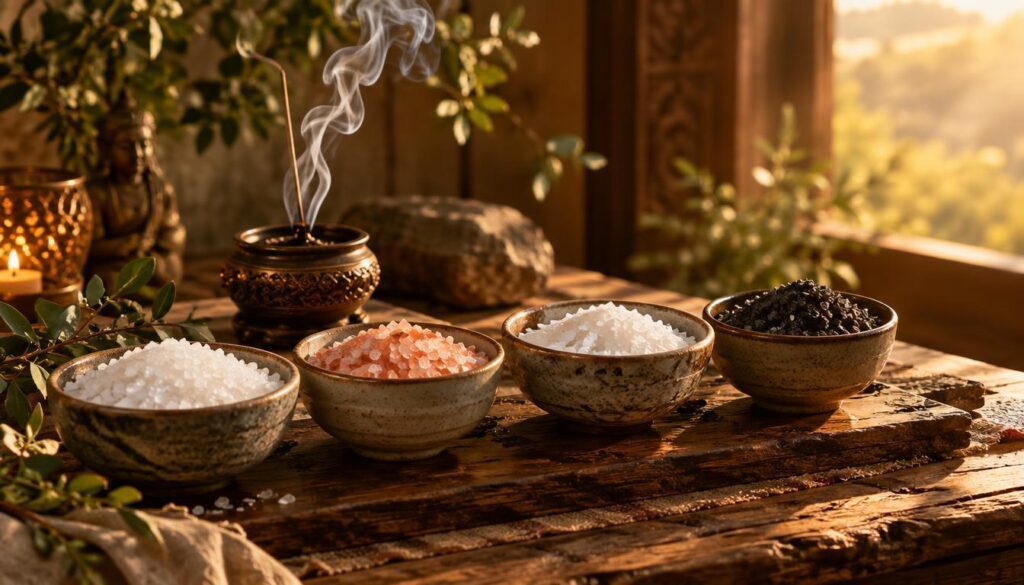
| Salt type | What it is | Possible ritual use | Practical caution |
|---|---|---|---|
| Pink Himalayan salt | Mined rock salt, commonly pink in appearance | A chosen ritual material | Color does not prove added spiritual or health benefits |
| Dead Sea salt | Mineral-containing salt from the Dead Sea | A possible bath ritual choice | “Healing” claims are not established medical outcomes |
| Epsom salt | Magnesium sulfate, not sodium chloride | A possible bath material | Bathwater use does not establish “detoxification” |
| Sea salt | Salt produced by evaporating seawater | A bowl, bath, or boundary ritual | Check product directions; avoid irritated skin |
Pink Himalayan salt benefits are sometimes linked to its color, but color does not establish a health gain. Dead Sea salt healing claims also need care: mineral content alone does not prove a treatment works.
Epsom salt detoxification is not established by adding it to bathwater. Epsom salt is magnesium sulfate, not table salt (sodium chloride). Sea salt minerals may vary by product, but that doesn’t prove mineral replenishment through a ritual.
Use the product as directed, and avoid irritated or broken skin. For baths, follow the label and consider your own skin needs. A ritual doesn’t need special or costly salt to feel meaningful.
Once you have chosen a material, use it with care in a simple home practice. A small amount and a clear purpose are enough to mark a reset.
How to Cleanse a Room With Salt
After a tense evening at home, you may want a simple ritual to mark a fresh start. Salt can symbolize a boundary or change in the room.
Salt and water can damage some surfaces, leave residue, or create a slipping hazard. Test first, use little, and keep loose salt away from pets and children.
A Simple Salt-Water Floor Wash
Use a modest amount of salt in water only if the floor can handle it. This act represents energy cleansing; it does not mean salt physically absorbs unwanted energy.
- Use a small amount of salt.
- Fully dissolve the salt in a bucket of water.
- Test an inconspicuous floor area first, then check for damage or residue.
- Mop toward an exit while holding a clear intention for the space.
Let the floor dry before walking across it. If the surface reacts, stop and clean it according to its care instructions.
A Dry Salt Boundary at an Entrance
For a dry option, place a small bowl of salt near an entrance as a symbolic boundary. Remove it when you are ready, then clean the area so the salt doesn’t remain on the floor.
A salt circle protection practice may involve placing salt around a candle or altar. Treat a protective circle as optional, and keep salt away from the candle flame and children or pets.
Do not pour salt onto a surface unless you know it is safe for that material. Smoke cleansing or a smudging practice may also mark a transition for some people, but a smudging ceremony belongs to particular traditions. It is not required for a salt ritual.
A salt boundary is a personal symbol, not a measurable barrier. Once you have reset a shared room, you can turn to a private practice for reflection and grounding.
How to Create a Salt Bath for Grounding
On a quiet evening, you might choose a bath to pause and reflect, not to treat a condition. The ritual can be simple, with comfort and safety guiding each choice.
No clinically effective salt-bath dose is established here. A bath does not prove detoxification, replenish minerals, or treat muscles.
Prepare a Comfortable Ritual Bath
A spiritual salt bath can give you a calm setting for a few minutes of attention. Keep the practice easy to stop, and do not expect a medical result.
- Check the product label and use only a modest amount suitable for the bath.
- Fully dissolve the salt in comfortably warm water.
- Set an intention or take a few quiet breaths before soaking.
- Rinse off afterward, and stop if your skin feels irritated.
For a ritual bath, choose a simple thought, such as “I can rest now.” You do not need to add many steps or follow a fixed spiritual rule.
Keep the Bath Gentle and Low-Risk
A sea salt or mineral bath may feel comfortable, but comfort does not prove a health benefit. Take claims about muscle relaxation with caution; a bath is not a proven muscle treatment in this context.
Avoid a bath if a clinician has told you to avoid one, or if salt irritates broken or sensitive skin. Keep bathwater out of your mouth, and leave the tub if you feel unwell.
Salt bathing does not rejuvenate skin or detoxify the body. If you have a skin condition or questions about a bath, ask a qualified health professional who knows your needs.
The practice may help you set aside a quiet moment, but its role remains personal. That differs from salt therapies promoted for physical health, which call for separate evidence and care.
What Science Says About Salt Therapy and Health Claims
Spiritual meaning and measurable medical benefit are different questions. Salt therapy claims need their own evidence, separate from what a ritual means to you.
Do not use halotherapy in place of prescribed respiratory care. No evidence presented here establishes a health benefit from inhaling salt particles in a salt room.
| Practice or claim | What the practice involves | What can be concluded here | Safety boundary |
|---|---|---|---|
| Halotherapy | Inhaling salt particles in a salt-room setting | No evidence here establishes a health benefit | Do not replace prescribed respiratory care |
| Salt bath | Soaking in water with dissolved salt | A calming routine may feel relaxing; detoxification or anti-inflammatory treatment is not established | Stop if irritation occurs; do not swallow bathwater |
| Negative-ion or salt-lamp mood claim | Being near a salt lamp or similar device | No evidence here shows negative ions remove negative energy or improve mood | Do not use it to treat a mood or health condition |
Halotherapy benefits are often described as support for respiratory health, but that claim should not be treated as proven care. If you have breathing symptoms, contact a qualified health professional and follow prescribed advice.
Claims about anti-inflammatory salt benefits or negative ions for mood also need evidence. A lamp’s presence does not show that it changes mood through negative ions or removes spiritual energy.
Antimicrobial effects depend on the setting and conditions. That does not mean ordinary salt rituals disinfect a home or treat skin or respiratory conditions.
Salt in a room does not replace normal cleaning. Saltwater isn’t a household disinfectant, and you shouldn’t use salt to treat a health problem.
A salt ritual may carry spiritual meaning, but that meaning does not establish a medical effect or replace prescribed care.
Evidence-aware limits let you keep a practice meaningful without confusing it with treatment. You can now decide which safe, personal routines belong in your daily life.
Ways to Make Salt Rituals Part of Everyday Life
Start with one intention, not several new rituals at once. One small choice is easier to keep than a routine that feels like a duty.
Choose only practices that feel safe and useful to you. A salt ritual can support self-discovery and wellness as a personal habit, not a requirement.
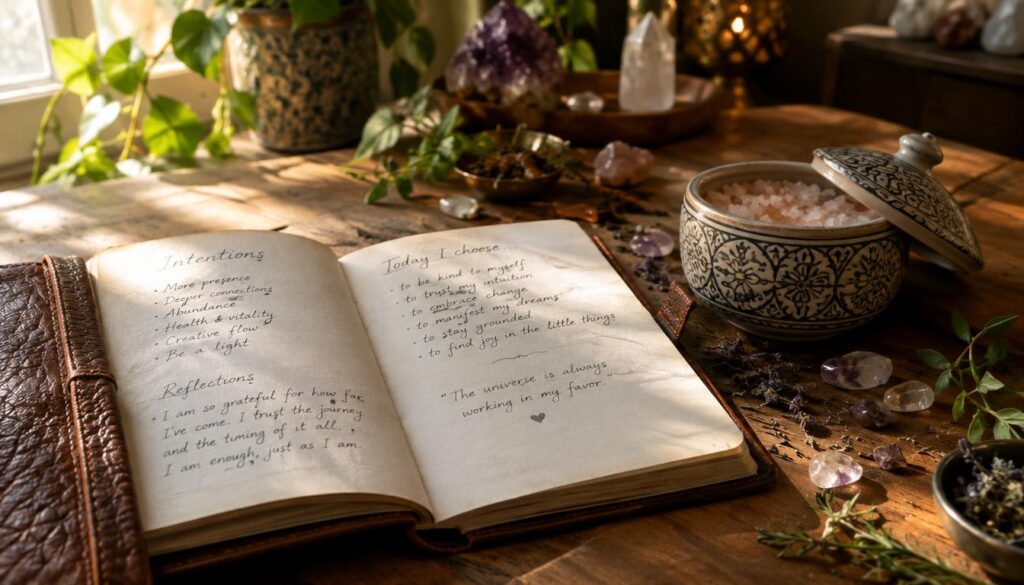
- Keep a small, covered bowl in a private ritual area, and refresh it as you like.
- Write one intention before meditation or a quiet pause.
- Try a brief foot soak only if it feels comfortable and safe for you.
- Use a salt-free cloth or another suitable method to clean crystals when you’re unsure what they need.
A private bowl may mark a place for reflection without changing the rest of your home. You can refresh it when you choose, rather than following a set schedule.
Writing can also give negative energy release a clear personal meaning. Name what you want to set aside, then decide what action would help you in ordinary life.
Salt can damage fragile crystals such as malachite or selenite. Do not soak or bury crystals in salt unless stone-specific care guidance permits it.
When you are unsure how a crystal should be cleaned, choose a dry, salt-free method instead.
Crystal cleansing does not require salt. Himalayan salt, table salt, and other forms can still harm a stone if its surface or structure reacts to salt or moisture.
You don’t need to add every idea to your routine. Choose one low-risk practice, or skip rituals that do not feel useful, before moving on with your day.
Conclusion
Salt’s meaning comes from tradition and the intention you bring to a practice. A simple ritual can create a moment for reflection, but it doesn’t guarantee spiritual protection or health outcomes.
Keep spiritual claims separate from medical facts, and use salt with care around surfaces, skin, children, and pets. You do not need a complex routine for a meaningful pause.
Choose one low-risk next step: write an intention before a quiet pause, then notice whether it supports your sense of balance.